UCR professor studies engineering and invention on the half-shell
Marine snails, sea urchins, and other animals from the sea are teaching researchers in UC Riverside’s Department of Chemical and Environmental Engineering how to make the world a better place.
Consider, for example, the possibilities of designing a lightweight armor that would protect U.S. soldiers in Iraq from Improvised Explosive Devices. Or, what flexible ceramics might offer industry. Or, how everyone could benefit from new ways of producing and storing energy.
Nature holds these secrets and the answers to the questions that Prof. David Kisailus’s research group is learning how to ask. “My hope,” Kisailus said, “is that we can truly learn from these organisms how to design, optimize, and synthesize engineering materials that display properties that we as engineers can only dream of.”
Studying ocean animals daily as they grow seems a tough task for Inland Southern California scientists. Instead of commuting to the coast, the researchers have brought the oceans to UCR in a unique 500-gallon seawater system that dominates the Biomimetic and Nanostructured Materials Laboratory, offering homes for both coldwater (60 degrees Fahrenheit) and tropical (80 degrees Fahrenheit) species.
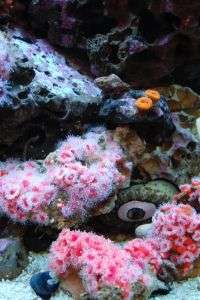
While some people trek to exotic, faraway locales to admire the beauty of coral reefs, at UCR, people simply can visit Bourns Hall to see a dramatic and authentic tropical coral reef ecosystem. Another showcase tank boasts a thriving coldwater marine population that includes California’s red abalone (Haliotis rufescens), purple and brown sea urchins (Strongylocentrotus purpuratus and Lytechinus pictus), giant keyhole limpets (Megathura crenulata), several coral species (Balanophyllia elegans, Astrangia lajollaensis and Paracyathus stearnsi), along with numerous colonies of club-tipped corallimorpharians (Corynactis californica).
Other tanks hold animals for studies, while a series of separate small tanks host the crankier, more aggressive species or those with special dietary needs. The mother of all pump and filtration systems circulates and processes the water throughout, with total flow rates of nearly 10,000 gallons of seawater per hour, providing an environment like their natural habitat.
James Weaver, an invertebrate marine zoologist who works as a research associate with Kisailus, designed and built the elaborate tanks and filtration system, which includes a 6-foot-tall fluidized bioreactor. But to these researchers, the animals in the tanks are the true marvels in engineering. “We just utilize nature as our platform for inspiration,” Kisailus said.
Kisailus first became excited about materials science while doing research lab work as an undergraduate at Drexel University. After earning his master’s degree in Materials Science at the University of Florida, Kisailus did his Ph.D. work at University of California, Santa Barbara, where he met Weaver as a fellow graduate student.
The two dreamed then of someday combining Weaver’s expertise in invertebrate zoology and Kisailus’s in materials science. That dream has come true at UCR. “We are now constantly bouncing ideas off each other again and it seems as if there will never be a shortage of novel ideas,” Kisailus said.
In their teamwork, Weaver is the guy who brings in animals with unique features, while Kisailus is the guy with the beaker. “James brings me knowledge of all these critters,” Kisailus said, “And I say, let's look at how the abalone grows its shell. Maybe we can use a similar strategy to modify a nanostructure in a solar cell to make them more efficient.”
Sea urchins synthesize flexible ceramics … and some marine sponges form fracture-resistant glass rods and fibers. “We look at these mineralizing skeletal systems and adapt the lessons learned from their study for the synthesis of real-life engineering," he said.
Consider red abalone, the largest of California’s marine snails, with a large oval shell that coastal Native Americans once used as a shallow bowl. Inside the shell is mother-of-pearl, or nacre, a tough material that absorbs energy. Maybe, he said, the abalone can show scientists how to make a lightweight armor that is strong enough to protect American soldiers in Iraq from devastating IED attacks.
As the red abalone grows, it constructs its shell in the same way a new building goes up, girders first. In the case of the abalone shell, however, the girders are composed of organic material. Then it fills in the areas between the girders with the mineral component, resulting in the formation of a very tough layered nano-composite. “It’s all in a very predefined orientation, all controlled by genetics,” Kisailus said.
The scientists are trying to mimic that precision, using beakers and simple chemistry to make materials with controlled size and shape. If they succeed, Kisailus sees a future with more efficient energy storage and conversion — and eventually, some solutions to the global energy crisis. “Imagine having a solar cell that can be inexpensive, flexible, and highly efficient,” Kisailus said. “I believe many of the organisms we study hold the keys to solving these problems.”
The sea tanks are drawing in a crowd of young researchers. “It was my co-op experiences and work as a researcher as an undergraduate at Drexel University that set me on this path to research and intrigued my imagination,” Kisailus said. “Although I am a new professor, and have two graduate students, I am hiring many undergraduates to work in my lab and learn to connect the textbook to research. Right now I have 11 undergrads buzzing around in the lab and will probably hire a few more … many with outstanding potential coming from all walks of life. I hope to inspire them the way I have been and get them excited about biomimetics and materials science.”
He also wants to invite area kids from kindergarten through high school to come tour the lab and see the drama and beauty of the marine tanks. It’s his hope to inspire them to pursue a higher education. “They’re the future,” Kisailus said.
Source: University of California - Riverside


