Antioxidant therapy shows early promise for preventing, perhaps reversing, Alzheimer's disease
April 30, 2008 Antioxidant therapy shows early promise for preventing, perhaps reversing, Alzheimer's disease

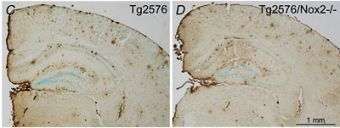
Amyloid plaques in the brain of the mice with Alzheimer's disease. The plaques are the brown spots distributed throughout the brain.

Curbing harmful processes in the brain's vasculature set off by the enzyme NADPH oxidase may reverse some of the cognitive decline associated with Alzheimer's disease, according to new findings published in a recent issue of the Proceedings of the National Academy of Sciences.

Identifying the enzyme's role in dementia could translate into a new drug target for Alzheimer's disease in humans.

Costantino Iadecola, the George C. Cotzias Distinguished Professor of Neurology and Neuroscience at Weill Cornell Medical College and chief of the Division of Neurobiology at NewYork-Presbyterian Hospital/Weill Cornell Medical Center, led the research, which found that after the enzyme was genetically "switched off," mice with a type of dementia mimicking Alzheimer's regained important cognitive abilities.

The amount of Alzheimer's-linked amyloid plaques in the brains of the mice remained unchanged, indicating that NADPH oxidase, which produce toxic free radicals, independently influences the progression of dementia.

The researchers also genetically engineered mice that produced a mutated form of NADPH enzyme that did not produce the toxic free radicals. The result: The formerly "demented" mice regained their healthy, exploratory behaviors, just as non-demented mice do. According to the authors, the findings suggest that neurological damage from Alzheimer's may not be permanent and might even be reversed through antioxidant treatment.

Source: Cornell University


print this article email this article download pdf blog this article bookmark this article     Stumble it Digg this share on Facebook retweet share on Reddit add to delicious
Rate this story - 4.4 /5 (11 votes)


April 30, 2008 all stories

Comments: 0

4.4 /5 (11 votes)
  • Stumble this up

  • Digg this

  • share this

  • hide
  • Related Stories


  • hide
  • Relevant PhysicsForums posts

Other News

Study of testosterone in older men

Medicine & Health / Research

created 54 minutes ago | popularity not rated yet | comments 0

Los Angeles Biomedical Research Institute at Harbor-UCLA Medical Center announced today that it will participate in a large national study of the effectiveness of testosterone as a treatment for anemia, cardiovascular disease, ...


Tumor-initiating Cells Detected in Pten Null Prostate Cancer Model

Medicine & Health / Cancer

created 24 minutes ago | popularity not rated yet | comments 0

(PhysOrg.com) -- New findings published in Cancer Research, a journal of the American Association for Cancer Research, advance the current understanding of the role of stem/progenitor cells on the initiation and progression of pro ...


A child sleeping (Sleep)

Dreams may have an important physiological function

Medicine & Health / Neuroscience

created 6 hours ago | popularity 3.9 / 5 (10) | comments 5

(PhysOrg.com) -- Dreams have long been assumed to have psychological functions such as consolidating emotional memories and processing experiences or problems, but according to a Harvard psychiatrist and sleep ...


Study provides first clear idea of how rare bone disease progresses

Study provides first clear idea of how rare bone disease progresses

Medicine & Health / Research

created 1hour ago | popularity not rated yet | comments 0

An international team of scientists, led by researchers at the University of Pennsylvania School of Medicine, is taking the first step in developing a treatment for a rare genetic disorder called fibrodysplasia ...


baby mice

Early life stress has effects at the molecular level

Medicine & Health / Neuroscience

created 8 hours ago | popularity 4.8 / 5 (4) | comments 0

(PhysOrg.com) -- A new study of mice suggests that stress and trauma in early life can have an impact on the genes and result in behavioral problems later in life.