Faster than a Speeding Bubble
April 30, 2008 Faster than a Speeding Bubble

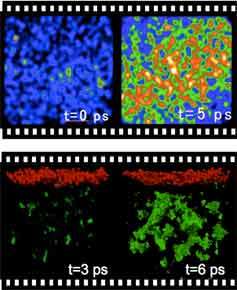
X-ray scattering images (above) and corresponding 3D depictions (below) of nucleation events, or "bubbles," forming in the semiconductor Indium Antimonide in the first instances after being hit with a laser pulse.

What do melting chocolate and bubbles in a champagne glass have in common? Besides being treats one might sample at a sophisticated soiree, they are both handy examples of first-order phase transitions in which a material transforms from one phase to another—that is, atoms changing from an orderly arrangement into a more chaotic arrangement.

Now, in an experiment led by Aaron Lindenberg, an international collaboration of scientists has uncovered new clues about the first instants of that process. The results are published in the April 4 edition of Physical Review Letters.

"We did not at all expect to see what we saw," said Lindenberg, "although in the aftermath we can go back and realize perhaps we should have. What's amazing about the process is that it spans such a huge range of time scales."

The process of melting, or in the case of champagne, of bubbling, has long been of interest to scientists. Phase transitions take place in the tiniest fraction of a second. In the case of Indium Antimonide (InSb), a semiconductor used by scientists to study such processes, the first steps in melting take a few hundred femtoseconds, a quadrillionth of a second. But no one knew what happened after that.

In the current study, the group used a laser to excite the sample and then measured the structure of the disordered liquid using X-rays, a technique called "pump-probe." Critical to the experiment is timing the initial laser used to pump the sample with energy, and the X-ray beam used to probe the results, to within mere femtoseconds. The resulting diffuse pattern of scattered X-rays from the disordered sample is used to map out where the atoms are at a given instant. Subsequent repeats of the pumping and probing at different relative delays between the laser and X-ray beam enables the researchers to reconstruct how the material evolves over time.

Lindenberg and colleagues found that the structure of the disordered liquid was far different from what one would have expected. Tiny atomic-scale bubbles, called nucleation events, form first and seed the process, a unique transient state of matter in which large fluctuations dominate the response of the material.

The group captured the process on a timescale 100 times shorter than any other previous X-ray study. The results give scientists a deeper understanding of how disordered materials behave on short timescales, and could lead to improved materials processing techniques, such as electronics manufacturing.

The current study also represents the last scientific paper to come from SLAC's Sub-Picosecond Pulse Source (SPPS) collaboration, led by Jerry Hastings, which was undertaken to study very fast atomic scale processes using ultra short pulses of X-rays. The work at SPPS presages the science to come from SLAC's Linac Coherent Light Source (LCLS), now under construction, which will create coherent X-ray laser pulses that are even shorter.

"SPPS was a remarkable success," said SSRL Director Jo Stohr. "It was great to see prominent X-ray scientists from all over the world coming to SLAC to participate in this unique experiment. It is an indication of what is yet to come with LCLS."

Source: by Brad Plummer, SLAC Today


print this article email this article download pdf blog this article bookmark this article     Stumble it Digg this share on Facebook retweet share on Reddit add to delicious
Rate this story - 3.8 /5 (10 votes)

Rank Filter

Move the slider to adjust rank threshold, so that you can hide some of the comments.


Display comments: newest first

  • zevkirsh - Apr 30, 2008
    • Rank: not rated yet
    this will mark the first time , bubbles have actually been seen being formed!

April 30, 2008 all stories

Comments: 1

3.8 /5 (10 votes)
  • Stumble this up

  • Digg this

  • share this

  • hide
  • Related Stories

  • Animated Movie of Ice
    created Jan 07, 2008 | popularity not rated yet | comments 0
  • X-ray Method Images Ions at Interface
    created Jun 12, 2004 | popularity not rated yet | comments 0
  • The world's smallest synchrotron, MIRRORCLE-6X, now commercially available
    created Feb 21, 2005 | popularity not rated yet | comments 0


  • hide
  • Relevant PhysicsForums posts

  • Coulomb's Law
    created 4 hours ago
  • Laser spots
    created 9 hours ago
  • Do you know elementary physics?
    created 10 hours ago
  • Bicycles and their mad skillz
    created 11 hours ago
  • More from Physics Forums - General Physics

Other News

Aquatic creatures mix ocean water

Physics / General Physics

created 10 hours ago | popularity 5 / 5 (3) | comments 0

Understanding mixing in the ocean is of fundamental importance to modeling climate change or predicting the effects of an El Niño on our weather. Modern ocean models primarily incorporate the effects of winds and tides. However, ...


Generating electricity from air flow

Physics / General Physics

created 13 hours ago | popularity 3.9 / 5 (8) | comments 1

A group of researchers at the City College of New York is developing a new way to generate power for planes and automobiles based on materials known as piezoelectrics, which convert the kinetic energy of motion into electricity. ...


Nuclear weapons: Predicting the unthinkable

Physics / General Physics

created 14 hours ago | popularity 2.7 / 5 (3) | comments 0

If a nuclear weapon were detonated in a metropolitan area, how large would the affected area be? Where should first responders first go? According to physicist Fernando Grinstein, we have some initial understanding to address ...


Butterfly proboscis to sip cells

Physics / General Physics

created 11 hours ago | popularity not rated yet | comments 0

A butterfly's proboscis looks like a straw -- long, slender, and used for sipping -- but it works more like a paper towel, according to Konstantin Kornev of Clemson University. He hopes to borrow the tricks of this piece ...


Restored machine to explore mysteries of Big Bang (AP)

Restored machine to explore mysteries of Big Bang

Physics / General Physics

created Nov 21, 2009 | popularity 4.6 / 5 (18) | comments 19

(AP) -- Scientists are preparing the world's largest atom smasher to explore the depths of matter after successfully restarting the $10 billion machine following more than a year of repairs.