Biologists are from Mars, chemists are from Venus?
“Plays well with others.” That popular phrase on a T-shirt is being taken to a whole new level in higher education these days, as experts in a variety of fields increasingly must work together to address some of society's biggest challenges, from a warming planet to cancer.
But how do scientists from different disciplines and institutions collaborate? How do they work together to incorporate the distinct perspectives, languages and research styles of their fields?
“When scientists from different disciplines say 'We work together,' we want to know what that means,” says Steve Fifield, associate policy scientist at the University of Delaware.
Fifield, who is affiliated with the Delaware Education Research and Development Center at UD, is leading research to uncover how scientists from different disciplines form working relationships. The two-year project is funded by a $197,300 grant from the National Science Foundation's Innovation and Organizational Sciences program.
The findings will shed light on scientific collaboration--a process about which little is known, but much is expected.
“Agencies such as the National Science Foundation have deemed large-scale interdisciplinary research projects critical to U.S. innovation and competitiveness,” Fifield notes. “Yet there have been few studies of how scientists actually bridge disciplinary boundaries. There's no 'how-to' for it--at least not yet,” he says, smiling.
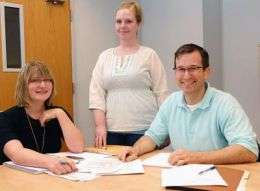
Fifield's research team includes co-investigators Regina Smardon, a sociologist at the University of Virginia, and Karl Steiner, associate director of the Delaware Biotechnology Institute, along with postdoctoral researcher Katherine McGurn Centellas and graduate research assistant Jennifer Koester.
Two emerging research centers at UD are the focus of the study. The Center for Translational Cancer Research involves individuals from UD, Alfred I. duPont Hospital for Children/Nemours, Christiana Care Health System/Helen F. Graham Cancer Center, and the Delaware Biotechnology Institute. The center, under the direction of Mary C. Farach-Carson, professor of biological sciences, seeks to establish a pipeline for developing translational cancer researchers and clinicians, spanning the undergraduate to postgraduate levels, and to build teams of clinicians, biologists and engineers, chemists and computer scientists to attack cancer-related problems.
The Center for Critical Zone Research, led by Donald Sparks, the S. Hallock du Pont Chair of Plant and Soil Sciences, aims to develop a world-class, leading-edge research capability focusing on the Earth's “critical zone”--the life-sustaining environment from the treetops to the groundwater where complex interactions of rock, soil, water, air and living organisms occur. Interfacial chemistry, bionanotechnology, and environmental genomics are the center's primary research areas.
The project team has been busy interviewing researchers affiliated with the centers and observing them in labs, seminars, even tumor clinics, as well as social settings, such as monthly get-togethers at Grotto's Pizza.
“We're studying 'participation customs'--how groups of people interact,” Centellas says. An anthropologist with a background in biology, she also has significant international experience, studying the organizational structure and dynamics of research centers in Bolivia.
“Scientists come trained in a particular way according to their discipline,” she notes. “Each group comes with a different vocabulary. How does one group learn to communicate with another? How do people discuss problems and form collegial relationships? How does work get assigned--is it by expertise, by technical facility, by the availability of a grad student? We're getting into the nuts and bolts of people coming together,” she says.
Koester, a master's student in sociology, is observing researchers to see if their collaboration is static or dynamic.
“Are people actively involved in communicating with one another, dividing up tasks, or is it done mostly at a distance, or without much interaction?” she says. “That gives us a lot of insight into how transformative the process is.”
Koester eventually wants to become a professor herself, leading research projects and teaching students in social science.
Although the project only began last fall, the team already has several preliminary findings and will present their results at the American Sociological Society's annual meeting in August.
“We've discovered that individuals can find themselves narrowing back to a niche specialization when doing collaborative research,” Fifield says. “Thus, interdisciplinary research may tend to move people back to their core expertise.”
The scientists also have noticed differences in culture between academics doing cancer research versus clinicians (medical doctors) who want to pursue cancer research in academia. Some meetings begin at Christiana Hospital at 7 a.m., which is before the workday starts for many university researchers.
“It's a time-use issue--in how you think about what an hour is worth,” Centellas says. “People may need to modify certain behaviors to become part of a group.”
By the end of the two-year project, the team will better understand the kinds of choices and strategies that help researchers to collaborate--how people manage to achieve it, and what gets in the way. The research may not result in a “how-to” list, Fifield says, but the team will be able to offer take-away messages and tips.
“Right now, the processes of interdisciplinary research get black-boxed. They remain a bit of a mystery. We may be able to unpack that a bit,” he notes.
Source: University of Delaware


