New type of pulsating white dwarf star discovered
May 1st, 2008 Astronomers discover new type of pulsating white dwarf star

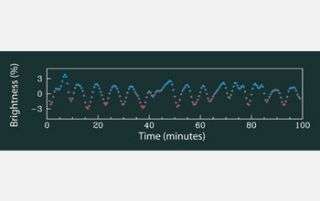
The image shows the changes in light output over time of the first-discovered pulsating carbon white dwarf star. Credit: K. Williams/ T. Jones/ McDonald Obs

University of Texas at Austin astronomers Michael H. Montgomery and Kurtis A. Williams, along with graduate student Steven DeGennaro, have predicted and confirmed the existence of a new type of variable star, with the help of the 2.1-meter Otto Struve Telescope at McDonald Observatory. The discovery is announced in today's issue of Astrophysical Journal Letters.

Called a "pulsating carbon white dwarf," this is the first new class of variable white dwarf star discovered in more than 25 years. Because the overwhelming majority of stars in the universe--including the sun--will end their lives as white dwarfs, studying the pulsations (i.e., variations in light output) of these newly discovered examples gives astronomers a window on an important end point in the lives of most stars.

A white dwarf star is the leftover remnant of a sun-like star that has burned all of the nuclear fuel in its core. It is extremely dense, packing half to 1.5 times the sun's mass into a volume about the size of Earth. Until recently, there were thought to be two main types of white dwarfs: those with an outer layer of hydrogen (about 80 percent of white dwarfs), and those with an outer layer of helium, whose hydrogen shells have somehow been stripped away (the other 20 percent).

Last year, University of Arizona astronomers Patrick Dufour and James Liebert discovered a third type of white dwarf star. For reasons that are not understood, these "hot carbon white dwarfs" have had both their hydrogen and helium shells stripped off, leaving their carbon layer exposed. Astronomers suspect that these could be among the most massive white dwarfs of all, the remnants of stars slightly too small to end their lives in a supernova explosion.

After these new carbon white dwarfs were announced, Montgomery calculated that pulsations in these stars were possible. Pulsating stars are of interest to astronomers because the changes in their light output can reveal what goes on in their interiors--similar to the way geologists study seismic waves from earthquakes to understand what goes on in Earth's interior. In fact, this type of star-study is called "asteroseismology."

So, Montgomery and Williams' team began a systematic study of carbon white dwarfs with the Struve Telescope at McDonald Observatory, looking for pulsators. DeGennaro discovered that a star about 800 light-years away in the constellation Ursa Major, called SDSS J142625.71+575218.3, fits the bill. Its light intensity varies regularly by nearly two percent about every eight minutes.

"The discovery that one of these stars is pulsating is remarkably important," said NSF astronomer Michael Briley. "This will allow us to probe the white dwarf's interior, which in turn should help us solve the riddle of where the carbon white dwarfs come from and what happens to their hydrogen and helium."

The star lies about ten degrees east northeast of Mizar, the middle star in the handle of the Big Dipper. This white dwarf has about the same mass as our Sun, but its diameter is smaller than Earth's. The star has a temperature of 35,000 degrees Fahrenheit (19,500 C), and is only 1/600th as bright as the Sun.

None of the other stars in their sample were found to pulsate. Given the masses and temperatures of the stars in their sample, SDSS J142625.71+575218.3 is the only one expected to pulsate, based on Montgomery's calculations.

The astronomers speculate that the pulsations are caused by changes in the star's carbon outer envelope as the star cools down from its formation as a hot white dwarf. The ionized carbon atoms in the star's outer layers return to a neutral state, triggering the pulsations.

There is a chance that the star's variations might have another cause. Further study is needed, the astronomers say. Either way, studying these stars will shed light on the unknown process that strips away their surface layers of hydrogen and helium to lay bare their carbon interiors.

This research was funded by the National Science Foundation and the Delaware Asteroseismic Research Center.

Source: National Science Foundation


print this article email this article download pdf blog this article bookmark this article     Digg this Stumble it share on Facebook share on Reddit add to delicious save to Yahoo! bookmarks
4.6/5 after 27 votes


May 1st, 2008 all stories
Space & Earth / Astronomy

Comments: 0
Rank: 4.6/5 after 27 votes

  • Stumble this up

  • Digg this

  • Share it:
  • share on Facebook
  • share on MySpace
  • share on Slashdot
  • rss-newsfeed
  • share on Google
  • share on Reddit
  • add to delicious
  • save to Yahoo! bookmarks
  • share on Windows Live
  • Add to Mixx!
Rating: 4.6/5 after 27 votes

  • Related Stories

  • Spacewalkers equip Hubble with new computer
    created May 15, 2009 | popularity not rated yet | comments 0
  • Understanding stellar explosions is less straightforward than previously thought
    created Apr 30, 2009 | popularity not rated yet | comments 0
  • Oddball stars discovered in new Hubble images
    created Apr 27, 2009 | popularity not rated yet | comments 0
  • Largest collection of anomalous white dwarfs observed by Hubble
    created Apr 23, 2009 | popularity not rated yet | comments 0
  • Will dams on Amazon tributary wreak global havoc?
    created Apr 05, 2009 | popularity not rated yet | comments 0

Tags


  • Physicists Demonstrate Quantum Memory with Matter Qubits
    Physicists Demonstrate Quantum Memory with Matter Qubits
    Physics / General Physics
    created Jul 03, 2009 | popularity 4.4 / 5 (17) | comments 1
  • 'Holey' Nanosheets for Wastewater Dye Removal
    Nanotechnology / Nanomaterials
    created Jul 01, 2009 | popularity 5 / 5 (5) | comments 1
  • Jellyfish Robot Swims Like its Biological Counterpart
    Jellyfish Robot Swims Like its Biological Counterpart
    Electronics / Robotics
    created Jun 26, 2009 | popularity 4.4 / 5 (8) | comments 1
  • Could Maxwell's Demon Exist in Nanoscale Systems?
    Could Maxwell's Demon Exist in Nanoscale Systems?
    Physics / General Physics
    created Jun 24, 2009 | popularity 4.4 / 5 (18) | comments 29
  • Living Safely with Robots, Beyond Asimov's Laws
    Living Safely with Robots, Beyond Asimov's Laws
    Electronics / Robotics
    created Jun 22, 2009 | popularity 4.6 / 5 (52) | comments 40
  • Other News

    Steam billows from the cooling towers at a nuclear power generating station in Byron

    Tropical zone expanding due to climate change: study

    Space & Earth / Earth Sciences

    created 1hour ago | popularity 5 / 5 (2) | comments 0

    Climate change is rapidly expanding the size of the world's tropical zone, threatening to bring disease and drought to heavily populated areas, an Australian study has found.


    US ambitions to send astronauts back to the moon as a prelude to missions to Mars have been put in doubt

    Forty years ago man first walked on the moon

    Space & Earth / Space Exploration

    created 23 hours ago | popularity 4.3 / 5 (4) | comments 2

    Forty years ago on July 20, 1969, American astronaut Neil Armstrong realized the oldest dream of human civilizations when he became the first man to walk on the moon.


    The least sea ice in 800 years

    The least sea ice in 800 years

    Space & Earth / Earth Sciences

    created Jul 01, 2009 | popularity 4.1 / 5 (65) | comments 60

    New research, which reconstructs the extent of ice in the sea between Greenland and Svalbard from the 13th century to the present indicates that there has never been so little sea ice as there is now. The ...


    Gas around young galaxy

    Intense heat killed the Universe's would-be galaxies, researchers say

    Space & Earth / Astronomy

    created Jul 01, 2009 | popularity 3.4 / 5 (21) | comments 27

    (PhysOrg.com) -- Our Milky Way galaxy only survived because it was already immersed in a large clump of dark matter which trapped gases inside it, scientists led by Durham University's Institute for Computational ...


    Scientists' Drill Hits Magma: Only Third Time on Record

    Scientists' Drill Hits Magma: Only Third Time on Record

    Space & Earth / Earth Sciences

    created Jun 29, 2009 | popularity 4.7 / 5 (22) | comments 21

    (PhysOrg.com) -- Scientists drilling a borehole deep into Iceland’s rocky crust to explore new methods of using geothermal energy hit a major roadblock on Thursday: Their drill ran into molten rock at a depth ...