Spiraling nanotrees offer new twist on growth of nanowires
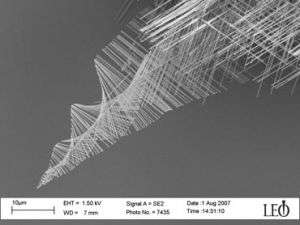
Since scientists first learned to make nanowires, the nano-sized wires just a few millionths of a centimeter thick have taken many forms, including nanobelts, nanocoils and nanoflowers.
But when University of Wisconsin-Madison chemistry professor Song Jin and graduate student Matthew Bierman accidentally made some pine tree shapes one day — complete with tall trunks and branches that tapered in length as they spiraled upward — they knew they’d stumbled upon something peculiar.
“At the beginning we saw just a couple of trees, and we said, ‘What the heck is going on here?’” recalls Jin. “They were so curious.”
Writing in the May 1 edition of Science Express, Jin and his team reveal just how curious the nanotrees truly are. In fact, they’re evidence of an entirely different way of growing nanowires, one that promises to give scientists a powerful means to create new and better nanomaterials for all sorts of applications, including high-performance integrated circuits, biosensors, solar cells, LEDs and lasers.
Until now, most nanowires have been made with metal catalysts, which promote the growth of nanomaterials along one dimension to form long rods. While the branches on Jin’s trees also elongate in this way, growth of the trunks is driven by a “screw” dislocation, or defect, in their crystal structure. At the top of the trunk, the defect provides a spiral step for atoms to settle on an otherwise perfect crystal face, causing them stack together in a spiral parking ramp-type structure that quickly lengthens the tip.
Dislocations are fundamental to the growth and characteristics of all crystalline materials, but this is the first time they’ve been shown to aid the growth of one-dimensional nanostructures. Engineering these defects, says Jin, may not only allow scientists to create more elaborate nanostructures, but also to investigate the fundamental mechanical, thermal and electronic properties of dislocations in materials.
His team created its nanotrees specifically by applying a slight variation of a synthesis technique called chemical vapor deposition to the material lead sulfide. But the chemists believe the new mechanism will be applicable to many other materials, as well.
“We think these findings will motivate a lot of people to do this purposefully, to design dislocation and try to grow nanowires around it,” Jin says. “Or perhaps people who have grown a structure and were puzzled by it will read our paper and say, ‘Hey, we see something similar in our system, so maybe now we have the solution.’”
What initially puzzled Jin and his students about their pine tree structures was the long length of the trunks compared with the branches, a difference that indicated the trunks were growing much faster. The result was surprising because when complex, branching nanostructures are grown with metal catalysts, the branches are usually all of similar length because of similar growth rates, leading to boxy shapes rather than the cone-shapes of the trees.
Another oddity was the twist to the trunks, which sent the branches spiraling.
“The long and twisting trunks were telling us we had a new growth mode,” says Jin. Suspecting dislocation, the team set about refining their technique for growing the pine trees – they soon learned to produce entire forests with ease – and then confirmed the presence of dislocations with a special type of transmission electron microscopy.
Upon closer examination, the twisting trunks and spiraling branches also turned out to embody a well-known general theory about the mechanical deformation of crystalline materials caused by screw dislocations. Although this so-called “Eshelby twist” was first calculated back in 1953 and is discussed in many textbooks, Jin’s experimental results likely offer the best support yet for the theory.
“These are beautiful, truly intriguing structures, but behind them is also a really beautiful, interesting science,” says Jin. “Once you understand it, you just feel so…satisfied.”
Source: University of Wisconsin-Madison


