'Dynamic duo' develops framework for Earth's inaccessible interior
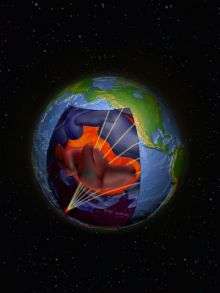
A new model of inner Earth constructed by Arizona State University researchers pulls past information and hypotheses into a coherent story to clarify mantle motion.
“The past maybe two or three years there have been a lot of papers in Science and Nature about the deep mantle from seismologists and mineral physicists and it’s getting really confusing because there are contradictions amongst the different papers,” says Ed Garnero, seismologist and an associate professor in Arizona State University’s School of Earth and Space Exploration.
“But we’ve discovered that there is a single framework that is compatible with all these different findings,” he adds.
Garnero partnered with geodynamicist and assistant professor Allen McNamara, also in the School of Earth and Space Exploration in ASU’s College of Liberal Arts and Sciences, to synthesize the information for their paper to be published in the May 2 issue of Science.
“Our goal was to bring the latest seismological and dynamical results together to put some constraints on the different hypotheses we have for the mantle. If you Google ‘mantle’ you’ll see 20 different versions of what people are teaching,” explains McNamara.
According to the ASU scientists, all this recent research of the past few years fits into a single story. But what is that story" Is it a complicated and exceedingly idiosyncratic story or is it a straightforward simple framework"
“In my opinion,” explains Garnero, “it’s simple. It doesn’t really appeal to anything new; it just shows how all those things can fit together.”
The pair paints a story for a chemically complex inner earth, a model that sharply contrasts the heavily relied upon paradigm of the past few decades that the mantle is all one thing and well mixed. The original model was composed of simple concentric spheres representing the core, mantle and crust – but the inner Earth isn’t that simple.
What lies beneath
Earth is made up of several layers. Its skin, the crust, extends to a depth of about 40 kilometers (25 miles). Below the crust is the mantle area, which continues to roughly halfway to the center of Earth. The mantle is the thick layer of silicate rock surrounding the dense, iron-nickel core, and it is subdivided into the upper and lower mantle, extending to a depth of about 2,900 km (1,800 miles). The outer core is beneath that and extends to 5,150 km (3,200 mi) and the inner core to about 6,400 km (4,000 mi).
The inner Earth is not a static storage space of the geologic history of our planet – it is continuously churning and changing. How a mantle convects and how the plates move is very different depending on whether the mantle is isochemical (chemically homogenous made entirely of only one kind of material) or heterogeneous, composed of different kinds of compounds.
Garnero and McNamara’s framework is based upon the assumption that the Earth’s mantle is not isochemical. Garnero says new data supports a mantle that consists of more than one type of material.
“Imagine a pot of water boiling. That would be all one kind of composition. Now dump a jar of honey into that pot of water. The honey would be convecting on its own inside the water and that’s a much more complicated system,” McNamara explains.
Observations, modeling and predictions have shown that the deepest mantle is complex and significantly more anomalous than the rest of the lower mantle. To understand this region, seismologists analyze tomographic images constructed from seismic wave readings. For 25 years they have been detecting differences in the speeds of waves that go through the mantle.
This difference in wave speeds provides an “intangible map” of the major boundaries inside the mantle – where hot areas are, where cold areas are, where there are regions that might be a different composition, etc. The areas with sluggish wave speeds seem to be bounded rather abruptly by areas with wave speeds that are not sluggish or delayed. An abrupt change in wave speed means that something inside the mantle has changed.
If the mantle is all the same material, then researchers shouldn’t be observing the boundary between hot and cold in the mantle as a super sharp edge and the temperature anomalies should also be more spread out. The abrupt change in velocity was noticeable, yet they didn’t know what caused it.
Garnero and McNamara believe that the key aspect to this story is the existence of thermo-chemical piles. On each side of the Earth there are two big, chemically distinct, dense “piles” of material that are hundreds of kilometers thick – one beneath the Pacific and the other below the Atlantic and Africa. These piles are two nearly antipodal large low shear velocity provinces situated at the base of Earth’s mantle.
“You can picture these piles like peanut butter. It is solid rock but rock under very high pressures and temperatures become soft like peanut butter so any stresses will cause it to flow,” says McNamara.
Recently mineral physicists discovered that under high pressure the atoms in the rocks go through a phase transition, rearranging themselves into a tighter configuration.
In these thermo-chemical piles the layering is consistent with a new high pressure phase of the most abundant lower mantle mineral called post-perovskite, a material that exists specifically under high pressures that cause new arrangements of atoms to be formed.
Perovskite is a specific arrangement of silicon and magnesium and iron atoms.
“At a depth a few hundred kilometers above the core, the mineral physicists tell us that the rocks’ atoms can go into this new structure and it should happen abruptly and that’s consistent with the velocity discontinuities that the seismologists have been seeing for decades,” says Garnero.
These thick piles play a key role in the convection currents. Ultra-low velocity zones live closest to the edges of the piles because that’s the hottest regions of the mantle due to the currents that go against the pile walls as they bring the heat up from the core. Off their edges exist instability upwellings that turn out to be the plumes that feed hot spots such as Hawaii, Iceland and the Galapagos.
“We observe the motions of plate tectonics very well, but we can’t fully understand how the mantle is causing these motions until we better understand how the mantle itself is convecting,” says McNamara. “The piles dictate how the convective cycles happen, how the currents circulate. If you don’t have piles then convection will be completely different.”
Source: Arizona State University


