Strap-On Helicopter Could Offer Solo Flying Experience
May 2, 2008 by Lisa Zyga
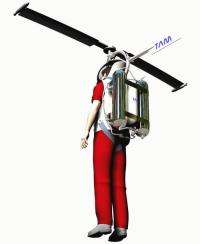
Technologia Aeroespacial Mexicana (TAM) has designed a strap-on helicopter. Tiny rockets on the tips of the propellers eliminate the need for a tail rotor, making it possible for the device to be worn on a human body. Credit: TAM.
Ever since the first human saw a bird soaring through the clouds, our species has harbored a great envy for the freedom that flying gives.
Now a company from Mexico is trying to capitalize on this desire with their design for a strap-on helicopter, which is intended to be worn on the back of an individual and lift them into the air. The idea is not new, but the technology may have some novelty, although details are sparse.
Technologia Aeroespacial Mexicana (TAM), the company behind the Libelula strap-on helicopter, explains on its Web site how the device is powered by two hydrogen fuel canisters. Tiny rockets at the tips of the helicopterīs rotor blades take the place of a tail rotor, a component which couldnīt be safely attached to a human body. According to the company, the Libelula would be the lightest helicopter in the world, so light that it could be strapped to a personīs body with a carbon fiber corset.
"The best [part] of this technology is that [these] kinds of helicopters donīt need a tail rotor because they donīt have any torque, so with a simple vane they can turn - being the simplest form of an helicopter and the easiest and safer to fly," the company says on its Web site.
At the moment, the idea is just an idea. However, the company has a successful history of developing and fabricating a variety of hydrogen peroxide rockets, jet packs, a flying rocket belt, rocket bicycles, and other similar machines. And on its Web site, the company claims to have most of the components for the Libelula helicopter - many of which are the same as those on the rocket belt - and suggests that it is only a matter of time before embarking on a test flight.
More information: Technologia Aeroespacial Mexicana
via: DVICE


but yes... COMPLETELY dangerous.
It would be cleaner than driving so I'd prefer one to an internal combustion engined car. No traffic either, how quick could you get to work? Think I'll wait for all the creases to be ironed out first as I don't want to be a guinea pig falling out the sky.
Although calculations are needed, "autorotation" might make the device slightly viable during an emergency loss of power.
It would suck if you're buzzing along and see someone you know and raise your hand to wave...
But lets be honest, being designed by Mexicans you know there's only one thing on their mind, jump-flying that border fence.
1- As automobile replacement: Rush hour traffic would be interesting to say the least. Now you don't worry about pile-ups, rather than getting chopped to bits...
2- If you crash, the blades will fly off and take out bystanders, or your body parts...
3- Gyroscopic forces means you have to lean 90 degrees earlier in the direction of the rotating blades, making directional control totally awkward, eg for clockwise rotating rotor (viewed from overhead) to go forward you lean left...
4- If your personal heli throws a blades, bye bye. You will be shaken and stirred to bits, and the coroners will have trouble counting the broken bones...
Isn't hydrogen more expensive than gasoline to manufacture and store.
Hardly, you're just outsourcing the pollution to a coal gasification plant somewhere out of sight, out of mind.
By the time you get your hands on one there'll be LOTS of traffic.
It's an absolute air traffic control nightmare. The fuel economy is crap. For safety reasons you'd have to fly only in dedicated air traffic corridors, declare your expected flight path in advance, wait your turn at a designated landing area, wear a transponder and always be reachable by radio.
It's not any kind of technical problem that is preventing you and always will prevent you from owning and operating a personal aircraft.
Hydrogen gas is produced from coal or natural gas.
Coal can be gasified and undergo water-gas shift, producing 2 hydrogen gas molecules per carbon.
Natural gas can similarly be steam reformed to produce hydrogen gas. You get 4 hydrogen gas molecules for one molecule of methane(2 for the carbon and 2 for the 4 hydrogen atoms in methane).
With the possible exception of high temperature electrolysis using nuclear power, electrolysis is not competitive with coal or gas.
Hydrogen gas is difficult to store and has a strong tendency to leak.
The hand raising issue could be resolved with a taller "mast" or with shock bracelets that zap you if you bring your hand too close to the blade. I think that a fair degree of training would always be required to use something like this though - unless a modified version could incorporate a tilt resistant roll cage. There is already an enterprise that is making (if not marketing) a single person helicopter for ranchers, large area landowners and such, called (I think) the Mosquito.
http://www.realte...sts/1878
I first saw it on a Canadian Discovery Channel show, Daily Planet.
WolfAtTheDoor, The article addressed the lack of the need for a tail rotor by having the blade-tip propulsion. Apparently SOME testing has been done. Are they looking for volunteer test pilots? :-)
Of course they have torque, plenty of it, everything that rotates in the air has got to have torque to counteract friction!
The thing is that the special kind of torque that is the main source of helicopters rotation on the vertical axis (engine is pushing the axle in one direction while at the same time pushing itself in the other in relation to stationary observer) is not present.
But as the bearings are not ideal there will be torque acting on the pilot related to the friction in the main bearing. This effect is surly much smaller (and opposite direction) to the effect in normal helicopters but its present.
Lovely concept, dangerous to be sure but still worth trying out imo.
For more comments on this article, please see my blog post on it at:
http://angrylabra...ion.html
http://www.heline...ion.com/