Toolbox
- size +

'Nanomechanical Oscillators' Could Lead to New Class of Computers
By Laura Mgrdichian
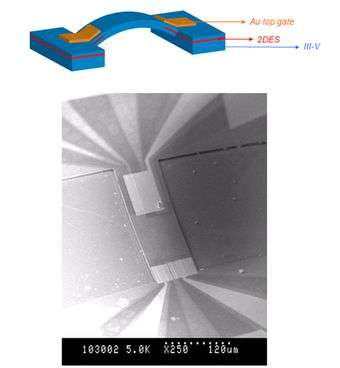
A schematic drawing (top) and scanning electron microscope image of the nanomechanical oscillator. Figure courtesy Imran Mahboob.

More than 50 years ago, a graduate student in Japan conceived the “Parametron,” an electrical circuit that could form the basis for digital computers. The concept ultimately fell flat, but recently a pair of scientists gave new life to the idea, and their work could be a first step toward a nanomechanical computer that is based on mechanical rather than electrical operations.
Rather than today's electronic “0” and “1” bits—the most basic pieces of information a computer can store, defined by whether a transistor has a zero or non-zero voltage across it—the Parametron used the response of an electrical oscillator to an applied frequency. The Parametron could only oscillate in two ways, a behavior that was exploited to represent 0's and 1's to enable binary logic.

Computers based on the Parametron were built, but the idea never took off as there were difficulties with power consumption and integration, and the much faster transistor quickly rendered it obsolete.

In the era of nanotechnology, the Parametron has been resurrected using mechanical oscillators. The scientists who have revived its spirit are Imran Mahboob and Hiroshi Yamaguchi of the NTT Corporation in Japan. Their electromechanical oscillator has a bridge-over-gap structure, and it's tiny: The gap is four micrometers deep and the bridge is 260 micrometers long, 84 micrometers wide, and 1.35 micrometers thick.

The bridge and the larger piece of material that contains the gap are made of the widely used semiconductor gallium arsenide (GaAs).

At the each end of the bridge, known as clamping points, there is a sandwich structure: a thin GaAs layer between a gold electrode and a “two-dimensional electronic system,” a general term for a material in which the electrons are confined to a plane.

When an alternating-current voltage that matches the bridge's natural frequency is applied across it, the bridge will oscillate vertically. This physical motion is due to a chain of events that begins with a displacement of atoms in the thin GaAs layer in response to the voltage. This causes the positive and negative charges in the layer to separate, which, in turn, produces a strain across the length of the bridge. The bridge bends slightly, a movement that can be tuned to a resonance frequency—there are more than one—by adjusting the voltage.

These resonance modes can be used to store information as bits. For example, neighboring oscillators with resonances that differ in phase—meaning they do not oscillate in unison—can represent 0 and 1 values.

“This is a highly tunable system, which we expect will make it easily integrable into complex architectures,” says Imran.

A nanomechanical computer based on his and Yamaguchi's concept would likely never be as fast as a transistor-based computer. But it would have some advantages, including being more resilient to electromagnetic shock and more energy efficient. This could make it a good replacement for computers that do not need to be ultra-fast, such as those in appliances, mobile phones, and cars.

Citation: I. Mahboob and H. Yamaguchi Nature Nanotechnology advance online publication, 13 April 2008 (DOI:10.1038/nnano.2008.84)

Copyright 2008 PhysOrg.com.
All rights reserved. This material may not be published, broadcast, rewritten or redistributed in whole or part without the express written permission of PhysOrg.com.

» Next Article in Nanotechnology - Physics: Spiraling nanotrees offer new twist on growth of nanowires

would you recommend this story?


User Rating

4.2 out of 5 after 67 total votes
  • not at all
  • 1
  • 2
  • 3
  • 4
  • 5
  • highly

Leave a Comment or

Rank filter

Move the slider to adjust rank threshold, so that you can hide some of the comments.
Posted by mvg 05/02/08 09:18
Not rated yet.
This sounds similar to what Nantero has been working on:

http://nantero.com/nram.html
Posted by Mercury_01 05/02/08 10:27
Not rated yet.
I wonder how it would handle solar radiation in space. We could use it in sattelites to protect against solar storms.
Posted by earls 05/02/08 10:34
Rank: 2/5 after 4 votes
Meh, they're stretching for uses that will quickly be filled by other better advances in light and electricity.
Posted by googleplex 05/02/08 14:24
Rank: 3.67/5 after 3 votes
Has anyone heard of using different voltages to give a non-binary state. E.g. use 100 states by having 100 incremental steps in voltage. I often think binary is so limited in data density.
Posted by Glis 05/02/08 16:57
Rank: 3/5 after 4 votes
Yes, I would like a gigantic slower computer made out of more expensive materials (GaAs and fat Au pads). I can understand that it may have specialized applications, but it shouldn't even be compared to modern transistors or being used in a phone/car(mechanical shock/vibration).

googleplex: Yup. I see digital creeping into some kind of discreet analog eventually.
Posted by Soylent 05/03/08 02:57
Rank: 1/5 after 2 votes
Has anyone heard of using different voltages to give a non-binary state?


Yes. They were called analog computers and they got their ass handed to them by the transistor and binary logic.
Posted by superhuman 05/03/08 13:19
Rank: 3.8/5 after 5 votes
> The gap is four micrometers deep and the bridge is 260 micrometers long, 84 micrometers wide, and 1.35 micrometers thick

Nanomechanical computer made out of micromechanical oscillators? interesting
Posted by deepsand 05/05/08 10:40
Rank: 3/5 after 2 votes
Has anyone heard of using different voltages to give a non-binary state?


Yes. They were called analog computers and they got their ass handed to them by the transistor and binary logic.


One look at the catalogs of IC producers will suffice to demonstrate that analog is alive & well.

In fact, digital circuitry relies on analog representations at the electronic cell level.
Posted by deepsand 05/05/08 10:45
Rank: 5/5 after 1 vote
> The gap is four micrometers deep and the bridge is 260 micrometers long, 84 micrometers wide, and 1.35 micrometers thick

Nanomechanical computer made out of micromechanical oscillators? interesting


In the Title, "Nano" is in quotations, indicative of being merely representational or predicative.

Prototypes, being employed as proofs-of-concept, are frequently of a scale different from that of production models.
Posted by superhuman 05/07/08 21:13
Not rated yet.
>In the Title, "Nano" is in quotations, indicative of being merely representational or predicative.

Its as representational or predicative as the term 'microcomputer' when applied to Eniac.

>Prototypes, being employed as proofs-of-concept, are frequently of a scale different from that of production models.

Micro-world is classical while nano-world is quantum mechanical so its not just a matter of scaling things down.
Posted by Soylent 05/08/08 08:38
Not rated yet.
One look at the catalogs of IC producers will suffice to demonstrate that analog is alive & well.


One look at any practical computational architecture designed in the last 3 decades will show that analog signaling is dead as a dodo and binary logic reigns supreme.

In fact, digital circuitry relies on analog representations at the electronic cell level.


Silly semantics games. Such analog information has no value in digital circuitry; wherever it creeps in and causes a signal to change from representing one level to the other we call it an error and we say that the device is faulty or running out of specification.
Posted by googleplex 05/09/08 18:59
Not rated yet.
Has anyone heard of using different voltages to give a non-binary state?


Yes. They were called analog computers and they got their ass handed to them by the transistor and binary logic.


I am aware of analog computers.
I am talking about hybrid base-x digital.
Incidentally I have an anologue computer cockroach at home designed by a Los Alomos labs guy. It only has 4 transitors but behaves like a cockroach - avoids objects, attract to light!