Closing the Achievement Gap in Math and Science
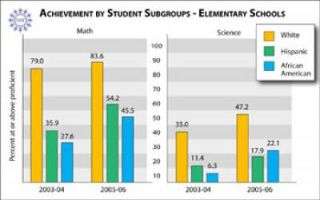
The latest results from the National Science Foundation's (NSF) Math and Science Partnership (MSP) program show not only improved proficiency among all elementary and middle school students, but also a closing of the achievement gaps between both African-American and Hispanic students and white students in elementary school math, and between African-American and white students in elementary and middle-school science.
Since 2002, the MSP program has supported institutions of higher education and K-12 school systems in partnering higher education faculty from science, technology, engineering and math (STEM) disciplines with K-12 teachers. Through the program, STEM faculty provide professional development and mentoring to math and science teachers to deepen their content knowledge in their field of expertise--all with the goal of better preparing students in these subjects.
The MSP program currently supports 52 such partnerships around the country that unite some 150 institutions of higher education with more than 700 school districts, including more than 5,200 schools in 30 states and Puerto Rico. More than 70 businesses, numerous state departments of education, science museums and community organizations are also partners.
The current results are drawn from schools whose MSP projects target specific improvements in their math and/or science programs. The data used are student scores on state proficiency tests in math and science collected over three different school years. The figure at right shows how student subgroups within MSP projects focused on math improvements performed on math tests in the 2003-2004 and 2005-2006 school years, respectively. Among approximately 39,000 students at 160 schools, the scores of white students performing at or above the proficient level rose 4.6 percentage points between the 2003-2004 and the 2005-2006 school years. Meanwhile, the results for Hispanic and African-American students went a long way towards closing an identified achievement gap. The percentage of Hispanic students performing at or above proficient rose by 18.3 percentage points--from 35.9 to 54.2 percent--and those of African-American students rose by 17.9 points--from 27.6 to 45.5 percent. Although small in number, Asian-American students, special education students, and students with limited English proficiency also showed gains.
The rise in science scores among elementary students within MSP projects focused on science improvements was not quite as pronounced, as shown in the figure at right, with the percentage of Hispanic students scoring at or above proficient rising by 6.5 percentage points, those of African-American students by 15.8, and those of white students by 12.2. Science testing is not mandated in all states, and there was a smaller universe of schools--96 schools, with assessments for only 7,500 students--reporting science proficiency results. However, science testing promises to be an area of increasing focus in the states, because the No Child Left Behind act requires that all states implement science testing by 2009.
Similar analyses were conducted for MSP middle schools. Math scores were drawn from 151 schools within MSP projects focused on math improvements and representing about 95,000 students while science scores were drawn from 51 schools within MSP projects focused on science improvements and representing about 9,500 students. While both math and science scores went up in all subgroups, results were the most pronounced among African-American science students; the percentage of students performing at or above proficient rose from 15.9 percent to 23.5 percent over the period, and this closed the achievement gap with white students.
"I'm happy to see that schools' involvement in MSP projects is continuing to have a positive impact on student proficiency results," says NSF program director Dan Maki. "We're particularly excited about the progress being made among Hispanic and African-American students, as closing achievement gaps--while improving achievement for all students--has been a goal of the MSP program since its inception. We continue to monitor data for participating high schools, but we aren't seeing trends yet."
Currently, MSP projects are actively engaged in determining which strategies most strongly correlate to improved student performance. For example, the Milwaukee Mathematics Partnership, led by the University of Wisconsin-Milwaukee, has a major objective of developing district- and school-based teacher leaders and distributing their expertise across Milwaukee's schools. The project has studied how often the teacher leaders effectively spend time with other teachers and strongly connect with networks of teachers, and found that schools in which teacher leaders play important roles demonstrate stronger student achievement results in mathematics.
Source: National Science Foundation


