Environmental fate of nanoparticles depends on properties of water carrying them
The fate of carbon-based nanoparticles spilled into groundwater – and the ability of municipal filtration systems to remove the nanoparticles from drinking water – depend on subtle differences in the solution properties of the water carrying the particles, a new study has found.
In slightly salty water, for example, clusters of Carbon 60 (C60) would tend to adhere tightly to soil or filtration system particles. But where natural organic compounds or chemical surfactants serve as stabilizers in water, the C60 fullerene particles would tend to flow as easily as the water carrying them.
“In some cases, the nanoparticles move very little and you would get complete retention in the soil,” said Kurt Pennell, a professor in the School of Civil and Environmental Engineering at the Georgia Institute of Technology. “But in different solution conditions or in the presence of a stabilizing agent, they can travel just like water. The movement of these nanoparticles is very sensitive to the solution conditions.”
Research into the transport and retention of C60 nanoparticles was reported April 11 in the online version of the American Chemical Society journal Environmental Science and Technology and will be published later in the print edition. The research was funded by the U.S. Environmental Protection Agency.
Comparatively little research has been done on what happens to nanoparticles when they are released through accidental spills – or when products containing them are discarded. Researchers want to know more about the environmental fate of nanoparticles to avoid creating problems like those of polychlorinated biphenyls (PCBs), in which the harmful effects of the compounds were discovered only after their use became widespread.
“It will be difficult to control the waste stream, so these nanoparticles are likely to get everywhere,” said Pennell. “We want to figure out now what will happen to them and how toxic they will be in the environment.”
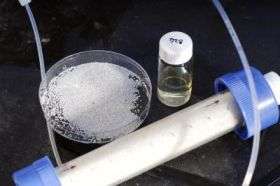
To study the flow and retention of the nanoparticles in simulated soil and filtration systems, Pennell’s research team filled glass columns with either glass microbeads or sand, and saturated the columns with water. They then sent a “pulse” of water containing C60 nanoparticles through the columns, followed by additional water containing no nanoparticles.
They measured the quantity of nanoparticles emerging from the columns and analyzed the sand and glass beads to observe the quantity of C60 retained there. They also extracted the contents of the columns to measure the distribution of retained nanoparticles.
“In sand, we saw a uniform distribution of the nanoparticles throughout the column, which suggests that under the circumstances we examined, there is a limited retention capability due to filtration,” Pennell explained. “Once that capacity is reached, the particles will pass through until they are retained by other grains of soil or sand.”
Traditional theories regarding the activity of such packed-bed filters suggest that particles would build up near the column entrance, with concentrations falling off thereafter. The study findings suggest that the predictions of “filter theory” will have to be modified to explain the transport of nanoparticles in soil, Pennell said.
The nanoparticles retained were tightly bound to the sand or beads and could only be removed by changing the pH of the water.
“That would be a good thing if you were trying to filter these particles from a water system and were worried about them moving into the environment,” Pennell said. “Once they go onto the soil system, it’s unlikely that they will come off as long as the conditions don’t change.”
The researchers observed that up to 77 percent of the nanoparticle mass was retained by the sand, while the glass beads retained between 8 and 49 percent. Preparation of the solutions containing C60 dramatically affected the retention; when no salt was added, the particles flowed through the columns like water.
“We want to make a mechanistic assessment of why the particles are attaching,” Pennell said. “When we look at real soils with finer particles, we will expect to see more retention.”
For municipal drinking water filtration, the sensitivity to solution characteristics means local conditions may play a key role.
“Under most conditions, you should be able to remove nanoparticles from the water,” Pennell explained. “But you will have to be careful if the nanoparticles are stabilized by a natural surfactant or humic acid. If those are present in the water, the nanoparticles could go right through.”
In a continuation of the work, Pennell and his Georgia Tech collaborators – Joseph Hughes, John Fortner and Younggang Wang – are now studying more complicated transport issues in real soils and with other types of nanoparticles. In field conditions, the nanoparticles are likely to be found with other types of carbon – and potentially with other nanostructures.
“When we study systems with real soil, we will have background interference with humics and other materials,” Pennell noted. “Ramping up the complexity will make this research a real challenge.”
Ultimately, Pennell hopes to develop information about a broad range of nanoparticles to predict how they’ll be retained and transported under a variety of conditions. Facilitating that is mathematical modeling being done by collaborators Linda Abriola and Yusong Li at Tufts University in Medford, Mass.
“We want to build up to the point that we can systematically vary properties and parameters,” Pennell explained. “Over time, we should be able to classify nanoparticles based on their properties and have a good idea of how they will behave in the environment.”
Source: Georgia Institute of Technology


