NASA calls on APL to send a probe to the sun
May 2, 2008
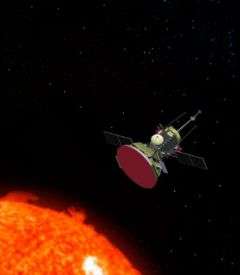
Artist's concept of NASA's Solar Probe spacecraft making its pass toward the sun, where it will study the forces that create solar wind. Preliminary designs include a 9-foot-diameter, 6-inch-thick, carbon-foam-filled solar shield atop the spacecraft body, and two sets of solar arrays that would retract or extend as the spacecraft swings toward or away from the sun -- making sure the panels stay at proper temperatures and power levels. Credit: NASA/Johns Hopkins University Applied Physics Laboratory
The Johns Hopkins University Applied Physics Laboratory is sending a spacecraft closer to the sun than any probe has ever gone - and what it finds could revolutionize what we know about our star and the solar wind that influences everything in our solar system.
NASA has tapped APL to develop the ambitious Solar Probe mission, which will study the streams of charged particles the sun hurls into space from a vantage point within the sun's corona -- its outer atmosphere -- where the processes that heat the corona and produce solar wind occur. At closest approach Solar Probe would zip past the sun at 125 miles per second, protected by a carbon-composite heat shield that must withstand up to 2,600 degrees Fahrenheit and survive blasts of radiation and energized dust at levels not experienced by any previous spacecraft.
Experts in the United States and abroad have grappled with this mission concept for more than 30 years, running into seemingly insurmountable technology and budgetary limitations. But in February an APL-led team completed a Solar Probe engineering and mission design study at NASA's request, detailing just how the robotic mission could be accomplished.
The study team used an APL-led 2005 study as its baseline, but then significantly altered the concept to meet challenging cost and technical conditions provided by NASA.
"We knew we were on the right track," says Andrew Dantzler, Solar Probe project manager at APL. "Now we've put it all together in an innovative package; the technology is within reach, the concept is feasible and the entire mission can be done for less than $750 million [in fiscal 2007 dollars], or about the cost of a medium-class planetary mission. NASA decided it was time."
APL will design and build the spacecraft, on a schedule to launch in 2015. The compact, solar-powered probe would weigh about 1,000 pounds; preliminary designs include a 9-foot-diameter, 6-inch-thick, carbon-foam-filled solar shield atop the spacecraft body. Two sets of solar arrays would retract or extend as the spacecraft swings toward or away from the sun during several loops around the inner solar system, making sure the panels stay at proper temperatures and power levels. At its closest passes the spacecraft must survive solar intensity more than 500 times what spacecraft experience while orbiting Earth.
Solar Probe will use seven Venus flybys over nearly seven years to gradually shrink its orbit around the sun, coming as close as 4.1 million miles (6.6 million kilometers) to the sun, well within the orbit of Mercury and about eight times closer than any spacecraft has come before.
Solar Probe will employ a combination of in-place and remote measurements to achieve the mission's primary scientific goals: determine the structure and dynamics of the magnetic fields at the sources of solar wind; trace the flow of energy that heats the corona and accelerates the solar wind; determine what mechanisms accelerate and transport energetic particles; and explore dusty plasma near the sun and its influence on solar wind and energetic particle formation. Details will be spelled out in a Solar Probe Science and Technology Definition Team study that NASA will release later this year. NASA will also release a separate Announcement of Opportunity for the spacecraft's science payload.
"Solar Probe is a true mission of exploration," says Dr. Robert Decker, Solar Probe project scientist at APL. "For example, the spacecraft will go close enough to the sun to watch the solar wind speed up from subsonic to supersonic, and it will fly though the birthplace of the highest energy solar particles. And, as with all missions of discovery, Solar Probe is likely to raise more questions than it answers."
APL's experience in developing spacecraft to study the sun-Earth relationship - or to work near the sun - includes ACE, which recently marked its 10th year of sampling energetic particles between Earth and the sun; TIMED, currently examining solar effects on Earth's upper atmosphere; the twin STEREO probes, which have snapped the first 3-D images of explosive solar events called coronal mass ejections; and the Radiation Belt Storm Probes, which will examine the regions of energetic particles trapped by Earth's magnetic field.
Solar Probe will be fortified with heat-resistant technologies developed for APL's MESSENGER spacecraft, which completed its first flyby of Mercury in January and will begin orbiting that planet in 2011. Solar Probe's solar shield concept was partially influenced by designs of MESSENGER's sunshade.
Source: Johns Hopkins University
-
New kind of high-temperature photonic crystal could someday power everything from smartphones to spacecraft
Feb 03, 2012 |
4.9 / 5 (16) |
5
-
NASA's Juno spacecraft refines its path to Jupiter
Feb 03, 2012 |
3 / 5 (1) |
0
-
Mission to land on a comet
Feb 03, 2012 |
5 / 5 (10) |
2
-
Hayabusa 2 Mission approved by Japanese government
Feb 01, 2012 |
not rated yet |
0
-
NRL's SoloHI instrument selected for flight on solar orbiter mission
Jan 24, 2012 |
not rated yet |
0
-
Engineers build first sub-10-nm carbon nanotube transistor
Feb 01, 2012 |
4.9 / 5 (33) |
30
-
Something old, something new: Evolution and the structural divergence of duplicate genes
Jan 31, 2012 |
4.6 / 5 (7) |
1
-
The hidden nanoworld of ice crystals: Revealing the dynamic behavior of quasi-liquid layers
Jan 30, 2012 |
5 / 5 (4) |
1
-
Stock market network reveals investor clustering
Jan 27, 2012 |
3.9 / 5 (23) |
8
-
Of microchemistry and molecules: Electronic microfluidic device synthesizes biocompatible probes
Jan 26, 2012 |
5 / 5 (2) |
0
-
Never ending outer space.....
23 hours ago
-
Neutron Star fragments?
Feb 11, 2012
-
stationary or not?
Feb 11, 2012
-
Scale of the Universe
Feb 10, 2012
-
Titan's lack of impact craters
Feb 09, 2012
-
Real pictures of black hole eating a star?
Feb 08, 2012
- More from Physics Forums - General Astronomy
More news stories
Salvage workers begin pumping fuel from Italian shipwreck
Salvage workers Sunday began pumping fuel from the shipwrecked Italian cruise liner Costa Concordia, a day ahead of schedule, officials said.
8 hours ago |
5 / 5 (1) |
0
Latin America mining boom clashes with conservation
Latin America is experiencing a mining boom as prices rise fuelled by a hike in global demand, but the region is also being hit by a wave of violent protests, strikes and rallies by environmentalists.
16 hours ago |
5 / 5 (1) |
1
Political leaders play key role in how worried Americans are by climate change: study
More than extreme weather events and the work of scientists, it is national political leaders who influence how much Americans worry about the threat of climate change, new research finds.
Feb 06, 2012 |
5 / 5 (7) |
73
NASA budget will axe Mars deal with Europe: scientists
US President Barack Obama's budget proposal to be submitted next week for 2013 will cut NASA's budget by 20 percent and eliminate a major partnership with Europe on Mars exploration, scientists said Thursday.
Space & Earth / Space Exploration
Feb 10, 2012 |
5 / 5 (3) |
58
Humans may have helped the decline of African rainforests 3000 years ago
(PhysOrg.com) -- Large areas of rainforests in Central Africa mysteriously disappeared over three thousand years ago, to be replaced by savannas. The prevailing theory has been that the cause was a change ...
Scientists discover molecular secrets of 2,000-year-old Chinese herbal remedy
For roughly two thousand years, Chinese herbalists have treated Malaria using a root extract, commonly known as Chang Shan, from a type of hydrangea that grows in Tibet and Nepal. More recent studies suggest that halofuginone, ...
New method to examine batteries -- MRI from the inside
There is an ever-increasing need for advanced batteries for portable electronics, such as phones, cameras, and music players, but also to power electric vehicles and to facilitate the distribution and storage of energy derived ...
A mitosis mystery solved: How chromosomes align perfectly in a dividing cell
Although the process of mitotic cell division has been studied intensely for more than 50 years, Whitehead Institute researchers have only now solved the mystery of how cells correctly align their chromosomes during symmetric ...
Google might launch Drive for cloud storage soon
(PhysOrg.com) -- Google's next big move, according to the Wall Street Journal, is a cloud storage service called Drive. Hardly first to the plate, Google is simply catching up to introducing its cloud reposi ...
Lab study raises questions over nano-particle impact
Tests involving chickens have raised questions about the impact on health from engineered nano-particles, the ultra-fine grains commonly used in drugs and processed foods, scientists said on Sunday.
Overeating may double risk of memory loss
New research suggests that consuming between 2,100 and 6,000 calories per day may double the risk of memory loss, or mild cognitive impairment (MCI), among people age 70 and older. The study was released today and will be ...
May 02, 2008
Rank: not rated yet
May 02, 2008
Rank: not rated yet
May 04, 2008
Rank: not rated yet