A new idea for how anti-aging products delay ripening of fruit and wilting of flowers
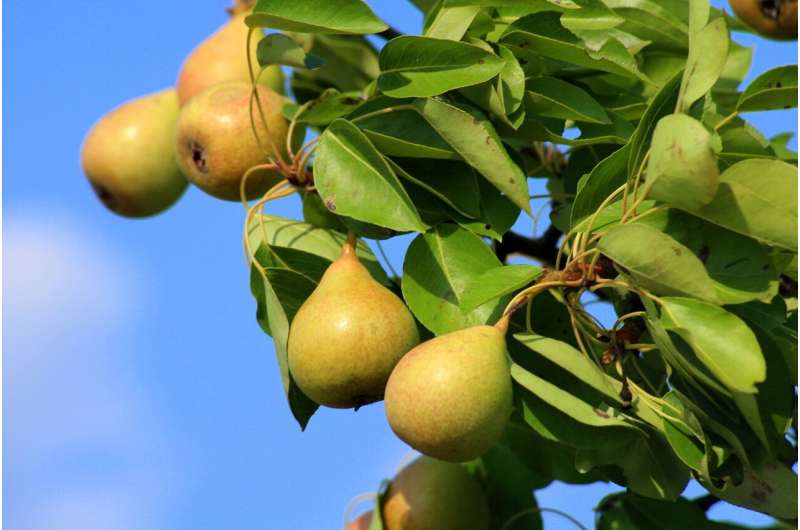
When plants encounter ethylene, a gas they also produce naturally as a hormone, the result is softening and ripening in the case of fruit, and wilting and fading in the case of flowers—all of which ethylene promotes.
To delay these effects, growers spray plants with products available in the market today, such as EthylBlocTM for flowers and SmartFreshSM for fruits and vegetables, that contain a compound that blocks ethylene's action on plants.
But how this compound, 1-methylcyclopropane or 1-MCP, works at the molecular level remains uncertain despite several chemical pathways chemists have proposed in the scientific literature.
Now, in a research paper published in the April issue of Chemistry & Biology, a team led by Michael Pirrung, a professor of chemistry and the holder of the University of California Presidential Chair in Chemistry at UC Riverside, offers a novel pathway for how "anti-aging" products like EthylBloc and SmartFresh block ethylene in plants, delaying the plants' demise and allowing people to enjoy their beauty and products for longer than nature allows.
The authors propose that a chemical reaction occurs between 1-MCP and naturally-occurring copper in plant cells. This knowledge could guide researchers in their attempts to discover new ethylene-blocking chemicals for preserving the freshness of fruits, vegetables and flowers for longer than currently is possible.
Until now, researchers believed that a "complex"—a chemical structure consisting of molecules that are weakly connected to one another—formed between 1-MCP and copper.
"A complex is loose and can break apart easily—something we don't see happening in the case of 1-MCP in plants," Pirrung explained. "A chemical reaction, which is far stronger than a complex, accounts for why 1-MCP is so effective."
How 1-MCP prevents ripening and wilting:
Plant cells possess copper-containing ethylene binding sites called ethylene receptors. (An ethylene receptor is a protein that sits in the cell membrane and has a site for binding ethylene on the outside of the cell.) When ethylene comes into contact with the receptor, it binds chemically with the copper, which inactivates the receptor. The inactivation results in the cell breaking down, which, in turn, initiates aging and the death of plant tissues.
1-MCP works by beating ethylene to the receptors. By binding with a sufficient number of receptors chemically and permanently, it forever makes them insensitive to ethylene. The plants do not "perceive" ethylene thereafter, preventing ripening and wilting.
Furthermore, unlike ethylene, 1-MCP does not inactivate the receptors. As a result, the cells do not break down, which prolongs the freshness of flowers and fruit after harvest, extends their shelf life, reduces waste and, ultimately, benefits producers and consumers.
Administering 1-MCP:
Because 1-MCP is an unstable gas, growers face a challenge in delivering it to fruits and flowers. Commercially, 1-MCP therefore is complexed with alpha-cyclodextrin, a ring-structured biocompatible molecule formed of six linked glucose units, to produce a stable, water-soluble powder.
When the powder is dissolved in water, 1-MCP is released as a vapor that travels through the air, making its way eventually to plants' ethylene receptors.
Novel pathway can lead to new products:
In their paper, the researchers show that 1-MCP reacts with copper to give a highly reactive chemical intermediate. Called a carbene, the intermediate will react with essentially any other kind of chemical group in the area.
"Very few such intermediates are known, and it is mostly difficult to make them," Pirrung said. "Based on the reaction of 1-MCP with copper, we discovered a very easy process to make a carbene. When the carbene is generated by the copper in the ethylene receptor, it is the receptor that reacts, creating the permanent linkage that prevents the receptor from perceiving ethylene."
According to Pirrung, knowledge of a chemical reaction between 1-MCP and copper in ethylene receptors could help researchers design new compounds, such as non-gaseous compounds, that are capable of working as well as 1-MCP but are not as difficult to handle.
"Such compounds would enable much more widespread treatment of fruits, flowers and vegetables to prevent their spoiling," he said.
Next in their research, Pirrung and his colleagues will study in more detail the chemical reaction between 1-MCP and plants' copper-containing receptors.
Provided by University of California - Riverside


