Creating Highly Sought Magnetic Nanoparticles in One Step
May 2, 2008 Creating Highly Sought Magnetic Nanoparticles in One Step

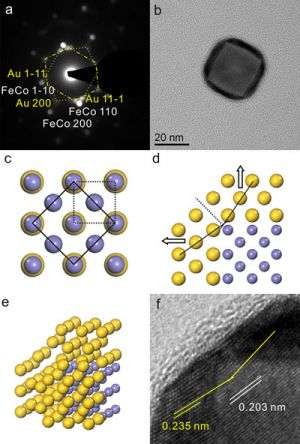
Structure of FeCo-Au nanocrystals. (a) CBED of the nanocrystal in (b), the two distorted hexagons (dot and dot-dash line) indicating two perpendicular Au [011]s. (b) a TEM bright field image of a nanocrystal. (c) illustration of the epitaxial relationship between the bcc FeCo (dotted line) and fcc Au (solid line) (smaller atom, Fe or Cu; larger atom, Au). (d) the perpendicular relationship between the two Au (110)s (indicated by arrows) at two neighboring facets of FeCo {100}, with a twinning at the rim. (e) a 3D illustration of a corner of the FeCo-Au nanocrystal. (f) HRTEM image of a corner of a nanocrystal with the same angle between the Au (111)s from the neighboring Au. Credit: NSLS

Researchers from the University of Minnesota have demonstrated a one-step technique for producing a class of magnetic nanoparticles that could be used in everything from biomedical applications to data storage. Consisting of an iron and cobalt core with a gold shell, the nanoparticle’s unique, and potentially very useful, magnetic properties were characterized at the NSLS.

Magnetic nanoparticles are envisioned for a wide variety of uses. In the medical realm, scientists hope to use single nanoparticles to deliver anticancer drugs or radionuclide atoms to a targeted area of the body, or to enhance the contrast in magnetic resonance imaging (MRI). The particles also could assist in the development of advanced data storage, and further down the road, in spintronic devices. In general, the higher the nanoparticle’s magnetic moment – the measure of a material’s magnetic strength – the more valuable it is for these applications.

“There’s a continuous search for magnetic nanoparticles that perform better than those currently available,” said University of Minnesota Professor Jian-Ping Wang. “Nanoparticles with high magnetic moments are especially valuable for biomedical uses, because the stronger they are, the smaller the quantity that can be used in the body. That’s a very important aspect for clinical trials.”

Nanoparticles made of iron-cobalt (the core) and gold (shell) – the material recently studied by Wang and his Ph.D. student, Yun-Hao Xu – have a magnetic moment three to four times higher than traditional iron oxide nanoparticles. In addition, the particle’s gold surface is biocompatible and easily links with large molecules – features that make it even more attractive to the biomedical community.

Although the benefits of these nanoparticles are now well known, Wang and Xu are the first to show how they can be created in a simpler and more efficient manner than traditional techniques. Conventional chemical methods are limited by the solvent’s boiling temperature, which must be extremely high for the reaction to take place, and the risk of exposure to air, which corrodes the sensitive particles.

“A lot of people like using the chemical method to make nanoparticles from solution,” Wang said. “I prefer the physical method.”

In their gas-condensation technique, Wang and Xu used a sputter gun to bombard a solid metallic target made of iron, cobalt, and gold with energetic ions. This all happens within a heat bath of high-pressure gas, which transforms the high-energy atoms into the desired nanoparticles.

The researchers then analyzed the resulting nanocrystals with high-resolution transmission electron microscopy and energy dispersive x-ray spectroscopy, as well as with x-ray magnetic circular dichroism at NSLS beamline U4B. Their findings: the cubic crystals formed through the physical method are very pure, with sharp and clean interfaces between the core and shell; the shell is thick enough to prevent oxidation of the iron-cobalt core (the source of the particle’s unique magnetic properties) for more than four months of air exposure; and the nanoparticles’ magnetic moments are close to the values in bulk iron-cobalt alloy. The details are published in the December 5, 2007 edition of Applied Physics Letters.

“Our findings suggest that the magnetic nanoparticles formed through this one-step technique are very promising for biomedical applications,” Wang said. “This method can easily be used to synthesize other nanoparticles tailored for uses in different technologies and fields such as for catalysts and hydrogen storage.”

Currently limited to producing small batches of the particles, the researchers are working on a way to develop the material in more massive quantities.

Citation: Y. Xu, J. Wang, "FeCo-Au Core-shell Nanocrystals," Appl. Phys. Lett., 91: 233107 (2007).

Source: National Synchrotron Light Source


print this article email this article download pdf blog this article bookmark this article     Stumble it Digg this share on Facebook retweet share on Reddit add to delicious
Rate this story - 4.1 /5 (12 votes)


May 2, 2008 all stories

Comments: 0

4.1 /5 (12 votes)
  • Stumble this up

  • Digg this

  • share this

  • hide
  • Related Stories

  • Nanoneedle is small in size, but huge in applications
    created Apr 28, 2009 | popularity not rated yet | comments 0
  • Through the Wire: A New Nanocatalyst Synthesis Technique
    created Mar 16, 2009 | popularity not rated yet | comments 0
  • Twin nanoparticle shown effective at targeting, killing breast cancer cells
    created Mar 10, 2009 | popularity not rated yet | comments 0
  • Magnetic nanotags allow sensitive detection of cancer biomarkers
    created Dec 02, 2008 | popularity not rated yet | comments 0
  • New blood scanner detects even faint indicators of cancer
    created Dec 02, 2008 | popularity not rated yet | comments 0


  • hide
  • Relevant PhysicsForums posts

  • What is inertial force?
    created 1hour ago
  • mass time acceleration => watts
    created 5 hours ago
  • Tyres - why is wider better for lateral grip?
    created 6 hours ago
  • Physics of Golf
    created 13 hours ago
  • More from Physics Forums - General Physics

Other News

New Digital 'Electronics' Concept May Continue Moore's Law

New Digital 'Electronics' Concept May Continue Moore's Law

Nanotechnology / Nanophysics

created 16 hours ago | popularity 4.7 / 5 (36) | comments 3

(PhysOrg.com) -- Computers of the future could be operating not on electrons, but on tiny waves traveling through an electron "fluid," if a new proposal is successful. The new circuit design, recently introduced ...


Nanoparticles may cause DNA damage across a cellular barrier

Nanoparticles may cause DNA damage across a cellular barrier

Nanotechnology / Bio & Medicine

created 9 hours ago | popularity 4.6 / 5 (5) | comments 0

(PhysOrg.com) -- Scientists have shown in the laboratory that metal nanoparticles damaged the DNA in cells on the other side of a cellular barrier. The research, by the University of Bristol, is published ...


How Size Matters For Catalysts: Study Links Size, Activity, Electronic Properties

How Size Matters For Catalysts: Study Links Size, Activity, Electronic Properties

Nanotechnology / Nanomaterials

created 12 hours ago | popularity 3.7 / 5 (3) | comments 0

(PhysOrg.com) -- University of Utah chemists demonstrated the first conclusive link between the size of catalyst particles on a solid surface, their electronic properties and their ability to speed chemical ...


Nanotechnology: A risky frontier?

Nanotechnology / Nanomaterials

created 15 hours ago | popularity 5 / 5 (1) | comments 0

Inside a cramped back room at Rushford Hypersonic, a start-up headquartered in southeastern Minnesota, sits a cube-like machine that throws a mean atomic fastball. At the push of a button, the reactor hurls atoms toward a ...


Breakthrough in industrial-scale nanotube processing

Breakthrough in industrial-scale nanotube processing

Nanotechnology / Nanomaterials

created Nov 02, 2009 | popularity 4.9 / 5 (19) | comments 3

(PhysOrg.com) -- Rice University scientists today unveiled a method for the industrial-scale processing of pure carbon-nanotube fibers that could lead to revolutionary advances in materials science, power ...