Record-setting Laser May Aid Searches for Earthlike Planets
May 5, 2008 Record-setting Laser May Aid Searches for Earthlike Planets

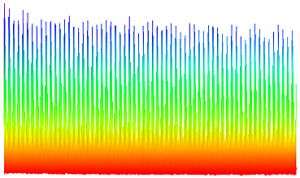
Experimental data from a NIST "gap-toothed" frequency comb that are false colored to indicate the range from low power (red) to high power (blue). The comb is specially designed for astronomy. Each "tooth" is a precisely known frequency, and the teeth are widely separated (by 20 gigahertz) in comparison to a standard comb. Credit: M. Kirchner & S. Diddams/NIST

Scientists at the University of Konstanz in Germany and the National Institute of Standards and Technology (NIST) have demonstrated an ultrafast laser that offers a record combination of high speed, short pulses and high average power. The same NIST group also has shown that this type of laser, when used as a frequency comb—an ultraprecise technique for measuring different colors of light—could boost the sensitivity of astronomical tools searching for other Earthlike planets as much as 100 fold.

The dime-sized laser, to be described Thursday, May 8, at the Conference on Lasers and Electro-Optics,* emits 10 billion pulses per second, each lasting about 40 femtoseconds (quadrillionths of a second), with an average power of 650 milliwatts. For comparison, the new laser produces pulses 10 times more often than a standard NIST frequency comb while producing much shorter pulses than other lasers operating at comparable speeds. The new laser is also 100 to 1000 times more powerful than typical high-speed lasers, producing clearer signals in experiments. The laser was built by Albrecht Bartels at the Center for Applied Photonics of the University of Konstanz.

Among its applications, the new laser can be used in searches for planets orbiting distant stars. Astronomers look for slight variations in the colors of starlight over time as clues to the presence of a planet orbiting the star. The variations are due to the small wobbles induced in the star’s motion as the orbiting planet tugs it back and forth, producing minute shifts in the apparent color (frequency) of the starlight. Currently, astronomers’ instruments are calibrated with frequency standards that are limited in spectral coverage and stability.

Frequency combs could be more accurate calibration tools, helping to pinpoint even smaller variations in starlight caused by tiny Earthlike planets. Such small planets would cause color shifts equivalent to a star wobble of just a few centimeters per second. Current instruments can detect, at best, a wobble of about 1 meter per second.

Standard frequency combs have “teeth” that are too finely spaced for astronomical instruments to read. The faster laser is one approach to solving this problem. In a separate paper,** the NIST group and astronomer Steve Osterman at the University of Colorado at Boulder describe how, by bouncing the light between sets of mirrors a particular distance apart, they can eliminate periodic blocks of teeth to create a gap-toothed comb. This leaves only every 10th or 20th tooth, making an ideal ruler for astronomy.

Both approaches have advantages for astronomical planet finding and related applications. The dime-sized laser is very simple in construction and produces powerful and extremely well-defined comb teeth. On the other hand, the filtering approach can cover a broader range of wavelengths. Four or five filtering cavities in parallel would provide a high-precision comb of about 25,000 evenly spaced teeth that spans the visible to near-infrared wavelengths (400 to 1100 nanometers), NIST physicist Scott Diddams says.

Osterman says he is pursuing the possibility of testing such a frequency comb at a ground-based telescope or launching a comb on a satellite or other space mission. Other possible applications of the new laser include remote sensing of gases for medical or atmospheric studies, and on-the-fly precision control of high-speed optical communications to provide greater versatility in data and time transmissions. The application of frequency combs to planet searches is of international interest and involves a number of major institutions such as the Max-Planck Institute for Quantum Optics and Harvard Smithsonian Center for Astrophysics.

References:

* A. Bartels, D. Heinecke and S.A. Diddams. Passively mode-locked 10 GHz femtosecond Ti:sapphire laser with >1 mW of power per frequency comb mode. Post-deadline paper presented at Conference on Lasers and Electro-Optics (CLEO), San Jose, Calif., May 4-9, 2008.

** D.A. Braje, M. S. Kirchner, S. Osterman, T. Fortier and S. A. Diddams. Astronomical spectrograph calibration with broad-spectrum frequency combs. To appear in European Physics Journal D. (Posted online at arXiv:0803.0565)

Source: NIST


print this article email this article download pdf blog this article bookmark this article     Stumble it Digg this share on Facebook retweet share on Reddit add to delicious
Rate this story - 4.6 /5 (45 votes)

Rank Filter

Move the slider to adjust rank threshold, so that you can hide some of the comments.


Display comments: newest first

  • okazakifudosan - May 05, 2008
    • Rank: 1 / 5 (5)
    %u305D%u308C%u306B%u3057%u3066%u3082%u4E88%u6E2C%u4E0D%u53EF%u80FD%u306A%u7BC4%u56F2%u3067%u30AB%u30BF%u30AB%u30CA%u306B%u5909%u63DB%u3055%u308C%u308B%u30A6%u30C1%u306EIME%u306F%u3069%u3046%u306B%u304B%u306A%u3089%u3093%u306E%u3067%u3057%u3087%u3046%u304B
    %u51FA%u4F1A%u3044%u7CFB%u3000%u767B%u9332
  • EarthScientist - May 06, 2008
    • Rank: 1 / 5 (1)
    I see okookie before me has it figured,but I figure it a little different,Most quadrants have 2 planets that are habitable,Mars is our other habitable planet,but its grid is shut down to 30 percent total heating due to the 14 thousand ago problem with destruction from the explosion components from the 28 ago planetary explosion.Its amazing that folks have to spend billions to try and find out all of the "secrets" of the universe when the grid men and lifter men can just give it to you ,nice and easy,plain and simple if you can handle it.Come get me ,NSA.

May 5, 2008 all stories

Comments: 2

4.6 /5 (45 votes)
  • Stumble this up

  • Digg this

  • share this

  • hide
  • Related Stories

  • Scientists Build First 'Frequency Comb' To Display Visible 'Teeth'
    created Oct 29, 2009 | popularity not rated yet | comments 0
  • Goal: developing the best atomic clock in the world
    created May 29, 2009 | popularity not rated yet | comments 0
  • LIDAR system offers peerless precision in remote measurements
    created May 24, 2009 | popularity not rated yet | comments 0
  • Creating the astro-comb to locate Earth-like planets
    created May 07, 2009 | popularity not rated yet | comments 0
  • HARPS-NEF to comb Kepler targets for new Earths
    created Apr 20, 2009 | popularity not rated yet | comments 0


  • hide
  • Relevant PhysicsForums posts

Other News

Stars Fueled by Dark Matter Could Hold Secrets to the Universe

Stars Fueled by Dark Matter Could Hold Secrets to the Universe

Physics / General Physics

created Nov 03, 2009 | popularity 4.5 / 5 (51) | comments 41

(PhysOrg.com) -- The first stars in the universe may have been very different from the stars we see today, yet they may hold clues to understanding some of the mysterious features of the universe. These "dark ...


Second Law of Thermodynamics May Explain Economic Evolution

Second Law of Thermodynamics May Explain Economic Evolution

Physics / General Physics

created Nov 02, 2009 | popularity 4.3 / 5 (30) | comments 28

(PhysOrg.com) -- Terms such as the "invisible hand," laissez-faire policy, and free-market principles suggest that economic growth and decline in capitalist societies seem to be somehow self-regulated. Now, ...


High-performance plasmas may make reliable, efficient fusion power a reality

High-performance plasmas may make reliable, efficient fusion power a reality

Physics / Plasma Physics

created Nov 02, 2009 | popularity 4.7 / 5 (39) | comments 33

In the quest to produce nuclear fusion energy, researchers from the DIII-D National Fusion Facility have recently confirmed long-standing theoretical predictions that performance, efficiency and reliability ...


'Teapot effect' solved

Solving Teapot Effect

Physics / General Physics

created Nov 02, 2009 | popularity 4.9 / 5 (11) | comments 10

(PhysOrg.com) -- A team of scientists from France have worked out why teapots dribble at low flow rates, and how to stop them. The effect is called the "teapot effect", and solving it could finally put an ...


Laser accelerated protons to the highest energies so far

Researchers use trident laser to accelerate protons to record energies

Physics / General Physics

created Nov 02, 2009 | popularity 4.7 / 5 (6) | comments 10

An international team of physicists at Los Alamos National Laboratory has succeeded in using intense laser light to accelerate protons to energies never before achieved. Using this technique, scientists can ...