Munch-o-matic: Scientists develop the artificial mouth
May 5, 2008 Artificial Mouth

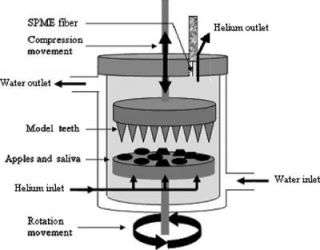
A schematic representation of the artificial mouth apparatus, which scientists have designed to mimic human digestion. Credit: Courtesy of the American Chemical Society

For years scientists have tried to build an electronic tongue, a robotic tasting device that could have profound applications in improving food quality and safety. But before machines learn to taste their food, they first need to learn how to chew it.

In a study scheduled for the May 14 issue of ACS’ bi-weekly Journal of Agricultural and Food Chemistry, scientists report the design of an artificial mouth that mimics the first vital steps of human digestion — chewing, saliva release and the initial breakdown of food.

In the study, Gaëlle Arvisenet and colleagues point out that a number of factors are involved in the release of aromatic and flavor compounds in the mouth. Chewing, the release of saliva, the rate of food breakdown and the temperature all affect the flavor and smell of food before it’s swallowed.

To accurately reproduce the effects of chewing, Arvisenet's team needed to build a machine that could imitate several — if not all — of these subtle processes. “Our aim was not to reproduce the human mouth conditions exactly, but to reproduce the result of mastication,” says Arvisenet.

The researchers compared apples chewed by their machine and by human mouths. The resulting apple pulp was scrutinized for texture, color and aromatic compound release. “Experimental conditions were determined that produced fruit in a state closest to that obtained after mastication in a human mouth,” reports Arvisenet.

Source: American Chemical Society


print this article email this article download pdf blog this article bookmark this article     Stumble it Digg this share on Facebook retweet share on Reddit add to delicious
Rate this story - 4 /5 (4 votes)

Rank Filter

Move the slider to adjust rank threshold, so that you can hide some of the comments.


Display comments: newest first

  • zevkirsh - May 05, 2008
    • Rank: not rated yet
    also if you have your mouth or jaw blown off your face, you can use this as a prosthetic.

May 5, 2008 all stories

Comments: 1

4 /5 (4 votes)
  • Stumble this up

  • Digg this

  • share this

  • hide
  • Related Stories


Other News

New hydrogen-storage method discovered

New hydrogen-storage method discovered

Chemistry / Materials Science

created 20 hours ago | popularity 4.4 / 5 (32) | comments 11

Scientists at the Carnegie Institution have found for the first time that high pressure can be used to make a unique hydrogen-storage material. The discovery paves the way for an entirely new way to approach ...


Accidental discovery produces durable new blue pigment for multiple applications

Accidental discovery produces durable new blue pigment for multiple applications

Chemistry / Biochemistry

created Nov 16, 2009 | popularity 4.5 / 5 (32) | comments 6

An accidental discovery in a laboratory at Oregon State University has apparently solved a quest that over thousands of years has absorbed the energies of ancient Egyptians, the Han dynasty in China, Mayan ...


One word: bioplastics

One word: bioplastics

Chemistry / Materials Science

created Nov 17, 2009 | popularity 4.6 / 5 (13) | comments 4

(PhysOrg.com) -- Every year, more than 250 billion pounds of plastic are produced worldwide. Much of it ends up in the world's oceans, a fact that troubles MIT biology professor Anthony Sinskey.


New on-off 'switch' triggers and reverses paralysis in animals with a beam of light

New on-off 'switch' triggers and reverses paralysis in animals with a beam of light (w/ Video)

Chemistry / Biochemistry

created Nov 18, 2009 | popularity 4.8 / 5 (5) | comments 4

In an advance with overtones of Star Trek phasers and other sci-fi ray guns, scientists in Canada are reporting development of an internal on-off "switch" that paralyzes animals when exposed to a beam of ultraviolet ...


New research provides blueprint for molecular basis of global warming

New research provides blueprint for molecular basis of global warming

Chemistry / Materials Science

created Nov 17, 2009 | popularity 4 / 5 (4) | comments 3

A new study indicates that major chemicals most often cited as leading causes of climate change, such as carbon dioxide and methane, are outclassed in their warming potential by compounds receiving less attention.