RFID testbed measures multiple tags at once and rapidly assesses new antenna designs
May 5, 2008
Durgin Testbed Parts

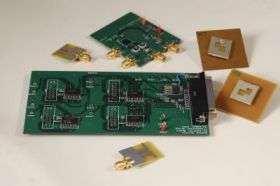
Components of the testbed Georgia Tech's Gregory Durgin developed to simultaneously measure hundreds of radio frequency identification RFID tags and rapidly test new RFID tag prototypes. Georgia Tech Photo: Gary Meek

Researchers have designed a system capable of simultaneously measuring hundreds of radio frequency identification (RFID) tags and rapidly testing new RFID tag prototypes.

“This testbed allows us to measure the signal strength of tags hidden behind other tags and to rapidly test unique antenna configurations and multiple antennas without actually constructing new tags for each experiment,” said Gregory Durgin, an assistant professor in the Georgia Institute of Technology’s School of Electrical and Computer Engineering.

The research, funded by the National Science Foundation and conducted with former graduate student Anil Rohatgi and current graduate student Joshua Griffin, was presented in April at the IEEE International Conference on RFID.

RFID tags are used for applications that include inventory management, package tracking, toll collection, passport identification and airport luggage security. Passive tags include an integrated circuit for storing and processing information, and an antenna that responds to radio waves transmitted from an RFID reader. The tag absorbs some of the radio frequency energy from the reader signal and reflects it back as a return signal delivering information from the tag’s memory, a technique called backscatter.

If several RFID tags are in the vicinity of a reader, the reader usually communicates with the tag transmitting the most powerful signal first and then puts it to ‘‘sleep’’ to prevent it from transmitting repeatedly. Then the reader moves to the next most powerful signal, and so on. This process can be very time-consuming.

“We designed a really inexpensive, simple anti-collision system that transmits multiple unique signals back to us simultaneously without this complicated back and forth process,” said Durgin.

The system includes three parts – a transmitter, receiver and emulator. The emulator simulates the activity of an integrated circuit. The transmitter sends a radio signal to the antenna. By attaching the emulator to an antenna, a unique spread spectrum signal is transmitted to the receiver.

Each antenna signal can then be separated from the others, allowing his team to simultaneously measure the signals from multiple tags. Their experiments have shown they can measure the power strength and phase of up to 256 antennas in the field of view, which is an area in front of the reader of approximately 20 feet by 20 feet.

“To test new signaling schemes and frequencies, we just have to change the emulator’s signal – we don’t have to fabricate a new chip that could cost $100,000 in a silicon foundry,” he added. “We can also evaluate multiple custom antennas in numerous configurations in realistic tag environments for only a fraction of the time and cost of previous methods.”

Testing multiple configurations is important because RFID readability and antenna power strength can be affected by the relative position and orientation of the tag antenna and the reader.

The researchers designed the testbed for measurements at 915 megahertz, a common ultra-high frequency for backscatter RFID applications. They are currently expanding the system to test antennas at higher frequencies – up to 5.7 gigahertz.

“At higher frequencies, even though the tag is physically stationary, you are electromagnetically lifting the antenna signal off the object and it starts to work better,” he said. “Plus, at higher frequencies, smaller antennas can be constructed, which means more antennas can be placed on a tag to produce more energy for communications.”

The tags usually require a reader to be within a foot of the chip, but operating at higher frequencies could greatly improve the range and reliability of the RFID tags, according to Durgin.

“This testbed is just the beginning of our ability to characterize the performance of different RFID tag antennas in a real channel and push these technologies to higher frequencies, longer read ranges and overall higher reliability,” he added.

Source: Georgia Institute of Technology

3.4 /5 (8 votes)  

Filter


Move the slider to adjust rank threshold, so that you can hide some of the comments.


Display comments: newest first

DGBEACH
May 06, 2008

Rank: not rated yet
These guys don't seem to have a clue as to what is already out there....check out a company named Mojix to see what point rfid has gotten to.

....and 5.7GHz is useless around metals and people...ergo just plain useless.

%u201CWe designed a really inexpensive, simple anti-collision system that transmits multiple unique signals back to us simultaneously without this complicated back and forth process,%u201D said Durgin.

That so-called "complicated back and forth process" is what makes the integrity of the system...can you say SECURITY?
There ARE bands of people out there who are quite tech savy, and who put alot of their time into defeating/sabotaging rfid systems out of a mindless belief that it infringes upon their privacy...and would vehemently defend the rights of even terrorists...I'm not one of those people.
Rank 3.4 /5 (8 votes)
Tags

Relevant PhysicsForums posts
  • How to tilt a object
    created8 hours ago
  • How to calculate total compressibility in liquid porous solid system
    created14 hours ago
  • Need help reading 3-D
    createdFeb 11, 2012
  • A way to send and receive wireless data
    createdFeb 11, 2012
  • Calling function with no input argument
    createdFeb 10, 2012
  • Force free body diagram problem on gym equipment
    createdFeb 10, 2012
  • More from Physics Forums - General Engineering

More news stories

AT&T customers surprised by 'unlimited data' limit

(AP) -- Mike Trang likes to use his iPhone 4 as a GPS device, helping him get around in his job. Now and then, his younger cousins get ahold of it, and play some YouTube videos and games.

Technology / Telecom

created 39 minutes ago | popularity 5 / 5 (1) | comments 0

Japan's Fukushima reactor may be reheating: operator

Temperature readings at one of the crippled Fukushima nuclear reactors have risen above Japan's stringent new safety standard but there was no immediate danger, its operator said Sunday.

Technology / Energy & Green Tech

created 1 hour ago | popularity 3 / 5 (2) | comments 0

Google might launch Drive for cloud storage soon

(PhysOrg.com) -- Google's next big move, according to the Wall Street Journal, is a cloud storage service called Drive. Hardly first to the plate, Google is simply catching up to introducing its cloud reposi ...

Technology / Internet

created 22 hours ago | popularity 4.2 / 5 (6) | comments 5 | with audio podcast report

Iran blocks email, restricts net access: reports

Iran has further restricted access to the Internet and blocked popular email services for the past few days, in a move a top lawmaker said could "cost the regime dearly," media reports said on Sunday.

Technology / Internet

created 15 hours ago | popularity 5 / 5 (3) | comments 5

Walney offshore wind farm is world's biggest (for now)

(PhysOrg.com) -- The Walney wind farm on the Irish Sea--characterized by high tides, waves and windy weather--officially opened this week. The farm is treated in the press as a very big deal as the Walney ...

Technology / Energy & Green Tech

created Feb 11, 2012 | popularity 4.1 / 5 (14) | comments 59 | with audio podcast weblog


Integrated pest management recommendations for the southern pine beetle

The southern pine beetle, Dendroctonus frontalis Zimmermann, is a chronic insect pest within pine forests in the southeastern United States. Under favorable environmental and host conditions, it is an agg ...

Cognitive impairment in older adults often unrecognized in the primary care setting

A new study published in the Journal of the American Geriatrics Society reveals that brief cognitive screenings combined with offering further evaluation increased new diagnoses of cognitive impairment in older veterans two to ...

Climate change causes harmful algal blooms in North Atlantic: study

Warming oceans and increases in windiness could be causing of an abundance of harmful algal blooms in the North Atlantic Ocean and North Sea, according to new research.

Many lung cancer patients get radiation therapy that may not prolong their lives

A new study has found that many older lung cancer patients get treatments that may not help them live longer. Published early online in CANCER, a peer-reviewed journal of the American Cancer Society, the findings suggest that p ...

Young adults allowed to stay on parents' health insurance have improved access to care

Researchers from Mount Sinai School of Medicine have found that laws permitting children to stay on their parents' health insurance through age 26 result in improved access to health care compared to states without those ...

Cancer rate 4 times higher in children with juvenile arthritis

New research reports that incident malignancy among children with juvenile idiopathic arthritis (JIA) is four times higher than in those without the disease. Findings now available in Arthritis & Rheumatism, a journal publis ...