Trouble in paradise: Warming a greater danger to tropical species
May 5, 2008
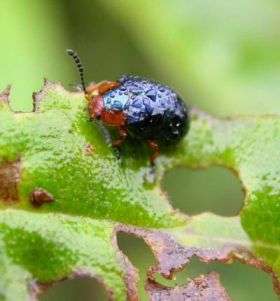
Leaf Beetle

This leaf beetle, which lives in the cloud forest on the east slope of the Andes Mountains in Ecuador, is from the family Chrysomelidae. Climate change could have a much bigger impact on such tropical species than scientists previously thought. Credit: Kimberly Sheldon, University of Washignton

Polar bears fighting for survival in the face of a rapid decline of polar ice have made the Arctic a poster child for the negative effects of climate change. But new research shows that species living in the tropics likely face the greatest peril in a warmer world.

A team led by University of Washington scientists has found that while temperature changes will be much more extreme at high latitudes, tropical species have a far greater risk of extinction with warming of just a degree or two. That is because they are used to living within a much smaller temperature range to begin with, and once temperatures get beyond that range many species might not be able to cope.

"There's a strong relationship between your physiology and the climate you live in," said Joshua Tewksbury, a UW assistant professor of biology. "In the tropics many species appear to be living at or near their thermal optimum, a temperature that lets them thrive. But once temperature gets above the thermal optimum, fitness levels most likely decline quickly and there may not be much they can do about it."

Arctic species, by contrast, might experience temperatures ranging from subzero to a comparatively balmy 60 degrees Fahrenheit. They typically live at temperatures well below their thermal limit, and most will continue to do so even with climate change.

"Many tropical species can only tolerate a narrow range of temperatures because the climate they experience is pretty constant throughout the year," said Curtis Deutsch, an assistant professor of atmospheric and oceanic sciences at the University of California, Los Angeles. "Our calculations show that they will be harmed by rising temperatures more than would species in cold climates.

"Unfortunately, the tropics also hold the large majority of species on the planet," he said.

Tewksbury and Deutsch are lead authors of a paper detailing the research, published in the May 6 print edition of the Proceedings of the National Academy of Sciences. The work took place while Deutsch was a UW postdoctoral researcher in oceanography.

The scientists used daily and monthly global temperature records from 1950 through 2000, and added climate model projections from the Intergovernmental Panel on Climate Change for warming in the first years of the 21st century. They compared that information with data describing the relationship between temperatures and fitness for a variety of temperate and tropical insect species, as well as frogs, lizards and turtles. Fitness levels were measured by examining population growth rates in combination with physical performance.

"The direct effects of climate change on the organisms we studied appear to depend a lot more on the organisms' flexibility than on the amount of warming predicted for where they live," Tewksbury said. "The tropical species in our data were mostly thermal specialists, meaning that their current climate is nearly ideal and any temperature increases will spell trouble for them."

As temperatures fluctuate, organisms do what they can to adapt. Polar bears, for example, develop thick coats to protect them during harsh winters. Tropical species might protect themselves by staying out of direct sunlight in the heat of the day, or by burrowing into the soil.

However, since they already live so close to their critical high temperature, just a slight increase in air temperature can make staying out of the sun a futile exercise, and the warming might come too fast for creatures to adapt their physiologies to it, Tewksbury said.

Other authors of the paper are Raymond Huey, Kimberly Sheldon, David Haak and Paul Martin of the University of Washington and Cameron Ghalambor of Colorado State University. The research was funded in part by the National Science Foundation and the UW Program on Climate Change.

The work has indirect implications for agriculture in the tropics, where the bulk of the world's human population lives. The scientists plan further research to examine the effects of climate change, particularly hotter temperatures, on tropical crops and the people who depend on them.

"Our research focused only on the impact of changes in temperature, but warming also will alter rainfall patterns," Deutsch said. "These effects could be more important for many tropical organisms, such as plants, but they are harder to predict because hydrological cycle changes are not as well understood."

Source: University of Washington

2.3 /5 (15 votes)  

Filter


Move the slider to adjust rank threshold, so that you can hide some of the comments.


Display comments: newest first

MikeB
May 05, 2008

Rank: 1.7 / 5 (3)
"might not", "appear to be", "most likely", "These effects could be more important for many tropical organisms, such as plants, but they are harder to predict because hydrological cycle changes are not as well understood."

Is this really science?
thinking
May 06, 2008

Rank: 5 / 5 (1)
Link everything to global warming and money flows your way...... global warming will cause gray hair...Global warming will cause 100 percent of all people alive today do die in the next 120 years..... Seriously, temperature has not risen in the last 10 years, and now according to the global warming religion, should not go up and perhaps will go down in the next ten years, but panic... global warming is real... and it will be bad... and man is the cause....
Captain_Sakonna
May 06, 2008

Rank: not rated yet
Mmm. What this article doesn't address is how difficult (or easy) it would be for these creatures to migrate to cooler places as the tropical zone expands.
Rank 2.3 /5 (15 votes)
Tags

Related Stories
Relevant PhysicsForums posts

More news stories

A mitosis mystery solved: How chromosomes align perfectly in a dividing cell

Although the process of mitotic cell division has been studied intensely for more than 50 years, Whitehead Institute researchers have only now solved the mystery of how cells correctly align their chromosomes during symmetric ...

Biology / Cell & Microbiology

created 13 hours ago | popularity 4.4 / 5 (20) | comments 0 | with audio podcast

Researchers find extensive RNA editing in human transcriptome

In a new study published online in Nature Biotechnology, researchers from BGI, the world's largest genomics organization, reported the evidence of extensive RNA editing in a human cell line by analysis of RNA-seq data, demons ...

Biology / Biotechnology

created 13 hours ago | popularity 5 / 5 (4) | comments 0 | with audio podcast

The proteins ensuring genome protection

Researchers from the University of Geneva (UNIGE), Switzerland, have discovered the crucial role of two proteins in developing a cell 'anti-enzyme shield'. This protection system, which operates at the level of molecular ...

Biology / Cell & Microbiology

created 13 hours ago | popularity 5 / 5 (3) | comments 0 | with audio podcast

Entire genome of extinct human decoded from fossil

(PhysOrg.com) -- In 2010, Svante Pääbo and his colleagues presented a draft version of the genome from a small fragment of a human finger bone discovered in Denisova Cave in southern Siberia. The ...

Biology / Biotechnology

created Feb 07, 2012 | popularity 4.7 / 5 (60) | comments 51 | with audio podcast

Why are there so few fish in the Earth's oceans?

(PhysOrg.com) -- A Stony Brook University researcher has found that, contrary to popular belief, there are not plenty of fish in the sea.

Biology / Plants & Animals

created Feb 08, 2012 | popularity 4.3 / 5 (19) | comments 27 | with audio podcast


Scientists discover molecular secrets of 2,000-year-old Chinese herbal remedy

For roughly two thousand years, Chinese herbalists have treated Malaria using a root extract, commonly known as Chang Shan, from a type of hydrangea that grows in Tibet and Nepal. More recent studies suggest that halofuginone, ...

New method to examine batteries -- MRI from the inside

There is an ever-increasing need for advanced batteries for portable electronics, such as phones, cameras, and music players, but also to power electric vehicles and to facilitate the distribution and storage of energy derived ...

Google might launch Drive for cloud storage soon

(PhysOrg.com) -- Google's next big move, according to the Wall Street Journal, is a cloud storage service called Drive. Hardly first to the plate, Google is simply catching up to introducing its cloud reposi ...

Lab study raises questions over nano-particle impact

Tests involving chickens have raised questions about the impact on health from engineered nano-particles, the ultra-fine grains commonly used in drugs and processed foods, scientists said on Sunday.

Starve a virus, feed a cure? Findings show how some cells protect themselves against HIV

A protein that protects some of our immune cells from the most common and virulent form of HIV works by starving the virus of the molecular building blocks that it needs to replicate, according to research published online ...

Iran blocks email, restricts net access: reports

Iran has further restricted access to the Internet and blocked popular email services for the past few days, in a move a top lawmaker said could "cost the regime dearly," media reports said on Sunday.