XMM-Newton discovers part of missing matter in the universe
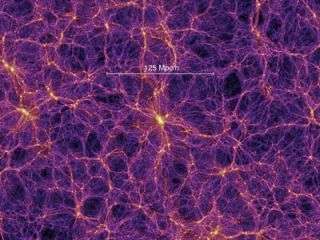
May 6, 2008 Cosmic Web

This is a model of the cosmic web. Clusters of galaxies are expected to develop at the intersections of the web. Credits: Springel et al., Virgo Consortium

ESA’s orbiting X-ray observatory XMM-Newton has been used by a team of international astronomers to uncover part of the missing matter in the universe.

10 years ago, scientists predicted that about half of the missing ‘ordinary’ or normal matter made of atoms exists in the form of low-density gas, filling vast spaces between galaxies.

All the matter in the universe is distributed in a web-like structure. At dense nodes of the cosmic web are clusters of galaxies, the largest objects in the universe. Astronomers suspected that the low-density gas permeates the filaments of the web.

The low density of the gas hampered many attempts to detect it in the past. With XMM-Newton’s high sensitivity, astronomers have discovered its hottest parts. The discovery will help them understand the evolution of the cosmic web.

Only about 5% of our universe is made of normal matter as we know it, consisting of protons and neutrons, or baryons, which along with electrons, form the building blocks of ordinary matter. The rest of our universe is composed of elusive dark matter (23%) and dark energy (72%).

Small as the percentage might be, half of the ordinary baryonic matter is unaccounted for. All the stars, galaxies and gas observable in the universe account for less than a half of all the baryons that should be around.

Scientists predicted that the gas would have a high temperature and so it would primarily emit low-energy X-rays. But its very low density made observation difficult.

Astronomers using XMM-Newton were observing a pair of galaxy clusters, Abell 222 and Abell 223, situated at a distance of 2300 million light-years from Earth, when the images and spectra of the system revealed a bridge of hot gas connecting the clusters.

"The hot gas that we see in this bridge or filament is probably the hottest and densest part of the diffuse gas in the cosmic web, believed to constitute about half the baryonic matter in the universe," says Norbert Werner from SRON Netherlands Institute for Space Research, leader of the team reporting the discovery.

“The discovery of the warmest of the missing baryons is important. That’s because various models exist and they all predict that the missing baryons are some form of warm gas, but the models tend to disagree about the extremes,” adds Alexis Finoguenov, a team member.

Even with XMM-Newton’s sensitivity, the discovery was only possible because the filament is along the line of sight, concentrating the emission from the entire filament in a small region of the sky. The discovery of this hot gas will help better understand the evolution of the cosmic web.

"This is only the beginning. To understand the distribution of the matter within the cosmic web, we have to see more systems like this one. And ultimately launch a dedicated space observatory to observe the cosmic web with a much higher sensitivity than possible with current missions. Our result allows to set up reliable requirements for those new missions." concludes Norbert Werner.

ESA’s XMM-Newton Project Scientist, Norbert Schartel, comments on the discovery, “This important breakthrough is great news for the mission. The gas has been detected after hard work and more importantly, we now know where to look for it. I expect many follow-up studies with XMM-Newton in the future targeting such highly promising regions in the sky.”

Source: ESA


print this article email this article download pdf blog this article bookmark this article     Stumble it Digg this share on Facebook retweet share on Reddit add to delicious
Rate this story - 4.6 /5 (72 votes)

Rank Filter

Move the slider to adjust rank threshold, so that you can hide some of the comments.


Display comments: newest first

  • zevkirsh - May 07, 2008
    • Rank: 4 / 5 (1)
    science fiction: if it is possible for us to invent a perfect black body that emits no radiation....is it possible that some alien civilization is inside a giant black body in deep space that we simply cannot see?
  • Sean_W - May 07, 2008
    • Rank: not rated yet
    There are probably several ways to remain hidden but emitting no radiation would not be optimal. You would not want to be blocking the radiation coming from behind you.
  • vidyunmaya - May 08, 2008
    • Rank: 1 / 5 (1)
    Search from Heart of The Universe (Centre of the Universe) for Cosmology Definition will help Science to advance
    COSMOLOGY DEFINITION:
    Cosmology is a borderland between science and Philosophy
    Cosmology deals with Multi-Universe concepts and the Universe as part of Cosmos.
    Cosmology details Creation, stability and dissolution of the Universe or parts thereof.
    Cosmology covers broad Prime drive functions and links :
    COSMOLOGY FROM PHILOSOPHY TO VEDAS
    1. Cosmology in Vedas 2.Cosmology in Philosophy 3.Science of Philosophy
    4. Basic Philosophy
    FROM SCIENCE TO COSMOLOGY
    1. Basic Science 2. Philosophy of Science 3.Cosmogony-Astrophysics
    4. Cosmology -Present Day under Revision
    NATURE TO COSMIC DIVINE
    1.Nature 2.Divine Function in Nature 3. Divine Universe 4.Cosmos Divine

    Key Words: Cosmology Definition, Cosmology Primer, Cosmology Drive,
    Cosmology Science, cosmology Vedas, Cosmology Philosophy, Cosmology Nature,
    Cosmic Divine Function, Cosmology interlinks, Cosmology Space Science,
    Cosmology Knowledge Base, Knowledge Expansion, creation in the Universe,
    Stability of the Universe , Dissolution of the part of the Universe
    Ref:COSMIC YOGA VISION SERIES-II: Centre of the Universe
    Heart of the Universe-Nov 2006 -Book By Vidyardhi Nanduri
    Copy Rights TXU 1-364-245 -
    The Science in Philosophy- Pridhvi Viswam Asya Dharineem Cosmos yoga vision series-II-
    cover upto 10^5 Light Years %u2014Vidyardhi Nanduri

May 6, 2008 all stories

Comments: 3

4.6 /5 (72 votes)
  • Stumble this up

  • Digg this

  • share this

  • hide
  • Related Stories


  • hide
  • Relevant PhysicsForums posts

  • Sideral question
    created 11 hours ago
  • Doppler shifted blackbody spectrum
    created 14 hours ago
  • Earth v. Moon
    created 16 hours ago
  • help me with coordinates and orbits
    created 16 hours ago
  • More from Physics Forums - General Astronomy

Other News

Astronauts finish another spacewalk, still no baby (AP)

Astronauts finish another spacewalk, still no baby

Space & Earth / Space Exploration

created 3 hours ago | popularity 5 / 5 (1) | comments 0

(AP) -- A spacewalking astronaut put aside the impending birth of his daughter and blazed through his first-ever venture outside the International Space Station on Saturday.


Unseasonably hot and dry weather combined with strong winds to fan scores of blazes in the country's southeastern states

Australia issues 'catastrophic' alerts as fires rage

Space & Earth / Environment

created 9 hours ago | popularity 4 / 5 (1) | comments 0

Australia has issued "catastrophic" alerts after record-breaking temperatures and wild lightning storms sparked more than 100 fires across the country, officials said Saturday.


Commuters wait on the platform shrouded by fog in London

Climate change not man-made, say majority of Britons: poll

Space & Earth / Environment

created Nov 15, 2009 | popularity 3.3 / 5 (15) | comments 45

Less than half of Britons believes that human activity is to blame for global warming, according to a poll carried out for The Times newspaper and published on Saturday.


Mysteriously warm times in Antarctica

Mysteriously warm times in Antarctica

Space & Earth / Earth Sciences

created Nov 18, 2009 | popularity 4.2 / 5 (21) | comments 28

(PhysOrg.com) -- A new study of Antarctica's past climate reveals that temperatures during the warm periods between ice ages (interglacials) may have been higher than previously thought. The latest analysis ...


UN: Fight climate change with free condoms (AP)

UN: Fight climate change with free condoms

Space & Earth / Environment

created Nov 18, 2009 | popularity 3.1 / 5 (11) | comments 22

(AP) -- The battle against global warming could be helped if the world slowed population growth by making free condoms and family planning advice more widely available, the U.N. Population Fund said Wednesday.