'Crispy noodle' chemistry could reduce carbon emissions
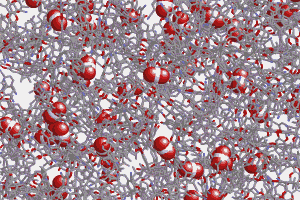
A new material developed in Manchester, which has a structure that resembles crispy noodles, could help reduce the amount of carbon dioxide being pumped out and drive the next generation of high-performance hydrogen cars.
Dr Peter Budd, a materials chemist working in the Organic Materials Innovation Centre (OMIC) at The University of Manchester, has won £150,000 worth of new funding to explore the use of a special polymer to effectively remove CO2 as it’s belched from fossil fuel power stations or hydrogen production plants.
The 18 month study, which is funded by the Engineering and Physical Sciences Research Council (EPSRC), will look at the feasibility of using catalytic membrane systems to capture and recover carbon dioxide.
Dr Budd proposes to explore the potential of composite membranes made from a ‘polymer of intrinsic microporosity’, or PIM, and a synthetic catalyst.
He even hopes to make progress towards creating a unique and highly efficient double membrane system that can be used for both CO2 removal and CO2 recovery.
This latest project expands on exciting work by Dr Budd, Professor Neil McKeown at Cardiff University and David Book at the University of Birmingham, which is aiming to use PIMs to store large amounts of hydrogen. This works could bring about the attractive possibility of safe hydrogen storage with an energy efficient release for consumption.
Polymers have not previously been investigated as materials for the storage of hydrogen because most polymers have enough conformational and rotational freedom to pack space efficiently and are therefore not microporous.
But the polymers developed by Dr Budd and colleagues do possess significant microporosity – and preliminary hydrogen sorption results are encouraging, with significant quantities adsorbed. Most importantly, the chemical composition of PIMs can be tailored via synthetic chemistry.
Dr Budd said: “The PIMs act a bit like a sponge when hydrogen is around. It's made up of long molecules that can trap hydrogen between them, providing a way of supplying hydrogen on demand.
“Imagine a plate of spaghetti - when it's all coiled together there's not much space between the strands. Now imagine a plate of crispy noodles - their rigid twisted shape means there are lots of holes.
“The polymer is designed to have a rigid backbone, and it has twists and bends built into it. Because of this, lots of gaps and holes are created between molecules - perfect for tucking the hydrogen into.
“The holes between the molecules give the polymer a very high surface area - each gram has a surface area equivalent to around three tennis courts. The molecules in the polymer act like sieves, catching smaller molecules like hydrogen in the gaps between them.
“The holes created in the polymer between molecules are a good fit for hydrogen. Hydrogen molecules stick in these holes and are kept there by weak forces - this means they can be released when they are needed.
“Hydrogen is most sticky when it is cooled down to low temperatures. When the hydrogen is needed to power the car, the system would just raise the temperature to free up the hydrogen molecules.”
PIMs were created at The University of Manchester several years ago by Dr Budd and colleagues.
Dr Budd says he is encouraged by the progress being made, but warns that a lot of work still needs to be done.
“In the context of climate change and dwindling oil reserves, hydrogen could be the perfect zero-carbon fuel for a car as it only gives water as a by-product," he adds.
At the moment, the polymer Dr Budd and key collaborators at The University of Birmingham and Cardiff University have developed can store about three per cent of its weight as hydrogen, but they hope to double this in the future.
“If we could get that figure up to six per cent hydrogen, that may be enough for a car to go around 300 miles without a refill,” says Dr Budd.
Although hydrogen-powered cars are now available commercially, they don’t yet perform as well as vehicles that burn conventional fossil fuels.
The greatest obstacle to the development of high performance hydrogen-powered cars remains the lack of a system for safe, efficient and convenient on-board storage of hydrogen.
Source: University of Manchester


