Rocky Mesas of Nilosyrtis Mensae, Mars
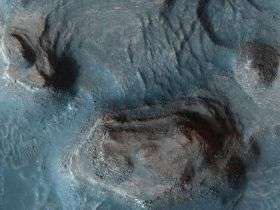
May 6, 2008 Rocky Mesas of Nilosyrtis Mensae, Mars

Credit: NASA/JPL-Caltech/Univ. of Arizona

Mesas in the Nilosyrtis Mensae region of Mars appear in enhanced color in this image from the High Resolution Imaging Science Experiment (HiRISE) camera on NASA's Mars Reconnaissance Orbiter (MRO).

The image, taken on April 5, 2007, is part of a campaign to examine more than two dozen candidate landing sites for the NASA Mars Science Laboratory rover, which is scheduled for launch in 2009.

This image shows a region of scientific interest to which the Mars Science Laboratory rover might drive. The rover would need to first land in a nearby area that is flatter and less rocky. Clay minerals have been detected in this region by imaging spectrometers on the European Space Agency's Mars Express orbiter and on MRO.

These minerals are of great interest in the search for evidence of life on ancient Mars. Someday the capability may exist for precision landing and hazard avoidance, so a rover could be set down right next to such rugged outcrops of interest for study and perhaps for collection of rock samples for return to Earth.

Source: NASA


print this article email this article download pdf blog this article bookmark this article     Stumble it Digg this share on Facebook retweet share on Reddit add to delicious
Rate this story - 3.3 /5 (7 votes)


May 6, 2008 all stories

Comments: 0

3.3 /5 (7 votes)
  • Stumble this up

  • Digg this

  • share this

  • hide
  • Related Stories

  • Robot Armada Might Scale New Worlds
    created Oct 28, 2009 | popularity not rated yet | comments 0
  • Image: Spirit's View From 'Troy'
    created Aug 18, 2009 | popularity not rated yet | comments 0
  • Meteorite Found on Mars Yields Clues About Planet's Past
    created Aug 10, 2009 | popularity not rated yet | comments 0
  • Rover Confirms Meteorite on Mars
    created Aug 06, 2009 | popularity not rated yet | comments 0
  • Mars Dust Devil Has Colorful Effect in Image Series
    created Jul 14, 2009 | popularity not rated yet | comments 0


  • hide
  • Relevant PhysicsForums posts

  • Consistency of Meteor Shower Dates (i.e. the peak of Perseids always on Aug 13th)
    created 8 hours ago
  • Favourite Astronomy Book?
    created 23 hours ago
  • dark energy
    created 23 hours ago
  • The shape of our solar system's orbits.
    created Nov 07, 2009
  • More from Physics Forums - General Astronomy

Other News

Rapid star formation spotted in 'stellar nurseries' of infant galaxies

Rapid star formation spotted in 'stellar nurseries' of infant galaxies

Space & Earth / Astronomy

created 12 minutes ago | popularity not rated yet | comments 0

The Universe's infant galaxies enjoyed rapid growth spurts forming stars like our sun at a rate of up to 50 stars a year, according to scientists at Durham University.


Controversial new climate change results

Controversial new climate change results

Space & Earth / Environment

created 21 hours ago | popularity 4.4 / 5 (21) | comments 21

(PhysOrg.com) -- New data show that the balance between the airborne and the absorbed fraction of CO2 has stayed approximately constant since 1850, despite emissions of CO2 having risen from about 2 billion ...


Earth

Atomic Particles Help Solve Planetary Puzzle

Space & Earth / Earth Sciences

created 11 hours ago | popularity 4.7 / 5 (7) | comments 0

(PhysOrg.com) -- A University of Arkansas professor and his colleagues have shown that the Earth's mantle contains the same isotopic signatures from magnesium as meteorites do, suggesting that the planet formed ...


The Stars My Destination

The Stars My Destination

Space & Earth / Space Exploration

created 12 hours ago | popularity 5 / 5 (14) | comments 0

The Voyager spacecraft are now in the outermost layer of the heliosphere, traveling toward interstellar space - the first man-made spacecraft to travel such a vast distance from Earth.


The 2009 Leonid Meteor Shower

The 2009 Leonid Meteor Shower

Space & Earth / Space Exploration

created 12 hours ago | popularity 5 / 5 (2) | comments 0

This year's Leonid meteor shower peaks on Tuesday, Nov. 17th. If forecasters are correct, the shower should produce a mild but pretty sprinkling of meteors over North America followed by a more intense outburst ...