Researchers target tumors with tiny 'nanoworms'
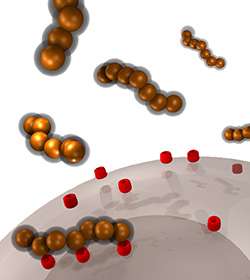
Scientists at UC San Diego, UC Santa Barbara and MIT have developed nanometer-sized “nanoworms” that can cruise through the bloodstream without significant interference from the body’s immune defense system and—like tiny anti-cancer missiles—home in on tumors.
Their discovery, detailed in this week’s issue of the journal Advanced Materials, is reminiscent of the 1966 science fiction movie, the Fantastic Voyage, in which a submarine is shrunken to microscopic dimensions, then injected into the bloodstream to remove a blood clot from a diplomat’s brain.
Using nanoworms, doctors should eventually be able to target and reveal the location of developing tumors that are too small to detect by conventional methods. Carrying payloads targeted to specific features on tumors, these microscopic vehicles could also one day provide the means to more effectively deliver toxic anti-cancer drugs to these tumors in high concentrations without negatively impacting other parts of the body.
“Most nanoparticles are recognized by the body's protective mechanisms, which capture and remove them from the bloodstream within a few minutes,” said Michael Sailor, a professor of chemistry and biochemistry at UC San Diego who headed the research team. “The reason these worms work so well is due to a combination of their shape and to a polymer coating on their surfaces that allows the nanoworms to evade these natural elimination processes. As a result, our nanoworms can circulate in the body of a mouse for many hours.”
“When attached to drugs, these nanoworms could offer physicians the ability to increase the efficacy of drugs by allowing them to deliver them directly to the tumors,” said Sangeeta Bhatia, a physician, bioengineer and a professor of Health Sciences and Technology at MIT who was part of the team. “They could decrease the side effects of toxic anti-cancer drugs by limiting their exposure of normal tissues and provide a better diagnosis of tumors and abnormal lymph nodes.”
The scientists constructed their nanoworms from spherical iron oxide nanoparticles that join together, like segments of an earthworm, to produce tiny gummy worm-like structures about 30 nanometers long—or about 3 million times smaller than an earthworm. Their iron-oxide composition allows the nanoworms to show up brightly in diagnostic devices, specifically the MRI, or magnetic resonance imaging, machines that are used to find tumors.
“The iron oxide used in the nanoworms has a property of superparamagnetism, which makes them show up very brightly in MRI,” said Sailor. “The magnetism of the individual iron oxide segments, typically eight per nanoworm, combine to provide a much larger signal than can be observed if the segments are separated. This translates to a better ability to see smaller tumors, hopefully enabling physicians to make their diagnosis of cancer at earlier stages of development.”
In addition to the polymer coating, which is derived from the biopolymer dextran, the scientists coated their nanoworms with a tumor-specific targeting molecule, a peptide called F3, developed in the laboratory of Erkki Ruoslahti, a cell biologist and professor at the Burnham Institute for Medical Research at UC Santa Barbara. This peptide allows the nanoworms to target and home in on tumors.
“Because of its elongated shape, the nanoworm can carry many F3 molecules that can simultaneously bind to the tumor surface,” said Sailor. “And this cooperative effect significantly improves the ability of the nanoworm to attach to a tumor.”
The scientists were able to verify in their experiments that their nanoworms homed in on tumor sites by injecting them into the bloodstream of mice with tumors and following the aggregation of the nanoworms on the tumors. They found that the nanoworms, unlike the spherical nanoparticles of similar size that were shuttled out of the blood by the immune system, remained in the bloodstream for hours.
“This is an important property because the longer these nanoworms can stay in the bloodstream, the more chances they have to hit their targets, the tumors,” said Ji-Ho Park, a UC San Diego graduate student in materials science and engineering working in Sailor’s laboratory.
Park was the motivating force behind the discovery when he found by accident that the gummy worm aggregates of nanoparticles stayed for hours in the bloodstream despite their relatively large size.
While it’s not clear yet to the researchers why, Park notes that “the nanoworm’s flexibly moving, one dimensional structure may be one the reasons for its long life in the bloodstream.”
The researchers are now working on developing ways to attach drugs to the nanoworms and chemically treating their exteriors with specific chemical “zip codes,” that will allow them to be delivered to specific tumors, organs and other sites in the body.
“We are now using nanoworms to construct the next generation of smart tumor-targeting nanodevices,” said Ruoslahti. We hope that these devices will improve the diagnostic imaging of cancer and allow pinpoint targeting of treatments into cancerous tumors.”
Source: University of California - San Diego


