Large mammal species live harder, die out faster
May 7th, 2008 By Lisa Zyga Large mammal species live harder, die out faster

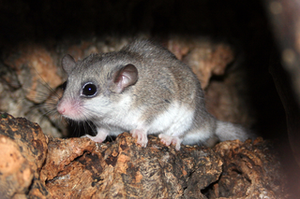
Researchers have discovered that small mammals, such as those similar to this dormouse, tend to survive longer as a species, while larger mammals tend to die out and/or evolve faster. Image: H. Osadnik.

Throughout Earth’s history, species have come and gone, being replaced by new ones that are better able to cope with life’s challenges. But some species last longer than others, while others may die out sooner or evolve more quickly.

Recently, a team of researchers from Finland, Norway and the US has found that larger mammals seem to evolve more quickly than smaller ones – but the reason isn’t body size, per se. Rather, the scientists found that some smaller mammals have the ability to hibernate, burrow or hide in other shelters. In doing so, they effectively sleep through harsh environmental changes.

Larger mammals, on the other hand, must endure the hard times when there’s little food or extreme weather. Their large size constrains them from digging burrows or lowering their metabolic rates for extended time periods. In a sense, larger mammals face the elements head-on like a fearless adventurer who might not make it through alive, and is forever changed by the experience.

The finding – which is based on analysis of a large Neogene Old World fossil dataset – is somewhat surprising. On an individual level, large mammals tend to live significantly longer than smaller ones. For example, elephants can live up to 70 years, while shrews are lucky to reach two. Because of their faster generation times, small mammals should evolve faster, and small mammal species and genera should appear and go extinct faster – but this is not the case.

“We believe the greatest significance of our work is showing that, contrary to expectation, small mammals do not evolve faster than large mammals, and that some of them actually evolve much slower,” Nils Stenseth, zoology professor at the University of Oslo, told PhysOrg.com. “The greatest potential significance is in the SLOH [sleep-or-hide] hypothesis – specifically in its implication that removing part of the environmental pressure slows down evolution quite dramatically.”

Previous studies – some focusing on tropical mammals – have had mixed results on size-based evolution rates for fossil mammals, with some finding the opposite pattern and some finding no difference. One possible explanation is that large mammals in tropical climates don’t face such harsh environmental conditions, and so they may last longer and evolve more slowly. Further, smaller mammals in tropical areas may suffer from the increased competition, leading to more rapid turnover rates for them.

But overall, small mammals’ ability to hibernate or enter a state of torpor seems to give them the largest benefit for prolonging their species duration. As the researchers found, 41 of 67 (61 percent) extinct small mammal genera had some kind of hibernation ability, while only 15 of 50 (30 percent) extinct large mammal genera did. And the small mammals that didn’t hibernate had relatively faster evolution rates, as they were forced to cope with the elements.

The longest living genera in the study were a mole, two gliding squirrels, and two dormice, which lasted about 16 million years, and all had the ability to burrow or hibernate. The tapir was the only large mammal that evolved at a slow rate more akin to the smaller mammals. Most large mammals that didn’t hibernate evolved into a new species or went extinct in just a few million years.

The shortest duration in the researchers’ data was one million years. However, Stenseth noted that the truly short-lived creatures are invisible in the fossil record. He also explained that short-lived and long-lived mammals both have their own advantages and disadvantages.

“The most diverse and abundant groups, such as the mouse-like (muroid) rodents, have high origination and extinction rates,” he said. “But slow evolvers like dormice are successful in their own way, and clearly very good at what they are doing.”

In light of the current climate crisis, this study may help scientists predict which kinds of species are more vulnerable to climatic fluctuations, the authors explain.

“There has been a steady loss of large mammals in recent times, and this trend is likely to continue,” said Mikael Fortelius, geology professor at the University of Helsinki and a co-author of the paper. “We are currently extending our PNAS study to include living mammals and hope to be able to present our results soon.”

More information: Liow, Lee Hsiang;, Fortelius, Mikael; Bingham, Ella; Lintulaakso, Kari; Mannila, Heikki; Flynn, Larry; and Stenseth, Nils Chr. “Higher origination and extinction rates in larger mammals.” Proceedings of the National Academy of Sciences. April 22, 2008, vol. 105, no. 16, 6097-6102.

Copyright 2008 PhysOrg.com.
All rights reserved. This material may not be published, broadcast, rewritten or redistributed in whole or part without the express written permission of PhysOrg.com.


print this article email this article download pdf blog this article bookmark this article     Digg this Stumble it share on Facebook share on Reddit add to delicious save to Yahoo! bookmarks
4.4/5 after 27 votes

Rank Filter

Move the slider to adjust rank threshold, so that you can hide some of the comments.


Display comments: newest first

  • Pogsquog - May 08, 2008
    • Rank: 4 / 5 (1)
    The explanation given in this article doesn't seem to stand up to scrutiny.

    Large mammals have smaller populations, which tend to be geographically less well distributed; and have low population density and birth rates. Increased size is also associated with increased specialization. All of these factors promote both faster evolution and higher risk of extinction.

    I suspect there is also a selection bias; it is easier to find extinct large species than it is to find extinct small ones; it's rather easier to tell the difference between extinct species of big cats than it is to tell the difference between extinct species of rats.

    Hibernation is also less common amongst large animals, because they can easily maintain their body heat and so remain active during cold conditions (so long as there is food available); small animals find it harder to stay warm, and hence it is more beneficial for them to hibernate.

    Besides, the results of the study could equally indicate that hibernation makes a species more likely to become extinct, rather than less.

    Cold conditions are more stable than warm ones - it is always cold and wet in the arctic, but it's not necessarily always wet on the equator.
  • El_Machinae - May 08, 2008
    • Rank: 4 / 5 (1)
    It could also be explained by fewer successful divergences among smaller animals. I'm having a bit of trouble wrapping my head around this: small animals should be able to exploit and adapt to new environments more quickly (due to their faster generation time). Maybe small animals experience quantitatively less environmental change? (e.g., it's all the same when you burrow).
  • MikeMarianiMD,FAAP - May 08, 2008
    • Rank: not rated yet
    The posting by Pogsquog is distinctly superior to the text of the article. Several remarks in the article contradict my biological understanding, though Pogsquog is right on in every regard!

May 7th, 2008 all stories
Biology /

Comments: 3
Rank: 4.4/5 after 27 votes

  • Stumble this up

  • Digg this

  • Share it:
  • share on Facebook
  • share on MySpace
  • share on Slashdot
  • rss-newsfeed
  • share on Google
  • share on Reddit
  • add to delicious
  • save to Yahoo! bookmarks
  • share on Windows Live
  • Add to Mixx!
Rating: 4.4/5 after 27 votes

  • Related Stories

  • 54-million-year-old skull reveals early evolution of primate brains
    created Jun 22, 2009 | popularity not rated yet | comments 0
  • 'Pelvis Has Left the Building'
    created Jun 04, 2009 | popularity not rated yet | comments 0
  • New insight into primate eye evolution
    created May 18, 2009 | popularity not rated yet | comments 0
  • A venomous tale: Vipers shape lizards' tail-shedding abilities
    created Mar 25, 2009 | popularity not rated yet | comments 0
  • Preserved shark fossil adds evidence to great white's origins
    created Mar 12, 2009 | popularity not rated yet | comments 0

Tags


  • Physicists Demonstrate Quantum Memory with Matter Qubits
    Physicists Demonstrate Quantum Memory with Matter Qubits
    Physics / General Physics
    created Jul 03, 2009 | popularity 4.4 / 5 (17) | comments 1
  • 'Holey' Nanosheets for Wastewater Dye Removal
    Nanotechnology / Nanomaterials
    created Jul 01, 2009 | popularity 5 / 5 (5) | comments 1
  • Jellyfish Robot Swims Like its Biological Counterpart
    Jellyfish Robot Swims Like its Biological Counterpart
    Electronics / Robotics
    created Jun 26, 2009 | popularity 4.4 / 5 (8) | comments 1
  • Could Maxwell's Demon Exist in Nanoscale Systems?
    Could Maxwell's Demon Exist in Nanoscale Systems?
    Physics / General Physics
    created Jun 24, 2009 | popularity 4.4 / 5 (18) | comments 29
  • Living Safely with Robots, Beyond Asimov's Laws
    Living Safely with Robots, Beyond Asimov's Laws
    Electronics / Robotics
    created Jun 22, 2009 | popularity 4.6 / 5 (52) | comments 40
  • Other News

    Researchers uncover the potential for super-sized abalone

    Biology / Microbiology

    created 4 minutes ago | popularity not rated yet | comments 0

    (PhysOrg.com) -- Designer abalone could be an option in the foreseeable future, thanks to a project conducted at UQ's Heron Island Research Station and the St Lucia campus.


    California water plan aims to save Puget Sound orcas

    Biology / Ecology

    created 16 hours ago | popularity not rated yet | comments 0

    A plan to restore salmon runs on California's Sacramento River also could help revive killer whale populations 700 miles to the north in Puget Sound, as federal scientists struggle to protect endangered species in a complex ...


    Scientists 'rebuild' giant moa using ancient DNA

    Biology / Plants & Animals

    created Jul 01, 2009 | popularity 5 / 5 (10) | comments 12

    (PhysOrg.com) -- Scientists have performed the first DNA-based reconstruction of the giant extinct moa bird, using prehistoric feathers recovered from caves and rock shelters in New Zealand.


    Pacific Giant Salamander (Dicamptodon tenebrosus)

    Salamanders, regenerative wonders, heal like mammals, people

    Biology / Microbiology

    created Jul 01, 2009 | popularity 5 / 5 (20) | comments 11

    The salamander is a superhero of regeneration, able to replace lost limbs, damaged lungs, sliced spinal cord -- even bits of lopped-off brain. But it turns out that remarkable ability isn't so mysterious after ...


    Genetically modified trees

    Anti-biotech groups obstruct forest biotechnology

    Biology / Biotechnology

    created Jun 30, 2009 | popularity 3.7 / 5 (7) | comments 5

    The potential of forest biotechnology to help address significant social and environmental issues is being "strangled at birth" by the rigid opposition of some groups and regulations that effectively preclude ...