Platypus genome explains animal's peculiar features; holds clues to evolution of mammals
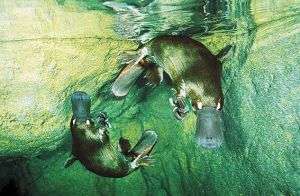
The duck-billed platypus: part bird, part reptile, part mammal -- and the genome to prove it. An international consortium of scientists, led by Washington University School of Medicine in St. Louis, has decoded the genome of the platypus, showing that the animal's peculiar mix of features is reflected in its DNA. An analysis of the genome, published today in the journal Nature, can help scientists piece together a more complete picture of the evolution of all mammals, including humans.
The platypus, classified as a mammal because it produces milk and is covered in a coat of fur, also possesses features of reptiles, birds and their common ancestors, along with some curious attributes of its own. One of only two mammals that lays eggs, the platypus also sports a duck-like bill that holds a sophisticated electrosensory system used to forage for food underwater. Males possess hind leg spurs that can deliver pain-inducing venom to its foes competing for a mate or territory during the breeding season.
"The fascinating mix of features in the platypus genome provides many clues to the function and evolution of all mammalian genomes," says Richard K. Wilson, Ph.D., director of the The Genome Center at Washington University and the paper's senior author. "By comparing the platypus genome to other mammalian genomes, we'll be able to study genes that have been conserved throughout evolution."
The platypus represents the earliest offshoot of the mammalian lineage some 166 million years ago from primitive ancestors that had features of both mammals and reptiles. "What is unique about the platypus is that it has retained a large overlap between two very different classifications, while later mammals lost the features of reptiles," says Wes Warren, Ph.D., an assistant professor of genetics, who led the project.
Comparison of the platypus genome with the DNA of humans and other mammals, which diverged later, and the genomes of birds, whose ancestors branched off an estimated 315 million years ago, can help scientists fill gaps in their understanding of mammalian evolution. The comparison also will allow scientists to date the emergence of genes and traits specific to mammals.
The Nature paper analyzes the genome sequence of a female platypus named Glennie from New South Wales, Australia. The project was largely funded by the National Human Genome Research Institute, part of the National Institutes of Health, and includes scientists from the United States, Australia, England, Germany, Israel, Japan, New Zealand and Spain.
"At first glance, the platypus appears as if it was the result of an evolutionary accident," says Francis S. Collins, M.D., Ph.D., director of NHGRI. "But as weird as this animal looks, its genome sequence is priceless for understanding how mammalian biological processes evolved."
"While we've always been able to compare and consider all of these creatures on the basis of their physical characteristics, internal anatomy and behavior, it's truly amazing to be able to compare their genetic blueprints and begin to get a close-up look at how evolution brings about change," Wilson says.
As part of their analysis, the researchers compared the platypus genome with genomes of the human, mouse, dog, opossum and chicken. They found that the platypus shares 82 percent of its genes with these animals. The chicken genome was chosen because it represents a group of egg-laying animals, including extinct reptiles, which passed on much of their DNA to the platypus and other mammals over the course of evolution.
The researchers also found genes that support egg laying - a feature of reptiles - as well as lactation - a characteristic of all mammals. Interestingly, the platypus lack nipples, so its young nurse through the abdominal skin.
The researchers also attempted to determine which characteristics of the platypus were linked to reptiles at the DNA level. When they analyzed the genetic sequences responsible for venom production in the male platypus, they found it arose from duplications in a group of genes that evolved from ancestral reptile genomes. Amazingly, duplications in the same genes appear to have evolved independently in venomous reptiles.
The platypus swims with its eyes, ears and nostrils closed, relying on electrosensory receptors in its bill to detect faint electric fields emitted by underwater prey. Surprisingly, the researchers found the genome contains an expansion of genes that code for a particular type of odor receptor. "We were expecting very few of these odor receptor genes because the animals spend the majority of their life in the water," Warren says.
Similar genes are found in animals that rely on a sense of smell, such as rodents and dogs, and the scientists suspect that their addition in the platypus allows the animals to detect odors while foraging underwater.
At roughly 2.2 billion base pairs, the platypus genome is about two-thirds the size of the human genome and contains about 18,500 genes, similar to other vertebrates. The animal has 52 chromosomes, including an unusual number of sex chromosomes: 10. The platypus X chromosome bears resemblance to the sex chromosome of a bird, known as Z.
Sequencing and assembling the platypus genome proved far more daunting than sequencing any other mammalian genome to date. About 50 percent of the genome is composed of repetitive elements of DNA, which makes it a challenge to assemble properly.
Citation: Warren WC, Mardis ER, Wilson RK, et al. Genome analysis of the platypus reveals unique signatures of evolution. Nature. May 8, 2008.
Source: Washington University


