A Super Solar Flare
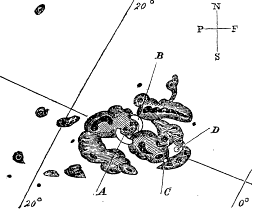
At 11:18 AM on the cloudless morning of Thursday, September 1, 1859, 33-year-old Richard Carrington—widely acknowledged to be one of England's foremost solar astronomers—was in his well-appointed private observatory. Just as usual on every sunny day, his telescope was projecting an 11-inch-wide image of the sun on a screen, and Carrington skillfully drew the sunspots he saw.
On that morning, he was capturing the likeness of an enormous group of sunspots. Suddenly, before his eyes, two brilliant beads of blinding white light appeared over the sunspots, intensified rapidly, and became kidney-shaped. Realizing that he was witnessing something unprecedented and "being somewhat flurried by the surprise," Carrington later wrote, "I hastily ran to call someone to witness the exhibition with me. On returning within 60 seconds, I was mortified to find that it was already much changed and enfeebled." He and his witness watched the white spots contract to mere pinpoints and disappear.
It was 11:23 AM. Only five minutes had passed.
Just before dawn the next day, skies all over planet Earth erupted in red, green, and purple auroras so brilliant that newspapers could be read as easily as in daylight. Indeed, stunning auroras pulsated even at near tropical latitudes over Cuba, the Bahamas, Jamaica, El Salvador, and Hawaii.
Even more disconcerting, telegraph systems worldwide went haywire. Spark discharges shocked telegraph operators and set the telegraph paper on fire. Even when telegraphers disconnected the batteries powering the lines, aurora-induced electric currents in the wires still allowed messages to be transmitted.
"What Carrington saw was a white-light solar flare—a magnetic explosion on the sun," explains David Hathaway, solar physics team lead at NASA's Marshall Space Flight Center in Huntsville, Alabama.
Now we know that solar flares happen frequently, especially during solar sunspot maximum. Most betray their existence by releasing X-rays (recorded by X-ray telescopes in space) and radio noise (recorded by radio telescopes in space and on Earth). In Carrington's day, however, there were no X-ray satellites or radio telescopes. No one knew flares existed until that September morning when one super-flare produced enough light to rival the brightness of the sun itself.
"It's rare that one can actually see the brightening of the solar surface," says Hathaway. "It takes a lot of energy to heat up the surface of the sun!"
The explosion produced not only a surge of visible light but also a mammoth cloud of charged particles and detached magnetic loops—a "CME"—and hurled that cloud directly toward Earth. The next morning when the CME arrived, it crashed into Earth's magnetic field, causing the global bubble of magnetism that surrounds our planet to shake and quiver. Researchers call this a "geomagnetic storm." Rapidly moving fields induced enormous electric currents that surged through telegraph lines and disrupted communications.
"More than 35 years ago, I began drawing the attention of the space physics community to the 1859 flare and its impact on telecommunications," says Louis J. Lanzerotti, retired Distinguished Member of Technical Staff at Bell Laboratories and current editor of the journal Space Weather. He became aware of the effects of solar geomagnetic storms on terrestrial communications when a huge solar flare on August 4, 1972, knocked out long-distance telephone communication across Illinois. That event, in fact, caused AT&T to redesign its power system for transatlantic cables. A similar flare on March 13, 1989, provoked geomagnetic storms that disrupted electric power transmission from the Hydro Québec generating station in Canada, blacking out most of the province and plunging 6 million people into darkness for 9 hours; aurora-induced power surges even melted power transformers in New Jersey. In December 2005, X-rays from another solar storm disrupted satellite-to-ground communications and Global Positioning System (GPS) navigation signals for about 10 minutes. That may not sound like much, but as Lanzerotti noted, "I would not have wanted to be on a commercial airplane being guided in for a landing by GPS or on a ship being docked by GPS during that 10 minutes."
Another Carrington-class flare would dwarf these events. Fortunately, says Hathaway, they appear to be rare:
"In the 160-year record of geomagnetic storms, the Carrington event is the biggest." It's possible to delve back even farther in time by examining arctic ice. "Energetic particles leave a record in nitrates in ice cores," he explains. "Here again the Carrington event sticks out as the biggest in 500 years and nearly twice as big as the runner-up."
These statistics suggest that Carrington flares are once in a half-millennium events. The statistics are far from solid, however, and Hathaway cautions that we don't understand flares well enough to rule out a repeat in our lifetime.
And what then?
Lanzerotti points out that as electronic technologies have become more sophisticated and more embedded into everyday life, they have also become more vulnerable to solar activity. On Earth, power lines and long-distance telephone cables might be affected by auroral currents, as happened in 1989. Radar, cell phone communications, and GPS receivers could be disrupted by solar radio noise. Experts who have studied the question say there is little to be done to protect satellites from a Carrington-class flare. In fact, a recent paper estimates potential damage to the 900-plus satellites currently in orbit could cost between $30 billion and $70 billion. The best solution, they say: have a pipeline of comsats ready for launch.
Humans in space would be in peril, too. Spacewalking astronauts might have only minutes after the first flash of light to find shelter from energetic solar particles following close on the heels of those initial photons. Their spacecraft would probably have adequate shielding; the key would be getting inside in time.
No wonder NASA and other space agencies around the world have made the study and prediction of flares a priority. Right now a fleet of spacecraft is monitoring the sun, gathering data on flares big and small that may eventually reveal what triggers the explosions. SOHO, Hinode, STEREO, ACE and others are already in orbit while new spacecraft such as the Solar Dynamics Observatory are readying for launch.
Research won't prevent another Carrington flare, but it may make the "flurry of surprise" a thing of the past.
Source: Trudy Bell & Dr. Tony Phillips, Science@NASA


