Three-Story Structure Slammed in Magnitude 8 Earthquake on Shake Table
May 7, 2008
Three-Story Structure Slammed in Magnitude 8 Earthquake on Shake Table

Engineers at UC San Diego's Englekirk Center are testing the seismic response of precast concrete floor systems that are used in parking garages, college dormitories, hotels, stadiums, prisons and increasingly in office buildings.

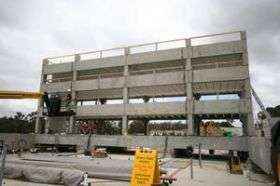
Engineering researchers are subjecting a three-story structure resembling a parking garage to a sequence of earthquake "shake test" jolts as powerful as magnitude 8.0 as part of a series of seismic tests to help improve building codes across the nation.

The 1 million-pound precast concrete structure has the largest footprint of any structure ever tested on a shake table in the United States; the shaking of the structure will continue through May with the most violent shakes coming in June. The increasing intensity of the seismic shaking will duplicate ground motions measured in actual earthquakes and adapted specific conditions in Knoxville, TN., Seattle, WA., and Northridge, CA. Engineers are testing the seismic response of precast concrete floor systems that are used in parking garages, college dormitories, hotels, stadiums, prisons and increasingly in office buildings.

“This is a landmark test that will enable a very fast and economically advantageous high technology construction method to be used in seismically active regions of the United States,” said Gilbert A. Hegemier, director of UC San Diego’s Powell Structural Research Laboratories, and professor and chair of the Jacobs School of Engineering’s Department of Structural Engineering.

The seismic tests of the one-half-scale structure involve a collaboration among UC San Diego, the University of Arizona, and Lehigh University. The $2.3 million project is being funded by the Precast/Prestressed Concrete Institute and its member companies and organizations, the National Science Foundation, the Charles Pankow Foundation, and the Network for Earthquake Engineering Simulation (NEES).

The goal of the project is to design a building by 2012 that can withstand a major earthquake. In the past, due in part to lack of industry knowledge, individual precast elements pulled apart, much like what happened with the collapse of the nine parking garages during the Northridge Earthquake in Los Angeles in 1994. Since that quake occurred in the early morning, one only one person died. However, experts say the death toll could have been much higher. The other problem is the seismic code for these types of precast buildings is 20 years old. The Precast/Prestressed Concrete Institute recently launched a competition to design better floors for such buildings.

“There are significant construction advantages in assembling concrete structures from pieces that are built ahead of time, but the challenge in using precast concrete is that the structure is not one continuous piece of concrete, but many individual ones that are connected together,” said Robert Fleischman, a civil engineering professor at the University of Arizona and principal investigator of this research project. “The floor section edges are interconnected and they sit on ledges; you can see these in any parking garage. These connections have had problems in earthquakes.”

The earthquake tests are being conducted at the Jacobs School of Engineering’s Englekirk Structural Engineering Center, which is about eight miles east of the university’s main campus. The $9 million Englekirk shake table is one of 15 earthquake testing facilities for NEES. The UCSD-NEES shake table, the largest in the United States and the only outdoor shake table in the world, is ideally suited for testing tall, full-scale buildings.

“The earthquake simulator at UC San Diego was designed to conduct state-of-the-art research and ultimately mitigate the disastrous impact of earthquakes in our communities,” said Jose Restrepo, co-principal investigator for the shake test and UCSD structural engineering professor. “The test on the precast concrete building is an example of how to use the latest construction and testing techniques to develop the next generation of design methodologies.”

Source: University of California

4.1 /5 (7 votes)  

Rank 4.1 /5 (7 votes)
Tags

Relevant PhysicsForums posts
  • How to calculate total compressibility in liquid porous solid system
    created3 hours ago
  • Need help reading 3-D
    created23 hours ago
  • A way to send and receive wireless data
    createdFeb 11, 2012
  • Calling function with no input argument
    createdFeb 10, 2012
  • Force free body diagram problem on gym equipment
    createdFeb 10, 2012
  • Empirical data regarding shower heads and water
    createdFeb 10, 2012
  • More from Physics Forums - General Engineering

More news stories

Google might launch Drive for cloud storage soon

(PhysOrg.com) -- Google's next big move, according to the Wall Street Journal, is a cloud storage service called Drive. Hardly first to the plate, Google is simply catching up to introducing its cloud reposi ...

Technology / Internet

created 11 hours ago | popularity 4.8 / 5 (5) | comments 4 | with audio podcast report

Iran blocks email, restricts net access: reports

Iran has further restricted access to the Internet and blocked popular email services for the past few days, in a move a top lawmaker said could "cost the regime dearly," media reports said on Sunday.

Technology / Internet

created 4 hours ago | popularity 5 / 5 (1) | comments 3

Love a click away in Indonesia's Twitter Republic

He was a geeky kid from Yogyakarta, she a glamorous city girl in Jakarta. In a country with one of the world's most vibrant social networking scenes they fell in love on Twitter.

Technology / Internet

created 12 hours ago | popularity 4 / 5 (1) | comments 0

Walney offshore wind farm is world's biggest (for now)

(PhysOrg.com) -- The Walney wind farm on the Irish Sea--characterized by high tides, waves and windy weather--officially opened this week. The farm is treated in the press as a very big deal as the Walney ...

Technology / Energy & Green Tech

created Feb 11, 2012 | popularity 4.2 / 5 (13) | comments 45 | with audio podcast weblog

Navy to begin tests on electromagnetic railgun prototype launcher

The Office of Naval Research (ONR)'s Electromagnetic (EM) Railgun program will take an important step forward in the coming weeks when the first industry railgun prototype launcher is tested at a facility ...

Technology / Engineering

created Feb 06, 2012 | popularity 4.5 / 5 (17) | comments 94 | with audio podcast


Overeating may double risk of memory loss

New research suggests that consuming between 2,100 and 6,000 calories per day may double the risk of memory loss, or mild cognitive impairment (MCI), among people age 70 and older. The study was released today and will be ...

Scientists discover molecular secrets of 2,000-year-old Chinese herbal remedy

For roughly two thousand years, Chinese herbalists have treated Malaria using a root extract, commonly known as Chang Shan, from a type of hydrangea that grows in Tibet and Nepal. More recent studies suggest that halofuginone, ...

New method to examine batteries -- MRI from the inside

There is an ever-increasing need for advanced batteries for portable electronics, such as phones, cameras, and music players, but also to power electric vehicles and to facilitate the distribution and storage of energy derived ...

Injured boomers beware: Know when to see doctor

(AP) -- It happened to nurse Jane Byron years after an in-line skating fall, business owner Haralee Weintraub while doing "men's" push-ups, and avid cyclist Gene Wilberg while lifting a heavy box.

Lab study raises questions over nano-particle impact

Tests involving chickens have raised questions about the impact on health from engineered nano-particles, the ultra-fine grains commonly used in drugs and processed foods, scientists said on Sunday.

A mitosis mystery solved: How chromosomes align perfectly in a dividing cell

Although the process of mitotic cell division has been studied intensely for more than 50 years, Whitehead Institute researchers have only now solved the mystery of how cells correctly align their chromosomes during symmetric ...