Professor studies what cars can learn from drivers' words
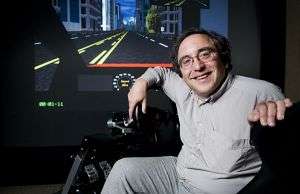
Years ago, Stanford communication and sociology researcher Clifford Nass wondered why some people treated their computers as humans, instead of machines, a question that led him down a path of interesting research. Now he wonders about drivers willing to have personal conversations with the artificial voice in their cars—and what will become of the secrets the humans share with their four-wheeled friends.
Nass is not the only one wondering. As cars become entertainment centers and data-gathering devices, the amount of information they're collecting about you is rapidly growing. And guess who might be interested? Insurance companies, advertisers, government agencies, your boss and perhaps your spouse.
"If you think about it, your car could know a heck of a lot about you," Nass said in an interview. "It can know where you go, and when. It can know your preferences in music, your preferences in news, your preferences in sports, your eating preferences and your purchasing preferences.
"Are there companies that would pay a lot of money for that information? You betcha."
On the other hand, Nass says, an intelligent car with a caring voice might persuade humans to drive more safely.
Drivers have been talking back to artificial voices since the advent of those annoying "Your door is ajar" messages in the 1980s. But now the floodgates have opened. Drivers can ask questions of their GPS navigation system and get answers. Music systems obey commands to play songs by a specific artist. Your car may dial a telephone or give you a verbal heads-up when the wiper fluid is low or there's traffic ahead. The GPS system, which knows exactly where you are, can offer up suggestions for nearby restaurants. As more cars are outfitted with data hard drives and wireless communication technology, even more information about your listening and driving habits can easily be stored and sent. But sent to whom?
"From the point of view of advertisers, the driver is a great captive audience," Nass said. "You have the ability of knowing where the person is, so you can have very location-specific advertising. A car can say, 'It's lunchtime. I know you like Italian food because I've been tracking where you park your car. There's an Italian restaurant nearby and if you go there now you can get a $3 discount.'
"The insurance company could say, 'Look, you've been parking in high-risk areas. I'm going to raise your collision insurance,' or 'We've detected that you've been driving at 80 miles per hour; that will affect your liability rates.'
"So there are huge social issues about the car."
That computer masquerading as a person, seemingly residing somewhere in your car, might be interested in more than mere facts. As it gets to know your voice, your facial expressions (from an onboard camera) and your style, it could adapt its conversation to your mood, just as a human passenger would. If the computer behind the synthetic voice sensed that you were tense, as the car's sensors were silently warning the computer that your driving was becoming erratic, the voice might attempt to calm you down. It would project just the right tone and employ the perfect turn of phrase.
In tests of volunteers driving automobile simulators in the lab, researchers put their subjects into stressful situations and tested out potential responses from the voice. For example, some drivers received a reproachful warning: "You're not driving very well and you need to pay more attention."
"Well, you won't be shocked to learn that people got angry and actually drove worse," laughed Nass as he told the story. As the voice ratcheted up its rhetoric ("You really need to be more careful!"), the driving deteriorated further. Finally, when the voice began insisting that the drivers pull over to the side of the road, they responded by getting into accidents.
In a 2007 study, Nass, doctoral student Helen Harris, and undergraduates Kyle Davis, David Diaz and Brooke Sullivan searched for ways to help people control their emotions in the car in a study called "Car-tharsis." In a frustrating situation, a soothing voice from the car might sympathize with your predicament: "Don't worry. There will be a chance to pass the truck." The unspoken message? You don't need to get upset. Or if you got cut off in traffic, the car might simply do the yelling for you: "Learn to drive!" or "You idiot!"
With all this knowledge and programmed empathy, the car could be a great driving tutor. But with what kind of voice? A coach? A friend? That could depend on your personal relationship with your car, Nass said. "What if you like dominating the car? The car shouldn't be presumptive; it should be submissive."
Nass, a native of Teaneck, N.J., holds a math degree and a doctorate in sociology, both from Princeton University. He got his start in car studies in the mid-1990s with a nudge from Toyota and BMW. Toyota funded research on the idea of a virtual passenger, on the theory that "you might want a car that would talk with you and keep you company while you drove." Then BMW came to him with a touchy problem involving the voice in the company's 5 Series of cars: "They had to have a product recall, because male German drivers wouldn't take directions from a female voice, because it was a 'woman.'"
Nass' eyes still light up with wonder at the thought of drivers reacting to a synthetic female voice as if it were a real person. The title of his latest book explains why humans react in this way: We are Wired for Speech.
"Our brains are so tuned for speech," he said while sipping a cup of English tea in his home on campus. "A newborn, at one day old, can distinguish speech from other sounds such as a dog barking. At four days old, babies can distinguish their language from other languages. Even the hairs in the ear at first react differently to speech than other sounds."
So when humans get behind the wheel and listen to the car talk, "Our brains react to this voice as a person. We basically have no choice."
The gender stereotypes that tripped up BMW also have come through loud and clear in Nass' experiments, to his dismay. Volunteers are more likely to perceive a male voice as authoritative, even when male and female voices speak exactly the same words.
After deciding that the new voice in the BMW should not be the car itself (as in the TV series Knight Rider), Nass and his colleagues considered other candidates—a golf buddy, a chauffeur, a pilot (dominant and not very friendly) and a person riding "shotgun" (talkative, not very smart)—before settling on a co-pilot, who could take over when the driver was in trouble but who understood that the driver (the pilot) was in charge. The chosen voice was male, somewhat friendly, and competent. He was a hit.
Today, Nass is still researching car voices and is the director of the Communication Between Humans and Interactive Media Lab in the Department of Communication, and the associate director of CarLab.
Some of his observations:
-- Depressed drivers drive better when their car speaks as if it, too, were feeling down. "If you're in a really bad mood, do you want a bouncy person around?"
-- Programming cars to speak in complex sentences may improve safety by forcing drivers to pay attention instead of zoning out.
-- Older drivers prefer younger voices—after all, everyone knows that an older voice can't see as well as a younger voice.
-- Drivers feel more engaged with the computer voice if they believe the computer is installed in their car, as opposed to a wireless connection to a distant computer. As a result, they disclose more information to the in-car computer and drive faster.
-- If the onboard computer adjusts the handling of the car to improve your less-than-perfect driving technique, should the computer tell you or keep the secret to itself? (Nass is still researching this one.)
While the talking car could turn out to be a major invader of your privacy, Nass says that it (or he or she) might just as well be a boon to safety. If the car can keep you alert and calm, warn you of troubles ahead ("There is a pedestrian in the middle of the road") and offer you timely advice about traffic and directions, wouldn't that be great?
Insurance companies and car manufacturers would jump at the low-cost, high-impact safety improvements. "Right now, affecting driving performance in cars is expensive," Nass said. "You can imagine how much it costs for anti-lock brakes. But what if you could simply change the voice in the car? Well, that would make change extremely cheap and effective. So that's what we're looking at."
Source: Stanford University


