Researchers Tackling Unsolved Questions About Protein Structures
May 7, 2008
Researchers Tackling Unsolved Questions About Protein Structures

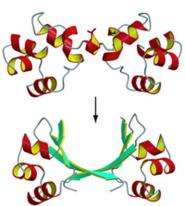
Two protein structures.

A University of Arizona research team is exploring the evolutionary origins of protein structures. Their findings will help people better understand how proteins evolved to carry out the instructions encoded in the genes of every living thing.

Protein molecules are made up of chains of amino acids. These chains bend and fold into a dizzying array of three-dimensional shapes and structures, depending on the order of the amino acids in a given chain. Those varied structures are part of what allow the proteins – which are assembled based on instructions coded in DNA – to regulate everything from an organism's growth and metabolism to the ways messages are transmitted from cell to cell. Protein structures are at the heart of how organisms function.

However, the evolution of those structures is still poorly understood, because there are few observed examples of proteins that have clearly evolved from one shape to another.

"The origin of the diversity of protein structures is a major unsolved problem," explains Matthew H.J. Cordes, a member of the UA's BIO5 Institute and an associate professor of biochemistry and molecular biophysics.

Cordes' lab is solving that problem. Two graduate students in his lab, Christian M. Roessler and Branwen M. Hall, have located protein molecules in two different viruses that have dramatically different structures: One protein has a helical, or corkscrew, shape, while the other is shaped more like a hairpin. Yet these very different proteins have similar amino acid sequences and perform similar functions – binding to DNA to help the viruses replicate and spread – making it likely that they had a common ancestor.

"Somehow, mutations converted the corkscrew structure to the hairpin structure," Cordes says of the finding, which was recently reported in the Proceedings of the National Academy of Sciences.

While this isn't the first example of structural differences among proteins with a common ancestor, it may be the most dramatic natural example of related proteins retaining clear similarity in amino acid sequence while undergoing major reorganization of their structure.

"This finding strongly confirms that evolutionary processes produce new protein shapes," Cordes says. "It could become a textbook example of the reality and beauty of evolutionary changes in structure." He adds that some proteins in this family with the hairpin shape bind to DNA more strongly than those with the corkscrew shape, though it is too early to tell if this is always the case. It's not yet known whether such an advantage helped drive the hairpin structure's evolution.

Cordes' graduate students found their protein pair via an unusual method: Roessler and Hall used a stepping-stone technique to make a series of small "jumps" among closely related proteins, following minute structural changes from one protein to another until they "landed" at a protein that was dramatically different from the one they'd started with, yet was still related to it.

Cordes' lab is now working out the details of the specific mutations that might have caused their two proteins to diverge from one another. They also plan to use their stepping-stone technique to shed light on the evolutionary links among other proteins.

"This is like space exploration," Cordes says. "We're journeying through the protein universe, step by step."

Source: University of Arizona

4.3 /5 (4 votes)  

Filter


Move the slider to adjust rank threshold, so that you can hide some of the comments.


Display comments: newest first

E_L_Earnhardt
May 07, 2008

Rank: not rated yet
You are about to solve the mystery of LIFE! Proceed with respect and caution!
Rank 4.3 /5 (4 votes)
Tags

Relevant PhysicsForums posts

More news stories

A mitosis mystery solved: How chromosomes align perfectly in a dividing cell

Although the process of mitotic cell division has been studied intensely for more than 50 years, Whitehead Institute researchers have only now solved the mystery of how cells correctly align their chromosomes during symmetric ...

Biology / Cell & Microbiology

created 7 hours ago | popularity 4.5 / 5 (12) | comments 0 | with audio podcast

Researchers find extensive RNA editing in human transcriptome

In a new study published online in Nature Biotechnology, researchers from BGI, the world's largest genomics organization, reported the evidence of extensive RNA editing in a human cell line by analysis of RNA-seq data, demons ...

Biology / Biotechnology

created 7 hours ago | popularity 5 / 5 (4) | comments 0 | with audio podcast

The proteins ensuring genome protection

Researchers from the University of Geneva (UNIGE), Switzerland, have discovered the crucial role of two proteins in developing a cell 'anti-enzyme shield'. This protection system, which operates at the level of molecular ...

Biology / Cell & Microbiology

created 7 hours ago | popularity 5 / 5 (3) | comments 0 | with audio podcast

Entire genome of extinct human decoded from fossil

(PhysOrg.com) -- In 2010, Svante Pääbo and his colleagues presented a draft version of the genome from a small fragment of a human finger bone discovered in Denisova Cave in southern Siberia. The ...

Biology / Biotechnology

created Feb 07, 2012 | popularity 4.7 / 5 (60) | comments 51 | with audio podcast

Why are there so few fish in the Earth's oceans?

(PhysOrg.com) -- A Stony Brook University researcher has found that, contrary to popular belief, there are not plenty of fish in the sea.

Biology / Plants & Animals

created Feb 08, 2012 | popularity 4.2 / 5 (18) | comments 27 | with audio podcast


Scientists discover molecular secrets of 2,000-year-old Chinese herbal remedy

For roughly two thousand years, Chinese herbalists have treated Malaria using a root extract, commonly known as Chang Shan, from a type of hydrangea that grows in Tibet and Nepal. More recent studies suggest that halofuginone, ...

New method to examine batteries -- MRI from the inside

There is an ever-increasing need for advanced batteries for portable electronics, such as phones, cameras, and music players, but also to power electric vehicles and to facilitate the distribution and storage of energy derived ...

Google might launch Drive for cloud storage soon

(PhysOrg.com) -- Google's next big move, according to the Wall Street Journal, is a cloud storage service called Drive. Hardly first to the plate, Google is simply catching up to introducing its cloud reposi ...

Lab study raises questions over nano-particle impact

Tests involving chickens have raised questions about the impact on health from engineered nano-particles, the ultra-fine grains commonly used in drugs and processed foods, scientists said on Sunday.

Overeating may double risk of memory loss

New research suggests that consuming between 2,100 and 6,000 calories per day may double the risk of memory loss, or mild cognitive impairment (MCI), among people age 70 and older. The study was released today and will be ...

Starve a virus, feed a cure? Findings show how some cells protect themselves against HIV

A protein that protects some of our immune cells from the most common and virulent form of HIV works by starving the virus of the molecular building blocks that it needs to replicate, according to research published online ...