When bears steal human food, mom's not to blame
May 7, 2008
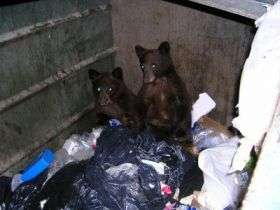
According to a study by researchers from the Wildlife Conservation Society, black bears that become habituated on human food and garbage do not necessarily learn these behaviors from their mother as previously assumed. Credit: Jon Beckmann/Wildlife Conservation Society
Researchers from the Wildlife Conservation Society (WCS) found that the black bears that become habituated to human food and garbage may not be learning these behaviors exclusively from their mothers, as widely assumed. Bears that steal human food sources are just as likely to form these habits on their own or pick them up from unrelated, “bad influence” bears.
The study, which examines the role of genetic relatedness in black bear behavior that leads to conflict with humans, appears in the latest edition of the Journal of Mammalogy.
“Understanding how bears acquire behavior is important in conservation biology and devising strategies to minimize potential human-wildlife conflicts,” says Dr. Jon Beckmann, a co-author of the study. “According to our findings, bears that feed on human food and garbage are not always learning these habits from their mothers.”
Distributed across much of North America, black bears—which average around 300 pounds in weight—become a problematic species for wildlife managers when they become accustomed to human sources of food, and the habit is a hard one to break. Bears that develop these tendencies often remain ‘problem’ bears for human communities, leading to property damage, injuries to people, not to mention costly relocation and sometimes death for bears.
Working in both the Lake Tahoe Basin on the California-Nevada border and California’s Yosemite National Park (where bears breaking into visitors’ cars has become commonplace), the researchers examined genetic and behavioral data for 116 black bears. The bears were classified as either food-conditioned (or hooked on human food) or non-food-conditioned (those bears that forage on natural food sources). The study also focused on nine mother-offspring pairs to test the assumption that mother bears teach their cubs to invade garbage bins or homes.
The verdict: Researchers found little evidence linking food-conditioned behavior with related lineage. The study indicates that bears may seek out human food as a function of social learning that may be independent of close relatives, or as a habit that is acquired in isolation from other bears. Specifically, the study identified the mothers of nine of the bears in the study, of which five (56 percent) did not share the behavioral habits of their mothers.
“These findings can help inform management strategies that would otherwise assume that cubs will always repeat the behaviors of food-conditioned mothers,” says Dr. Jodi Hilty, Director of WCS-North America. “Moving mothers and cubs may have only a limited effect in eliminating human-bear conflicts, which seem to be primarily driven by human food sources that are available to bears.”
Meanwhile on the East Coast, WCS-Adirondacks has been supplying the High Peaks Wilderness Area in upstate New York with bear-proof food canisters for campers to rent at local stores. A recent survey found that 95 percent of campers now use the canisters, and reports of conflicts between bears and campers have declined significantly.
Source: Wildlife Conservation Society
-
Researchers study parenting behaviors of stressed-out birds
Feb 08, 2012 |
not rated yet |
0
-
Dealing with stress: New research highlights the survival skills of disease-causing E. coli
Jan 30, 2012 |
not rated yet |
0
-
CU-Boulder-led team to assess decline of Arctic sea ice in Alaska's Beaufort Sea
Jan 26, 2012 |
5 / 5 (1) |
2
-
Marine mammals on the menu in many parts of world
Jan 24, 2012 |
5 / 5 (1) |
5
-
Lack of sleep makes your brain hungry
Jan 18, 2012 |
5 / 5 (3) |
0
-
Engineers build first sub-10-nm carbon nanotube transistor
Feb 01, 2012 |
4.9 / 5 (31) |
30
-
Something old, something new: Evolution and the structural divergence of duplicate genes
Jan 31, 2012 |
4.6 / 5 (7) |
1
-
The hidden nanoworld of ice crystals: Revealing the dynamic behavior of quasi-liquid layers
Jan 30, 2012 |
5 / 5 (3) |
1
-
Stock market network reveals investor clustering
Jan 27, 2012 |
3.9 / 5 (23) |
8
-
Of microchemistry and molecules: Electronic microfluidic device synthesizes biocompatible probes
Jan 26, 2012 |
5 / 5 (1) |
0
More news stories
Entire genome of extinct human decoded from fossil
(PhysOrg.com) -- In 2010, Svante Pääbo and his colleagues presented a draft version of the genome from a small fragment of a human finger bone discovered in Denisova Cave in southern Siberia. The ...
Feb 07, 2012 |
4.7 / 5 (58) |
44
|
Why are there so few fish in the Earth's oceans?
(PhysOrg.com) -- A Stony Brook University researcher has found that, contrary to popular belief, there are not plenty of fish in the sea.
Feb 08, 2012 |
4.3 / 5 (17) |
26
|
Miami battling invasion of giant African snails
No one knows how they got there. But an invasion of African giant snails has southern Florida in a panic over potential crop damage, disease and general yuckiness surrounding the slimy gastropods.
Feb 10, 2012 |
4.5 / 5 (2) |
5
Deciding to go left or right: Researchers use device to determine that lower animals can navigate too
For decades, scientists have associated binary decision making opting to go left or right with higher-ranking animals, including humans. A team of Harvard researchers, however, is rewriting that ...
Feb 09, 2012 |
4 / 5 (1) |
4
|
Study shows chimps able to understand needs of others
(PhysOrg.com) -- By setting up a unique experiment, a small team of researchers has found that chimpanzees are able to understand need in other chimps, despite their general disinclination to offer aid when ...
Google might launch Drive for cloud storage soon
(PhysOrg.com) -- Google's next big move, according to the Wall Street Journal, is a cloud storage service called Drive. Hardly first to the plate, Google is simply catching up to introducing its cloud reposi ...
Latin America mining boom clashes with conservation
Latin America is experiencing a mining boom as prices rise fuelled by a hike in global demand, but the region is also being hit by a wave of violent protests, strikes and rallies by environmentalists.
Love a click away in Indonesia's Twitter Republic
He was a geeky kid from Yogyakarta, she a glamorous city girl in Jakarta. In a country with one of the world's most vibrant social networking scenes they fell in love on Twitter.
Walney offshore wind farm is world's biggest (for now)
(PhysOrg.com) -- The Walney wind farm on the Irish Sea--characterized by high tides, waves and windy weather--officially opened this week. The farm is treated in the press as a very big deal as the Walney ...
GPS court ruling leaves US phone tracking unclear
A US Supreme Court decision requiring a warrant to place a GPS device on the car of a criminal suspect leaves unresolved the bigger issue of police tracking using mobile phones, legal experts say.
Europeans protest controversial Internet pact
Tens of thousands of people marched in protests in more than a dozen European cities Saturday against a controversial anti-online piracy pact that critics say could curtail Internet freedom.