Iron 'snow' helps maintain Mercury's magnetic field, scientists say
May 7, 2008 Mercury

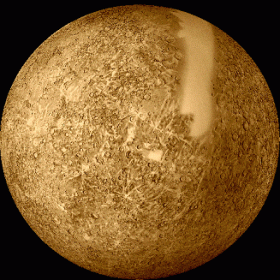
Mercury surface taken by Mariner 10. Credit: NASA

New scientific evidence suggests that deep inside the planet Mercury, iron “snow” forms and falls toward the center of the planet, much like snowflakes form in Earth’s atmosphere and fall to the ground.

The movement of this iron snow could be responsible for Mercury’s mysterious magnetic field, say researchers from the University of Illinois and Case Western Reserve University. In a paper published in the April issue of the journal Geophysical Research Letters, the scientists describe laboratory measurements and models that mimic conditions believed to exist within Mercury’s core.

“Mercury’s snowing core opens up new scenarios where convection may originate and generate global magnetic fields,” said U. of I. geology professor Jie (Jackie) Li. “Our findings have direct implications for understanding the nature and evolution of Mercury’s core, and those of other planets and moons.”

Mercury is the innermost planet in our solar system and, other than Earth, the only terrestrial planet that possesses a global magnetic field. Discovered in the 1970s by NASA’s Mariner 10 spacecraft, Mercury’s magnetic field is about 100 times weaker than Earth’s. Most models cannot account for such a weak magnetic field.

Made mostly of iron, Mercury’s core is also thought to contain sulfur, which lowers the melting point of iron and plays an important role in producing the planet’s magnetic field.

“Recent Earth-based radar measurements of Mercury’s rotation revealed a slight rocking motion that implied the planet’s core is at least partially molten,” said Illinois graduate student Bin Chen, the paper’s lead author. “But, in the absence of seismological data from the planet, we know very little about its core.”

To better understand the physical state of Mercury’s core, the researchers used a multi-anvil apparatus to study the melting behavior of an iron-sulfur mixture at high pressures and high temperatures.

In each experiment, an iron-sulfur sample was compressed to a specific pressure and heated to a specific temperature. The sample was then quenched, cut in two, and analyzed with a scanning electron microscope and an electron probe microanalyzer.

“Rapid quenching preserves the sample’s texture, which reveals the separation of the solid and liquid phases, and the sulfur content in each phase,” Chen said. “Based on our experimental results, we can infer what is going on in Mercury’s core.”

As the molten, iron-sulfur mixture in the outer core slowly cools, iron atoms condense into cubic “flakes” that fall toward the planet’s center, Chen said. As the iron snow sinks and the lighter, sulfur-rich liquid rises, convection currents are created that power the dynamo and produce the planet’s weak magnetic field.

Mercury’s core is most likely precipitating iron snow in two distinct zones, the researchers report. This double-snow state may be unique among the terrestrial planets and terrestrial-like moons in our solar system.

“Our findings provide a new context into which forthcoming observational data from NASA’s MESSENGER spacecraft can be placed,” Li said. “We can now connect the physical state of our innermost planet with the formation and evolution of terrestrial planets in general.”

Source: University of Illinois at Urbana-Champaign


print this article email this article download pdf blog this article bookmark this article     Stumble it Digg this share on Facebook retweet share on Reddit add to delicious
Rate this story - 3.5 /5 (16 votes)

Rank Filter

Move the slider to adjust rank threshold, so that you can hide some of the comments.


Display comments: newest first

  • EarthScientist - May 07, 2008
    • Rank: 1 / 5 (4)
    Oh my GOD, I just cant believe some of the goofy theories I read on these "Physics" sites.That poor Oriental tasker really has a vivid imagination,and all with a couple of experiments here ,of course with someone elses theory as a basis in the first place. That planet is a process planet and its core is built the same as our earth,and has different materials grown into it for its processes,but the fact remains that planet formation starts with crystalline ammonia,and its size provides more or less gravitational pull.

    All planets that rotate have to have a motor,young oriental tasker,and the grid on that planet and the strips of metals grown and the amount of strips ,plus the amount of energy adjusted to its field and its mass will give it that specific spin speed.

    All planet spheres make a noise when spinning that provides its process frequency,gas production or cymatic processes for the structure of the universe.

    Its crystalline ammonia boys,and it is engineered,and by men.
  • brant - May 07, 2008
    • Rank: not rated yet
    Iron snow?????

    And they say the idea of electricity in the universe is bad....
  • Soylent - May 08, 2008
    • Rank: not rated yet
    Iron snow?????

    And they say the idea of electricity in the universe is bad....


    The electric model of the universe necessitates placing a free charge on the sun so humongous that it would immediately proceed to blast away from the sun at a signficant fraction of the speed of light.

    Iron snow is at least possible in principle.
  • earls - May 08, 2008
    • Rank: not rated yet
    And we all know nothing leaves the sun at a significant fraction of the speed of light or thereof.

May 7, 2008 all stories

Comments: 4

3.5 /5 (16 votes)
  • Stumble this up

  • Digg this

  • share this

  • hide
  • Related Stories

  • Space scientists set for final spacecraft flyby of Mercury
    created Sep 28, 2009 | popularity not rated yet | comments 0
  • Magnesium detected in MESSENGER flyby of Mercury (w/Video)
    created Apr 30, 2009 | popularity not rated yet | comments 0
  • NASA's Messenger Spacecraft Returns To Mercury
    created Oct 01, 2008 | popularity not rated yet | comments 0
  • Unraveling the Mercury mystery: Boldly going where no one has gone before
    created Apr 09, 2008 | popularity not rated yet | comments 0
  • Mercury's shifting, rolling past
    created Mar 27, 2008 | popularity not rated yet | comments 0


  • hide
  • Relevant PhysicsForums posts

  • Electromagnet design
    created 1hour ago
  • Physics practice, please help me!
    created 1hour ago
  • Work done on femur
    created 4 hours ago
  • Magnet and Motors?
    created 5 hours ago
  • More from Physics Forums - General Physics

Other News

Stars Fueled by Dark Matter Could Hold Secrets to the Universe

Stars Fueled by Dark Matter Could Hold Secrets to the Universe

Physics / General Physics

created Nov 03, 2009 | popularity 4.5 / 5 (51) | comments 41

(PhysOrg.com) -- The first stars in the universe may have been very different from the stars we see today, yet they may hold clues to understanding some of the mysterious features of the universe. These "dark ...


Second Law of Thermodynamics May Explain Economic Evolution

Second Law of Thermodynamics May Explain Economic Evolution

Physics / General Physics

created Nov 02, 2009 | popularity 4.3 / 5 (30) | comments 28

(PhysOrg.com) -- Terms such as the "invisible hand," laissez-faire policy, and free-market principles suggest that economic growth and decline in capitalist societies seem to be somehow self-regulated. Now, ...


High-performance plasmas may make reliable, efficient fusion power a reality

High-performance plasmas may make reliable, efficient fusion power a reality

Physics / Plasma Physics

created Nov 02, 2009 | popularity 4.7 / 5 (39) | comments 33

In the quest to produce nuclear fusion energy, researchers from the DIII-D National Fusion Facility have recently confirmed long-standing theoretical predictions that performance, efficiency and reliability ...


'Teapot effect' solved

Solving Teapot Effect

Physics / General Physics

created Nov 02, 2009 | popularity 4.9 / 5 (11) | comments 10

(PhysOrg.com) -- A team of scientists from France have worked out why teapots dribble at low flow rates, and how to stop them. The effect is called the "teapot effect", and solving it could finally put an ...


Laser accelerated protons to the highest energies so far

Researchers use trident laser to accelerate protons to record energies

Physics / General Physics

created Nov 02, 2009 | popularity 4.7 / 5 (6) | comments 10

An international team of physicists at Los Alamos National Laboratory has succeeded in using intense laser light to accelerate protons to energies never before achieved. Using this technique, scientists can ...