It started with a squeak: Moonlight serenade helps lemurs pick mates of the right species
May 7, 2008 It started with a squeak: Moonlight serenade helps lemurs pick mates of the right species

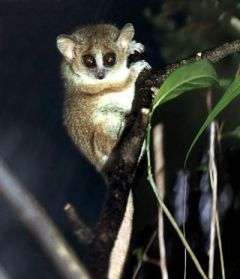
Micocebus murinus on the lookout for a mate. Credit: Tiho Hannover

Lonely hearts columns testify that finding a partner can be hard enough, but at least most human beings can be fairly certain that when we do we have got one of the right species. Things aren’t so simple for all animals. Some Malagasy mouse lemurs are so similar that picking a mate of the right species, especially at night time in a tropical forest, might seem like a matter of pot luck. However, new research in BioMed Central’s journal BMC Biology has shown that our desperately cute distant cousins use vocalisations to pick up a partner of the right species.

Until recently, grey, golden brown, and Goodman’s mouse lemurs were all thought to be the same species. But genetic testing revealed that they are, in fact, three distinct, species so similar that they cannot be told apart by their appearance—so called cryptic species.

“A fundamental problem for cryptic species that live in the same area and habitat is the coordination of reproduction and discrimination between potential mates of the same species and remarkably similar individuals of other species” say Pia Braune and colleagues from the Institute of Zoology, University of Veterinary Medicine, Hannover University.

Males of these nocturnal species use advertising calls to let females know that they are looking for love. The researchers recorded advertising calls from the three species and then played them back to grey mouse lemurs, noting what response, if any, they made. “Grey mouse lemurs reacted more to calls from other grey mouse lemurs than to those of either other species”, say the researchers. Furthermore, the grey mouse lemurs seemed to ignore the calls of golden brown mouse lemurs, which live in the same area and habitat to them, but show some interest in the calls of Goodman’s mouse lemur, which they would never normally meet. “The importance of vocalisation in attracting mates is well known for frogs and birds”, explain the authors, “but this is the first evidence for species-specific call divergence in the communication of cryptic primate species with overlapping ranges.”

The lemurs’ moonlight serenades help to ensure that individuals of one species don’t waste time trying to mate with those of another, which would produce either no offspring or infertile hybrids. Indeed, the possibility of grey and golden-brown mouse lemurs encountering each other might explain the difference in calls and responses, according to Braune: “our data support the evolutionary hypothesis that species cohesiveness has led to divergence in signalling and recognition to avoid costly hybridisation.”

Source: BioMed Central


print this article email this article download pdf blog this article bookmark this article     Stumble it Digg this share on Facebook retweet share on Reddit add to delicious
Rate this story - 3 /5 (1 vote)


May 7, 2008 all stories

Comments: 0

3 /5 (1 vote)
  • Stumble this up

  • Digg this

  • share this

  • hide
  • Related Stories

  • Discovery of virus in lemur could shed light on AIDS
    created Dec 01, 2008 | popularity not rated yet | comments 0
  • Extinction threat growing for mankind's closest relatives
    created Aug 05, 2008 | popularity not rated yet | comments 0
  • Lemur's evolutionary history may shed light on our own
    created Feb 25, 2008 | popularity not rated yet | comments 0
  • Paleontologists discover most primitive primate skeleton
    created Jan 23, 2007 | popularity not rated yet | comments 0
  • Study revises understanding of primate origins
    created Jan 17, 2007 | popularity not rated yet | comments 0


Other News

California's Ancient Kelp Forest

Biology / Ecology

created 45 minutes ago | popularity not rated yet | comments 0

(PhysOrg.com) -- The kelp forests off southern California are considered to be some of the most diverse and productive ecosystems on the planet, yet a new study indicates that today's kelp beds are less extensive and lush ...


Bush rats fight back

Bush rats fight back

Biology / Ecology

created 5 minutes ago | popularity not rated yet | comments 0

(PhysOrg.com) -- Sydney's native bush rats were unintended victims of a campaign to exterminate foreign black rats during a plague epidemic in 1900, according to new research by scientists who plan to reintroduce ...


Striped skunk

Skunk's Strategy Not Just Black and White

Biology / Plants & Animals

created 1hour ago | popularity not rated yet | comments 1

Predators with experience of skunks avoid them both because of their black-and-white coloration and their distinctive body shape, according to UC Davis wildlife researcher Jennifer Hunter. The study was published ...


Ancient penguin DNA raises doubts about accuracy of genetic dating techniques

Ancient penguin DNA raises doubts about accuracy of genetic dating techniques

Biology / Evolution

created 4 hours ago | popularity 5 / 5 (7) | comments 2

Penguins that died 44,000 years ago in Antarctica have provided extraordinary frozen DNA samples that challenge the accuracy of traditional genetic aging measurements, and suggest those approaches have been ...


Device enables world's first voluntary gorilla blood pressure reading

Device enables world's first voluntary gorilla blood pressure reading

Biology / Plants & Animals

created 2 hours ago | popularity not rated yet | comments 0

Zoo Atlanta recently became the first zoological institution in the world to obtain voluntary blood pressure readings from a gorilla. This groundbreaking stride was made possible by the Gorilla Tough Cuff, ...