New technique measures ultrashort laser pulses at focus
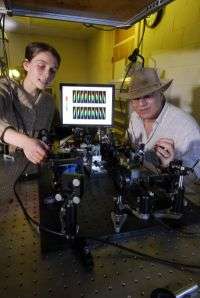
Lasers that emit ultrashort pulses of light are used for numerous applications including micromachining, microscopy, laser eye surgery, spectroscopy and controlling chemical reactions. But the quality of the results is limited by distortions caused by lenses and other optical components that are part of the experimental instrumentation.
To better understand the distortions, researchers at the Georgia Institute of Technology developed the first device to directly measure complex ultrashort light pulses in space and time at and near the focus. Measuring the pulse at the focus is important because that’s where the beam is most intense and where researchers typically utilize it. Knowing how the light is distorted allows researchers to correct for the aberrations by changing a lens or using a pulse shaper or compressor to manipulate the pulse into the desired form.
“Researchers have always measured the pulse immediately as it exited the laser, so they didn’t realize the extent to which the pulse became distorted by the time it reached the focus after traveling through the optics and lenses in the system,” said Rick Trebino, a professor in the Georgia Institute of Technology’s School of Physics and Georgia Research Alliance Eminent Scholar in Ultrafast Optical Physics.
The device was described in a presentation at the Conference on Lasers and Electro-Optics on May 8. This research was funded by the National Science Foundation and published in the August 2007 issue of the journal Optics Express.
It is difficult to measure ultrashort pulses because they typically last between a few femtoseconds and a picosecond, which are 10-15 and 10-12 of a second, and faster than the response time of the fastest electronics.
“The light comes out as a train of extremely short bursts. The laser crams all of the energy of a continuous laser into a few femtoseconds, which creates really intense laser pulses,” said Pam Bowlan, a graduate student supported by the Technological Innovation: Generating Economic Results (TI:GER) program.
To achieve the highest possible intensity of the laser, the pulse must be as small as possible in space and as short as possible in time. However, focused pulses nearly always have distortions in time that vary significantly from point to point in space due to lens aberrations in focusing optics.
To address those issues, the new device, called SEA TADPOLE (Spatial Encoded Arrangement for Temporal Analysis by Dispersing a Pair of Light E-fields), allows researchers to measure complicated ultrashort pulses simultaneously in space and time as they go through the focus.
“A lot of chemists and biologists use ultrafast lasers, so it was important that our device be easy to use because non-laser scientists don’t want to spend all day measuring their laser pulses,” noted Bowlan.
The research team – which also included former graduate students Pablo Gabolde and Selcuk Akturk – used the concept of interferometry to measure a pulse in space and time. Two pulses, one reference and one unknown, were sent through optical fibers. The fibers were mounted on a scanning stage so that the pulses could be measured at many locations around the focus.
The pulses were crossed and an interference pattern was recorded for each color of the pulse at each location with a digital camera. The patterns were used to determine the shape of the unknown pulse in space and time and to create movies showing how the intensity and color of the pulse changed in space and time as it focused.
“Because the laser pulses enter SEA TADPOLE through optical fibers, which only collect a very small portion of the light, the device naturally measures pulses with high spatial resolution and can measure them at a focus spot size smaller than a micron,” explained Bowlan. To further improve the spatial resolution of the device, the research team began to use specialized fibers, called near-field scanning optical microscopy fibers, which can resolve features smaller than the wavelength of the light.
The researchers tested the device by measuring ultrashort pulses focused by various lenses, since each lens can cause different complex distortions. To validate the measurements, Bowlan performed simulations of pulses propagating through the experimental lenses. Results showed that a common plano-convex lens displayed chromatic and spherical aberrations, whereas more expensive aspheric and doublet lenses exhibited mostly chromatic aberrations.
Spherical aberrations occur when the light that strikes the edges of the lens gets focused to a different point than the light that strikes the center, creating a larger, inhomogeneous focused spot size. Chromatic aberrations occur because the many colors in the laser travel at different speeds and do not stay together in space and time as the pulse passes through glass components in the experimental setup, such as lenses. As a result, each color arrives at the focus at a different time, creating a rainbow of colors in the electric field images.
Aberrations can drastically increase the pulse length, which decreases the laser intensity. A lower intensity forces researchers to increase the power of the laser, increasing the possibility of damaging the sample. Aberrations can also yield odd pulse and beam shapes at the focus, which complicate the interpretation of the experiment or application.
“Our system tells researchers what types of aberrations are present in instrumentation, which then allows them to test different lenses in the instrumentation setup or use a pulse shaper to create the desired pulse at the focus that’s free of distortions,” added Bowlan.
Source: Georgia Institute of Technology


