New gas sensors for monitoring carbon dioxide sinks
May 8th, 2008 New gas sensors for monitoring carbon dioxide sinks

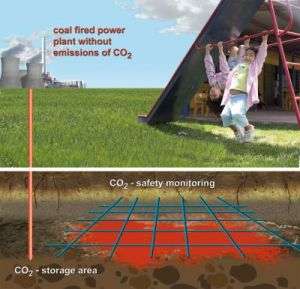
Functional principle of the membranbasierten Gassensors. A potential application of the new gas assensor is the monitoring of carbon dioxide storage from power plants. Credit: Source: Susan Waiter/UFZ

A novel gas sensor system makes it possible to monitor large areas cost-effectively the first time. The patented gas sensor is based on the principle of diffusion, according to which certain gases pass through a membrane faster than others.

Using a tube-like sensor it is possible to measure an average gas concentration value over a certain distance without influencing or distorting conditions in the measuring environment. If such sensors are laid in a particular pattern, it is possible to calculate the concentration of a gas over an area. The measuring tube can therefore replace a large number of individual sensors, making it much cheaper than previous methods.

The sensor was developed at the Helmholtz Centre for Environmental Research (UFZ) and is being presented for the first time at the 15th International Trade Fair for Water – Sewage – Refuse - Recycling (IFAT), which is taking place from 5 to 9 May in Munich.

Potential fields of application for the membrane-based gas sensors ("MeGa") are environmental remediation and landfill monitoring. But in future the technology could also be used to monitor gas pipelines, the formation of hydrogen sulphide in waterbodies or the underground injection of carbon dioxide. The principle can also be used in liquids, so the probe is also useful for monitoring waterbodies, including groundwater, and for monitoring boreholes. The slimline construction of the borehole and waterbody probe means that it can be used in gauges. The (permanent) connection to the part above ground allows data capture/evaluation to take place while the probe is submerged. A device with these features has never previously been available anywhere in the world. Another potential field of application is process monitoring in water treatment or in the food industry, e.g. in breweries and dairies.

The researchers are hoping that in future their system can also contribute to more intelligent ventilation of indoor spaces. An excessive level of carbon dioxide leads to fatigue and health problems, while excessive ventilation means a waste of energy. In classrooms, lecture theatres of all kinds and in workplaces there are therefore recommendations for indoor air concentrations of 1000 and 3000 ppm. "Monitoring these indoor air concentrations has failed so far because of a lack of suitable, reasonably priced measuring methods linked to appropriate ventilation technology," explains Dr Detlef Lazik from the UFZ. "With our membrane-based gas sensors it is for instance possible to have decentralised ventilation using a ventilator that is controlled by a gas sensor.

The ventilation is then simply switched on if an adjustable threshold value is exceeded." The same principle can be used for monitoring dangerous substances in buildings and facilities.

Source: Helmholtz Association of German Research Centres


print this article email this article download pdf blog this article bookmark this article     Digg this Stumble it share on Facebook share on Reddit add to delicious save to Yahoo! bookmarks
4/5 after 2 votes


May 8th, 2008 all stories
Technology / Engineering

Comments: 0
Rank: 4/5 after 2 votes

  • Stumble this up

  • Digg this

  • Share it:
  • share on Facebook
  • share on MySpace
  • share on Slashdot
  • rss-newsfeed
  • share on Google
  • share on Reddit
  • add to delicious
  • save to Yahoo! bookmarks
  • share on Windows Live
  • Add to Mixx!
Rating: 4/5 after 2 votes

  • Related Stories

  • Specialized polymer used to detect nerve agents, toxic chemicals for air monitoring in emergencies
    created Apr 15, 2009 | popularity not rated yet | comments 0
  • New method monitors critical bacteria in wastewater treatment
    created Feb 04, 2009 | popularity not rated yet | comments 0
  • Pret-a-sauver fashion for disasters
    created Oct 17, 2008 | popularity not rated yet | comments 0
  • Researchers Help U.S. Military Thwart Explosive Threats
    created Jul 18, 2008 | popularity not rated yet | comments 0
  • A New Take on Microbrewing
    created Apr 10, 2008 | popularity not rated yet | comments 0

Tags


  • Physicists Demonstrate Quantum Memory with Matter Qubits
    Physicists Demonstrate Quantum Memory with Matter Qubits
    Physics / General Physics
    created Jul 03, 2009 | popularity 4.4 / 5 (17) | comments 1
  • 'Holey' Nanosheets for Wastewater Dye Removal
    Nanotechnology / Nanomaterials
    created Jul 01, 2009 | popularity 5 / 5 (5) | comments 1
  • Jellyfish Robot Swims Like its Biological Counterpart
    Jellyfish Robot Swims Like its Biological Counterpart
    Electronics / Robotics
    created Jun 26, 2009 | popularity 4.4 / 5 (8) | comments 1
  • Could Maxwell's Demon Exist in Nanoscale Systems?
    Could Maxwell's Demon Exist in Nanoscale Systems?
    Physics / General Physics
    created Jun 24, 2009 | popularity 4.4 / 5 (18) | comments 29
  • Living Safely with Robots, Beyond Asimov's Laws
    Living Safely with Robots, Beyond Asimov's Laws
    Electronics / Robotics
    created Jun 22, 2009 | popularity 4.6 / 5 (52) | comments 40
  • Other News

    Geeks double as scourges and sages at media summit

    Technology / Business

    created 5 hours ago | popularity not rated yet | comments 0

    (AP) -- The media moguls attending an annual powwow staged by investment bank Allen & Co. used to be able to rest comfortably in the Idaho mountains as they mulled their next moves.


    Japan demands 119 million dlrs in tax from Amazon: report

    Technology / Business

    created 8 hours ago | popularity 3 / 5 (1) | comments 0

    Japanese authorities told a sales affiliate of US retail giant Amazon.com to pay about 119 million dollars in tax for unreported income over a three-year period, a newspaper said Sunday.


    Iconic skyscrapers find new luster by going green (AP)

    Iconic skyscrapers find new luster by going green

    Technology / Energy

    created 9 hours ago | popularity 1 / 5 (1) | comments 0

    (AP) -- When owners of the Empire State Building decided to blanket its towering facade this year with thousands of insulating windows, they were only partly interested in saving energy. They also needed ...


    Downturn dating: Hearts flutter as markets stutter (AP)

    Downturn dating: Hearts flutter as markets stutter

    Technology / Internet

    created 9 hours ago | popularity not rated yet | comments 0

    (AP) -- Credit the recession for "staycations" and bringing us more game-night parties at home. But also give it a shout for spurring more first dates.


    UK spy chief's family details posted on Facebook

    Technology / Internet

    created 9 hours ago | popularity not rated yet | comments 0

    (AP) -- He's the spy who came in from the beach.