May 9, 2008 feature
Flies' eyes could enhance robot vision
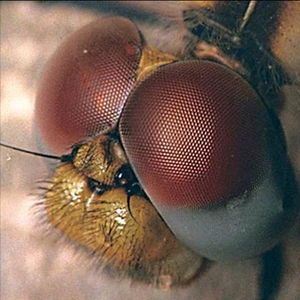
Robots with flies' eyes could take advantage of the insect’s vision system to better locate the edges and boundaries of objects. This ability could help robots perform a variety of tasks more quickly and accurately than if they were using traditional sensors.
Researchers from the Naval Air Warfare Center in China Lake, California, and the University of Wyoming have developed a fiber optic sensor inspired by the compound eye of the common housefly, Musca domestica. One of the biggest advantages of the design is that it can quickly locate edges and boundaries of images. Machines such as unmanned vehicles, guided missiles, and high-speed industrial inspection robots might take advantage of this ability to locate tiny, moving objects with high precision.
In a recent issue of Bioinspiration & Biomimetics, researchers D. Riley, et al., describe how flies’ vision systems are uniquely geared toward locating small objects with high precision. In fact, flies possess a visual precision beyond the resolution limit – a property called hyperacuity. This feature is actually common to many animals, including humans.
“The fly has significant advantages with respect to tracking,” the researchers told PhysOrg.com. “As a system, the fly has very quick reaction times. … They can react and track much better than untrained humans; however I would question that the quality of the rest of their vision is even comparable.” They added that, overall, insect vision (and sensor technology inspired by it) is still far inferior to human vision, and probably always will be.
The researchers explained that the more interesting component of the fly’s vision system is that the field of view of each photoreceptor in a fly’s eye overlaps with those next to it, with up to 90% overlap. Each eye contains about 3,000 ommatidia – the major structural unit of the eye – and each ommatidium contains eight photoreceptors. The photoreceptors’ main function is to convert light into ionic current, which then goes to the fly’s processing system(s).
Unlike conventional image processing systems which are often digital, the fly’s processing system is analog. Digital systems receive data pixel by pixel, and generally require time-consuming, computationally expensive processing. The analog system helps the fly extract edge information much more quickly, and also enables parallel processing. Both these features contribute to the fly’s highly accurate, high-speed vision system.
The researchers designed their sensor to mimic the fly’s overlapping photoreceptors and analog, parallel processing system. The sensor consists of a 1-mm-diameter ball lens that focuses light onto an array of photodetectors, where the field of view overlaps by about 70%. In experiments, the sensor could locate a 1-mm-wide string as the string moved across the field of vision at distances up to 200 mm from the lens, with minimal error.
Such a high-res vision system could have applications in a variety of medical, commercial, industrial, and defense areas. The researchers are currently fabricating a sensor that consists of seven ommatidia with seven photoreceptors, and hope to extend the design in scale and accuracy.
“We envision this sensor as a supplement to more traditional imaging sensors for most applications, and not as a replacement,” they explain. “Just as Musca domestica has both two compound eyes and a very simple camera eye, many computer and robot vision tasks can benefit from both types of sensors.”
More information: Riley, D T; Harmann, W M; Barrett, S F; and Wright, C H G. “Musca domestica inspired machine vision sensor with hyperacuity.” Bioinspiration & Biomimetics. 3 (2008) 026003 (13pp).
Copyright 2008 PhysOrg.com.
All rights reserved. This material may not be published, broadcast, rewritten or redistributed in whole or part without the express written permission of PhysOrg.com.


