The Antennae Galaxies move closer
May 9, 2008 The Antennae Galaxies move closer

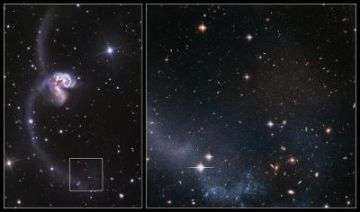
The Antennae Galaxies are among the closest known merging galaxies. The two galaxies, also known as NGC 4038 and NGC 4039, started to interact a few hundred million years ago, creating one of the most impressive sights in the night sky. They are considered by scientists as the archetypal merging galaxy system and are used as a standard with which to validate theories about galaxy evolution. The ground-based image (left) is taken by Robert Gendler and shows the two merging galaxies and their impressive long tidal tails. The Hubble Advanced Camera for Surveys image (right) shows a portion of the southern tidal tail. The main visible component consists of young blue stars recently formed out of the gas accumulating along the spine of the tail, and many red background galaxies can also be seen. The region is also filled by thousands of faint red stars, just visible when zooming on the image. By measuring the colors and brightnesses of red giant stars in the system, the scientists found that the Antennae Galaxies are much closer than previously thought: 45 million light-years instead of the previous best estimate of 65 million light-years. These red stars cannot be brighter than a certain threshold, and it is this luminosity threshold that was used to derive the new distance of the Antennae. Credit: NASA, ESA & Ivo Saviane (European Southern Observatory)/Robert Gendler

The Antennae Galaxies are among the closest known merging galaxies. The two galaxies, also known as NGC 4038 and NGC 4039, began interacting a few hundred million years ago, creating one of the most impressive sights in the night sky. They are considered by scientists as the archetypal merging galaxy system and are used as a standard against which to validate theories about galaxy evolution.

An international group of scientists led by Ivo Saviane from the European Southern Observatory has used Hubble’s Advanced Camera for Surveys and Wide Field Planetary Camera 2 to observe individual stars spawned by the colossal cosmic collision in the Antennae Galaxies. They reached an interesting and surprising conclusion.

By measuring the colours and brightnesses of red giant stars in the system, the scientists found that the Antennae Galaxies are much closer than previously thought: 45 million light-years instead of the previous best estimate of 65 million light-years.

The team targeted a region in the relatively quiescent outer regions in the southern tidal tail, away from the active central regions. This tail consists of material thrown from the main galaxies as they collided. The scientists needed to observe regions with older red giant stars to derive an accurate distance. Red giants are known to reach a standard brightness, which can then be used to infer their distance. The method is known as the tip of the red giant branch (TRGB).

The proximity of the Antennae system means it is the best-studied galaxy merger in the sky, with a wealth of observational data to be compared to the predictions of theoretical models. Saviane says: “All aspiring models for galaxy evolution must be able to account for the observed features of the Antennae Galaxies, just as respectable stellar models must be able to match the observed properties of the Sun. Accurate models require the correct merger parameters, and of these, the distance is the most essential”.

The previous canonical distance to the Antennae Galaxy was about 65 million light-years although values as high as 100 million light years have been used. Our Sun is only eight light-minutes away from us, so the Antennae Galaxies may seem rather distant, but if we consider that we already know of galaxies that are more than ten billion light-years away, the two Antennae Galaxies are really our neighbours.

The previous larger distance required astronomers to invoke some quite exceptional physical characteristics to account for the spectacular system: very high star-formation rates, supermassive star clusters, ultraluminous X-ray sources etc. The new smaller distance makes the Antennae Galaxies less extreme in terms of the physics needed to explain the observed phenomena. For instance, with the smaller distance its infrared radiation is now that expected of a “standard” early merging event rather than that of an ultraluminous infrared galaxy. The size of the star clusters formed as a consequence of the Antennae merger now agree with those of clusters created in other mergers instead of being 1.5 times as large.

The Antennae Galaxies are named for the two long tails of stars, gas and dust that resemble the antennae of an insect. These “antennae” are a physical result of the collision between the two galaxies. Studying their properties gives us a preview of what may happen when our Milky Way galaxy collides with the neighbouring Andromeda galaxy in several billion years. Although galaxy mergers today are not common, it is believed that in the past they were an important channel of galaxy evolution. Therefore understanding the physics of galaxy mergers is a very important task for astrophysicists.

The Antennae are located in the constellation of Corvus, the Crow.

Source: ESA/Hubble Information Centre


print this article email this article download pdf blog this article bookmark this article     Stumble it Digg this share on Facebook retweet share on Reddit add to delicious
Rate this story - 4.4 /5 (23 votes)


May 9, 2008 all stories

Comments: 0

4.4 /5 (23 votes)
  • Stumble this up

  • Digg this

  • share this

  • hide
  • Related Stories

  • Discovery of dwarf galaxy a big find for astronomy team
    created Oct 20, 2009 | popularity not rated yet | comments 0
  • Research Team Discover New Tidal Debris from Colliding Galaxies
    created Jun 09, 2009 | popularity not rated yet | comments 0
  • Antennae Galaxies
    created May 19, 2008 | popularity not rated yet | comments 0
  • NASA Unveils Cosmic Images Book in Braille for Blind Readers
    created Jan 15, 2008 | popularity not rated yet | comments 0
  • Hubble Sees Star Cluster 'Infant Mortality'
    created Jan 10, 2007 | popularity not rated yet | comments 0


  • hide
  • Relevant PhysicsForums posts

  • The shape of our solar system's orbits.
    created 20 hours ago
  • Above or Below the Line of Nodes
    created Nov 07, 2009
  • Supernova vs. Nova?
    created Nov 07, 2009
  • Supernova's Gamma Rays and Comets
    created Nov 06, 2009
  • More from Physics Forums - General Astronomy

Other News

Deep creep means milder, more frequent earthquakes along Southern California's San Jacinto fault

Deep creep means milder, more frequent earthquakes along Southern California's San Jacinto fault

Space & Earth / Earth Sciences

created 6 hours ago | popularity 4.7 / 5 (3) | comments 0

With an average of four mini-earthquakes per day, Southern California's San Jacinto fault constantly adjusts to make it a less likely candidate for a major earthquake than its quiet neighbor to the east, the ...


Success in 'space elevator' competition (AP)

Success in 'space elevator' competition (Update 3)

Space & Earth / Space Exploration

created Nov 05, 2009 | popularity 4.3 / 5 (33) | comments 50

(AP) -- A robot powered by a ground-based laser beam climbed a long cable dangling from a helicopter on Wednesday to qualify for prize money in a $2 million competition to test the potential reality of the ...


'Dropouts' pinpoint earliest galaxies

'Dropouts' pinpoint earliest galaxies

Space & Earth / Astronomy

created Nov 06, 2009 | popularity 4.2 / 5 (10) | comments 12

Astronomers, conducting the broadest survey to date of galaxies from about 800 million years after the Big Bang, have found 22 early galaxies and confirmed the age of one by its characteristic hydrogen signature ...


Space hotel taking bookings for 2012 opening

Space hotel taking bookings for 2012 opening

Space & Earth / Space Exploration

created Nov 05, 2009 | popularity 4.4 / 5 (20) | comments 11

(PhysOrg.com) -- The first orbiting space hotel is on track to open for its first customers in 2012, but hurry, as bookings are filling fast.


In a Galaxy Far, Far Away...

In a Galaxy Far, Far Away...

Space & Earth / Astronomy

created Nov 06, 2009 | popularity 4.8 / 5 (5) | comments 13

(PhysOrg.com) -- Astronomers have published the discovery of the farthest known object in the cosmos: a star that exploded when the universe was only 630 million years old -- only 4.6% of its current age. ...