Scientists endure Arctic for last campaign prior to CryoSat-2 launch
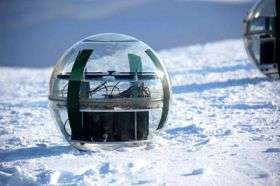
An international group of scientists has swapped their comfortable offices for one of the most inhospitable environments on the planet to carry out a challenging field campaign that is seen as the key to ensuring the data delivered by ESA's ice mission CryoSat will be as accurate as possible.
The scientists, mainly from Denmark, UK, Germany and Canada, are currently in the middle of CryoSat Validation Experiment (CryoVEx) 2008, an extensive three-week experiment programme in the far north of Greenland and Canada. CryoVEx 2008 is a continuation of a number of earlier campaigns that focus on collecting data on the properties snow and ice over land and sea.
The data collected during the campaigns will later enable scientists to accurately interpret the variations in ice thickness with time, which will be measured by the Earth Explorer CryoSat mission.
Although CryoVEx 2008 builds on previous exercises and the scientists are fairly seasoned when it comes to enduring the harsh Arctic environment, this year's campaign is a huge logistical undertaking as airborne, helicopter and ground measurements are being taken simultaneously in three different locations - out on the floating sea-ice north of the Canadian Forces Station Alert, on the Devon ice cap in Canada and on the vast Greenland ice cap.
The campaign includes a unique experiment in northern Greenland where the 'cold' ice is assumed to be similar to large parts of Antarctica. Accessing the planned northern areas has been particularly complicated due to limited infrastructure, military permits, unforgiving weather, large distances and a host of other constraints.
Despite these constraints, the range of equipment put to the service of the campaign is impressive. They include a Twin Otter carrying on-board the two key instruments for the investigations: ASIRAS, a radar altimeter that mimics the radar altimeter on-board CryoSat-2 and a laser scanner which maps the surface beneath the plan, and a helicopter with an on-board sensor that measures sea-ice thickness.
A second Twin-Otter is being used to position UK and Canadian scientists on the Greenland Ice Sheet, Devon Ice Cap and Alert and US and Canadian military aircraft are put into action to transport fuel to the Alert station and scientists.
"One of the key experiments will be to acquire coincident airborne and helicopter measurements over sea ice", says Rene Forsberg from the Danish National Space Centre who is responsible for the airborne programme. "In two previous campaigns we have been only partially successful and we would really like to know whether this novel experimental activity is possible and can contribute to the validation of CryoSat data over sea ice."
Launching in 2009, CryoSat-2 is specifically aimed at advancing our understanding of polar ice cover and its response to climate change. CryoSat-2 will measure fluctuations in the thickness of ice both on land and floating in the sea to provide a clear picture of the influence that climate change is having on the Earth's polar ice masses.
There are many challenges associated with building, launching and successfully operating an Earth Observation satellite and amongst the list of challenges is making sure that the resulting data is as accurate and meaningful as possible, which includes an assessment of the extent to which they may be in error.
As the CryoSat signal is sensitive to variations in the properties of snow and ice, it is crucial to understand, and then correct for, changes that occur naturally so that long-term trends can be determined with the highest possible precision.
ESA has therefore gone to considerable lengths to organise the series of CryoVEx campaigns in the Arctic to simulate the measurements that CryoSat-2 will take. This includes flying an airborne version of the CryoSat-2 radar altimeter and a laser altimeter to take measurements of ice while teams on the ground take measurements as the plane passes over.
Malcolm Davidson, ESA's CryoSat-2 Validation Manager explains, "As the airborne measurements have a much higher resolution than measurements made from a satellite, scientists can use the CryoVEx campaign to make direct comparisons between ground and airborne measurements. The knowledge gained with local measurements is then extrapolated to a global scale to predict the influence of snow and ice properties on the CryoSat-2 measurements from space."
Already halfway through the campaign, a huge amount of data has already been successfully collected and scientists look forward to completing the campaign with the knowledge that their hard work will go a long way in helping the CryoSat mission reach its goal of measuring ice-thickness change with unprecedented accuracy.
Source: European Space Agency


