Powering up IT for professional learning
The study and implementation of technology-enhanced professional learning has been fragmented. Now European researchers have linked such ‘islands’ of knowledge into a thriving, collaborative community.
The EU-funded PROLEARN project was set up four years ago to bridge the currently existing gap between research and education at universities and similar organisations, and training and continuous education that is provided for and within companies.
The connections created gives members on the networks the ability to develop a whole new breed of educational tools and technologies that could benefit learners in their professional spheres and workplaces.
More and more companies are realising they must invest in their employees’ continuing education to stay competitive. PROLEARN brings together the key research groups, other organisations and industrial partners, helping to create a ‘network of excellence’ in professional learning and training, says Dr Eelco Herder, the project’s manager.
The project leverages the significant resources universities and research centres all over Europe have devoted to improving technology-enhanced learning (TEL).
“Before PROLEARN, universities all over Europe often had exciting projects,” he says. “But they tried to find stand alone solutions. Little isolated islands of knowledge had their own standards, their own communications systems, their own proprietary TEL products and services.”
The power of shared knowledge
The basic aim of the project was to share knowledge and develop it via joint research projects.
“Because academic institutions are where TEL is being researched, they become the first adopters of new technologies, but there are also implications for the corporate world,” he says.
To ensure the wider adoption of TEL, systems from different institutions need to share data and ‘talk’ with one another. To promote system compatibility, the researchers employ an educationally-focused Simple Query Interface (SQI), a very basic application containing programming commands.
The SQI takes care of sending and responding to user queries, making it relatively easy to implement across the different systems used by universities around Europe.
“Despite some excellent results, this is still a work in progress because it is a political as well as a technological challenge,” Herder admits. “Quite apart from the technology aspect, people have to be persuaded adoption is in their best interests. The more people use it, the more effective it will be.”
To further the task the project’s researchers have also set up a new European Association for Technology Enhanced Learning (EATEL), and established annual conferences and events that will endure in their own right.
PROLEARN is also providing support to companies by establishing a Virtual Competence Centre. The networking service is designed to help improve the effectiveness of competence centres run by individual companies or by trade and industry associations.
Meanwhile the PROLEARN Academy, another network, is designed to transfer research results into education and training programmes, international conferences, and scientific journals.
PROLEARN is also testing software tools in common usage throughout the TEL community.
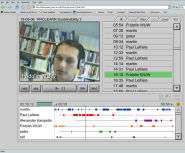
These have applications such as videoconferencing, web browsing and portfolio management. One of the most popular of these has been FlashMeeting, created by the UK’s Open University and currently offered to the community by EATEL.
FlashMeeting is a simple solution for videoconferencing via a web browser. The program has been adopted by academics around Europe and overseas due both to its ease of use and its features.
PROLEARN’s researchers have also helped developed other popular software tools, including the Conzilla dedicated browser and the Confolio portfolio management system. The programs are available free to EATEL’s members.
Academics struggle with commercial world
So far the research partners have not made a serious attempt to commercialise the programs, although they are exploring ways of developing sustainable business models.
“Academics are not primarily interested in creating commercial business models, but if we offer companies the chance to become paying members of our community they will be able to offer their ideas and use our infrastructure,” Herder says. “That will help pay for our ongoing staff and other costs for maintaining and further developing our tools and platforms.”
Private sector organisations and policy makers were able to exchange ideas with the TEL community at the first ECTEL conference in 2006.
Last year the second edition of the conference attracted about 200 delegates from 30 countries. Organisers expect a similar turnout this year on 17-19 September in Maastricht, the Netherlands.
The PROLEARN Summer School, which brings together graduate students and leading academics in TEL, has also been a great success for several years, according to Herder. The school will also continue and this year it will take place in Ohrid, Macedonia.
Meanwhile PROLEARN’s research partners have developed some forecasts on what education will look like by 2020. Collaboration will continue to be the key, the partners believe.
“The learner will not just be a consumer of knowledge, but somebody who is also able to create knowledge using external forces and feed it back into the community,” Herder says. “Learning becomes a two-way street and intelligence becomes collective by being part of a community.
He adds: “We hope PROLEARN has created a legacy for TEL by leaving a roadmap for research and an infrastructure which will make sure the community does not split up and go back to being a series of isolated islands.”
PROLEARN received funding from the EU's Sixth Framework Programme for research as a 'Network of Excellence' programme dealing with technology enhanced professional learning.
Source: ICT Results


