Planets by the Dozen
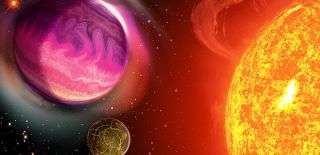
You know the planets of our solar system, each a unique world with its own distinctive appearance, size, and chemistry. Mars, with its bitter-cold, rusty red sands; Venus, a fiery world shrouded in thick clouds of sulfuric acid; sideways Uranus and its strange vertical rings. The variety is breathtaking.
Now imagine the variety that must exist in hundreds of solar systems. There may be worlds out there that make Venus seem hospitable and Uranus positively upright. Only 20 years ago, astronomers were unsure whether any such worlds existed beyond our own solar system. Now, they've found more than 280 of them, each with its own planetary "personality," each a fascinating example of what a world can be.
Yet the heyday of planetary discovery is only just beginning. This fall, astronomers will start a massive search for new planets by observing about 11,000 nearby stars over 6 years. This number dwarfs the roughly 3,000 stars that astronomers have searched to date for the presence of planets. Scientists estimate that the NASA-funded project, called MARVELS (Multi-object Apache Point Observatory Radial Velocity Exoplanet Large-area Survey), will find at least 150 new planets—perhaps many more.
"We're looking in particular for giant planets like Jupiter," says Jian Ge, principal investigator for MARVELS and an astronomer at the University of Florida in Gainesville. Ge likens big planets to "beacons of a lighthouse" signaling the presence of entire solar systems. "Once we find a big planet around a star, we know that smaller planets could be there, too."
MARVELS will do much more than just catalogue a few hundred more planets. By surveying the Jupiter-like planets around such a large number of stars, MARVELS aims to give astronomers the data they need to test competing theories for how planetary systems form and evolve.
To look at so many stars, MARVELS will use a telescope that can separately image 60 stars at a time, and this number will eventually be increased to 120 stars. The telescope, which will be housed at the Apache Point Observatory in the Sacramento Mountains of New Mexico, has a 2.5 meter primary mirror and a wide field of view that covers 7 square degrees of the sky—an area that would appear 35 times larger than the Moon.
An array of 60 fiber-optic threads will carry light from the telescope's focal plane to highly sensitive interferometers. These instruments can detect tiny changes in the frequency of a star's light. How does this help find planets? Ge explains: When a star is tugged to and fro by the gravity of an orbiting planet, the star's light is shifted to and fro in frequency--an effect called the Doppler shift. The powerful gravity of Jupiter-sized planets exerts a big tug on the parent star, making them relatively easy to find using the Doppler shift method.
If Ge and his colleagues see a star's frequency slowly increasing and decreasing in a repeating cycle over days, weeks, or months, it's a good bet that a planet is there.
Scientists are keen to learn what kinds of stars have orbiting gas giants. One theory for how these planets form predicts that stars rich in heavy elements such as silicon, oxygen, and nickel should be more likely to have Jupiter-like planets. Imagine a planet-forming disk surrounding such a star: The disk, like the star itself, would be rich in heavy elements. Those heavier elements would form rocky chunks in the disk, and these dense chunks would collide and merge to create a "planet seed" with strong enough gravity to gather gas around itself and grow into a behemoth.
So if MARVELS finds more gas giants around stars containing heavier elements, the survey would support this theory. But some gas giants might not need these heavy elements to form. Another theory suggests that Jupiter-like planets can arise simply because a disturbance in the planet-forming disk starts the gravitational collapse of a region of gas and dust—no seed required.
By examining a large number of stars with a variety of heavy element fractions, MARVELS may be able to distinguish between these two ideas.
Data from MARVELS will also shed light on other questions about planet formation, such as how often the orbits of gas giants migrate closer to their stars, and how planets sometimes end up with highly eccentric orbits instead of the nearly circular orbits predicted by theory. By surveying an unprecedented number of stars, MARVELS could deliver the data scientists need to find patterns about the conditions most favorable for planet creation, knowledge that can guide future, detailed observations of individual stars.
Follow-up observations might eventually use space telescopes powerful enough to make out the rough appearance of those many worlds. The planets we know may only hint at the marvels waiting … out there.
Source: Science@NASA, Dr. Tony Phillips


