New study finds number of fat cells stays constant throughout life
May 9th, 2008 New study finds number of fat cells stays constant throughout life

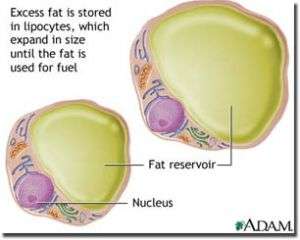
When energy input is equal to energy output, there is no expansion of fat cells (lipocytes) to accommodate excess. It is only when more calories are taken in than used that the extra fat is stored in the lipocytes and the person begins to accumulate fat. Courtesy: National Library of Medicine/National Institutes of Health

The radioactive carbon-14 produced by above-ground nuclear testing in the 1950s and '60s has helped researchers determine that the number of fat cells in a human's body, whether lean or obese, is established during the teenage years. Changes in fat mass in adulthood can be attributed mainly to changes in fat cell volume, not an increase in the actual number of fat cells.

These results could help researchers develop new pharmaceuticals to battle obesity as well as the accompanying diseases such as high blood pressure and diabetes.

A new study by Lawrence Livermore National Laboratory scientist Bruce Buchholz - along with colleagues from the Karolinska Institute in Sweden; Humboldt University Berlin, Foundation of Research and Technology in Greece; Karolinska University Hospital; and Stockholm University - applied carbon dating to DNA to discover that the number of fat cells stays constant in adulthood in lean and obese individuals, even after marked weight loss, indicating that the number of fat cells is set during childhood and adolescence.

Carbon dating is typically used in archaeology and paleontology to date the age of artifacts. However, in this application, which appeared in the May 4 early online edition of the journal Nature, the scientists used the pulse of radiocarbon to analyze fat cell turnover in humans.

Radiocarbon or carbon-14 is naturally produced by cosmic ray interactions with air and is present at low levels in the atmosphere and food. Its concentration remained relatively constant during the past 4,000 years, butatmospheric testing of nuclear weapons from 1950-1963 produced a global pulse in the amount of radiocarbon in the atmosphere, Buchholz said.

In the new study, Buchholz analyzed the uptake of carbon-14 in genomic DNA within fat cells to establish the dynamics of fat cell turnover. Approximately 10 percent of fat cells are renewed annually at all adult ages and levels of body mass index.

Neither fat cell death nor its generation rate is altered in early onset obesity, suggesting a tight regulation of the number of fat cells in obese adults.

“Fat cells change in size but no one had ever measured fat cell turnover,” Buchholz said. “An increase in cell size means it can hold more mass.”

Obesity is increasing in epidemic proportions in most countries and poses a public health problem by enhancing the risks for cardiovascular diseases and metabolic disorders such as type 2 diabetes. According to the Centers for Disease Control and Prevention, the prevalence of overweight and obesity has increased sharply for both adults and children since the 1970s. Data from two National Health and Nutrition Examination surveys show that among adults aged 20-74 years the prevalence of obesity increased from 15 percent (in the 1976-80 survey) to 32.9 percent (in the 2003-04 survey).

The two surveys also show increases in overweight children and teens. For children aged 2-5 years, the prevalence increased from 5 percent to 13.9 percent; for those aged 6-11 years, prevalence increased from 6.5 percent to 18.8 percent; and for those aged 12-19 years, prevalence increased from 5 percent to 17.4 percent.

In the Nature study, the team first found that there was a direct correlation between the measures of fat mass (measured from body mass index (BMI) and fat cell volume in subcutaneous fat, which represents about 80 percent of all fat, and visceral fat.

In a study of 687 adults, the researchers found that number of fat cells increases in childhood and adolescence, but levels off and remains constant in adulthood. The group looked at whether the number of fat cells changes under extreme conditions such as drastic weight loss by radical reduction in caloric intake, such as through bariatric surgery. The treatment resulted in a significant decrease in BMI and fat cell volume; however, it did not reduce the number of fat cells two years after the surgery. Similarly, significant weight gain (15-25 percent) over several months in non-obese adult men resulted in significant increase in body fat volume but no change in number. Subsequent weight loss back to baseline resulted in a decrease in fat cell volume but no change in the number of fat cells.

“If you are overweight and you lose weight, you still have the capacity to store lipids because you still have the same number of fat cells. That may be why it's so hard to keep the weight off,” Buchholz said.

Overweight and obesity result from an energy imbalance - eating too many calories and not getting enough physical activity. Body weight is the result of genes, metabolism, behavior, environment, culture and socioeconomic status. “This work may give us new ideas of how to deal with the diseases that go along with obesity,” Buchholz said.

Source: Lawrence Livermore National Laboratory


print this article email this article download pdf blog this article bookmark this article     Digg this Stumble it share on Facebook share on Reddit add to delicious save to Yahoo! bookmarks
4.2/5 after 16 votes

Rank Filter

Move the slider to adjust rank threshold, so that you can hide some of the comments.


Display comments: newest first

  • photojack - May 10, 2008
    • Rank: 5 / 5 (1)
    I've had a saying I've used for a decade or more about dieting and such, stated like a "formula." "If your caloric intake exceeds your caloric needs... you'll get fat! Did they just "discover" that? At over 50, I weigh within 5 pounds of my weight in college and I'm keeping it that way. Who ya gonna call? FAT BUSTERS! :-)
  • MikeMarianiMD,FAAP - May 10, 2008
    • Rank: not rated yet
    I was taught this in medical school in 1978.

May 9th, 2008 all stories
Medicine & Health / Research

Comments: 2
Rank: 4.2/5 after 16 votes

  • Stumble this up

  • Digg this

  • Share it:
  • share on Facebook
  • share on MySpace
  • share on Slashdot
  • rss-newsfeed
  • share on Google
  • share on Reddit
  • add to delicious
  • save to Yahoo! bookmarks
  • share on Windows Live
  • Add to Mixx!
Rating: 4.2/5 after 16 votes

  • Related Stories

  • Newly discovered gene regulates balance of 'bad' cholesterol
    created Jul 02, 2009 | popularity not rated yet | comments 0
  • Human cardiac master stem cells identified
    created Jul 01, 2009 | popularity not rated yet | comments 0
  • The battle for CRTC2: How obesity increases the risk for diabetes
    created Jun 21, 2009 | popularity not rated yet | comments 0
  • Fallopian tubes offer new stem cell source
    created Jun 18, 2009 | popularity not rated yet | comments 0
  • Peripheral nerve repair with fat precursor cells led to wider nerves and less muscle atrophy
    created Jun 16, 2009 | popularity not rated yet | comments 0

Tags


  • Physicists Demonstrate Quantum Memory with Matter Qubits
    Physicists Demonstrate Quantum Memory with Matter Qubits
    Physics / General Physics
    created Jul 03, 2009 | popularity 4.4 / 5 (17) | comments 1
  • 'Holey' Nanosheets for Wastewater Dye Removal
    Nanotechnology / Nanomaterials
    created Jul 01, 2009 | popularity 5 / 5 (5) | comments 1
  • Jellyfish Robot Swims Like its Biological Counterpart
    Jellyfish Robot Swims Like its Biological Counterpart
    Electronics / Robotics
    created Jun 26, 2009 | popularity 4.4 / 5 (8) | comments 1
  • Could Maxwell's Demon Exist in Nanoscale Systems?
    Could Maxwell's Demon Exist in Nanoscale Systems?
    Physics / General Physics
    created Jun 24, 2009 | popularity 4.4 / 5 (18) | comments 29
  • Living Safely with Robots, Beyond Asimov's Laws
    Living Safely with Robots, Beyond Asimov's Laws
    Electronics / Robotics
    created Jun 22, 2009 | popularity 4.6 / 5 (53) | comments 40
  • Other News

    Microscopic 'beads' could help create 'designer' immune cells that ignore transplanted organs

    Microscopic 'beads' could help create 'designer' immune cells that ignore transplanted organs

    Medicine & Health / Research

    created 11 minutes ago | popularity not rated yet | comments 0

    The future of organ transplantation could include microscopic beads that create "designer" immune cells to help patients tolerate their new organ, Medical College of Georgia researchers say.


    Caffeine reverses memory impairment in Alzheimer's mice

    Caffeine reverses memory impairment in Alzheimer's mice

    Medicine & Health / Research

    created 5 hours ago | popularity not rated yet | comments 0

    Coffee drinkers may have another reason to pour that extra cup. When aged mice bred to develop symptoms of Alzheimer's disease were given caffeine - the equivalent of five cups of coffee a day - their memory ...


    Overweight individuals have greater risk of reduced memory and thinking skills in late life

    Medicine & Health / Health

    created 2 hours ago | popularity 1 / 5 (1) | comments 0

    Individuals with higher mid-life Body Mass Index (BMI) in the 1960s have been found to have lower memory and thinking skills and a sharper decline in these abilities in old age, compared to those with lower BMI in mid-life.


    Researchers find possible environmental causes for Alzheimer's, diabetes

    Medicine & Health / Diseases

    created 5 hours ago | popularity 5 / 5 (2) | comments 0

    A new study by researchers at Rhode Island Hospital have found a substantial link between increased levels of nitrates in our environment and food with increased deaths from diseases, including Alzheimer's, diabetes mellitus ...


    Variations in 5 genes raise risk for most common brain tumors

    Medicine & Health / Genetics

    created 21 hours ago | popularity not rated yet | comments 1

    Common genetic variations spread across five genes raise a person's risk of developing the most frequent type of brain tumor, an international research team reports online in Nature Genetics.