Female concave-eared frogs draw mates with ultrasonic calls
May 11, 2008
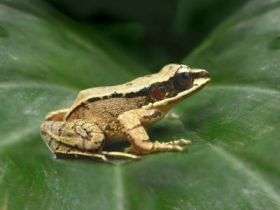
O. tormota lives in a noisy environment on the brushy edge of streams in the Huangshan Hot Springs, in central China, where waterfalls and rushing water provide a constant din. Photo courtesy of Albert Feng
Most female frogs don’t call; most lack or have only rudimentary vocal cords. A typical female selects a mate from a chorus of males and then –silently – signals her beau. But the female concave-eared torrent frog, Odorrana tormota, has a more direct method of declaring her interest: She emits a high-pitched chirp that to the human ear sounds like that of a bird. This is one of several unusual frog-related findings reported this week in the journal Nature.
O. tormota lives in a noisy environment on the brushy edge of streams in the Huangshan Hot Springs, in central China, where waterfalls and rushing water provide a steady din. The frog has a recessed eardrum, said Albert Feng, a professor of molecular and integrative physiology at the University of Illinois and team leader on the new study.
“In the world we know of only two species – the other one in southeast Asia – that have the concave ear,” Feng said. “The others all have eardrums on the body surface.”
Earlier studies, conducted by Feng, Jun-Xian Shen at the Institute of Biophysics at the Chinese Academy of Sciences and Peter Narins at the University of California, Los Angeles, found that O. tormota males emit – and respond to – unusual chirping calls from other males. These calls are audible, but also have energy in the ultrasonic range. The recessed ear structure protects an eardrum that is 1/30 the thickness of that of a normal frog, allowing it to detect very high frequency sounds.
The unusual ear structure and the high-pitched calls are likely an evolutionary adaptation to the noisy environment, Feng said. The waterfalls and streams produce a steady racket predominantly in a lower frequency range than that used by the frogs.
Laboratory experiments showed that the frogs could hear most of the audible and ultrasonic frequencies emitted by other O. tormota frogs. The only other animals known to use ultrasonic communication are bats, dolphins, whales and some insects.
The calls are quite complex. A single O. tormota frog broadcasts its message over several frequencies at once, at harmonic intervals, like a chord strummed simultaneously on several strings.
The new analysis, conducted by Shen, Feng and Narins, found that female O. tormota frogs also emit a call that spans audible and ultrasonic frequencies. The team has not observed females vocalizing in the wild (these frogs are nocturnal and can leap up to 30 times their body length), but in laboratory settings the females emitted calls only when they were carrying eggs.
Male O. tormota frogs exposed to recorded female calls were quite responsive, usually chirping within a small fraction of a second.
“The frog’s response is instantaneous – right after the stimulus,” Feng said.
In the laboratory, the males usually chirped and then leapt directly at the source of the female call. Their ability to home in on the sound call was astonishingly precise, Feng said. A typical male could leap toward the sound with an accuracy of over 99 percent.
“This is just unheard of in the frog kingdom,” he said.
Only elephants, humans, barn owls and dolphins are known to detect sound with similar precision. The small distance between the frog’s ears (about one centimeter) makes its ability to localize the sound that much more impressive, Feng said.
How the female picks a mate in the wild is still unknown, however.
“We have a lot of work to do to figure out whether she directs the signal to one male or whether she lets a bunch of males come and compete, or whether there is any kind of dueting session during which she then decides: ‘OK, You’re my guy. Hop on my back and I’ll take you to the creek!’” Feng said.
These studies likely have implications for human health. Earlier research into the mechanics of frog hearing and directional hearing helped Feng and his colleagues at the U. of I.’s Beckman Institute for Advanced Science and Technology design an “intelligent” hearing aid that boosts sound signals of interest embedded in other sounds in the immediate environment of the listener.
Source: University of Illinois at Urbana-Champaign
-
Ultrasonic frogs can tune their ears to different frequencies
Jul 22, 2008 |
4.6 / 5 (8) |
5
-
Abortion curb restores birth sex ratio in Taiwan
Jan 31, 2012 |
not rated yet |
0
-
MRI study finds that depression uncouples brain's hate circuit
Oct 04, 2011 |
5 / 5 (5) |
4
-
Team identifies new breast cancer tumor suppressor and how it works
Jun 27, 2011 |
not rated yet |
0
-
Scientists discover ultrasonic communication among frogs
May 11, 2009 |
5 / 5 (4) |
1
-
Engineers build first sub-10-nm carbon nanotube transistor
Feb 01, 2012 |
4.9 / 5 (33) |
30
-
Something old, something new: Evolution and the structural divergence of duplicate genes
Jan 31, 2012 |
4.6 / 5 (7) |
1
-
The hidden nanoworld of ice crystals: Revealing the dynamic behavior of quasi-liquid layers
Jan 30, 2012 |
5 / 5 (4) |
1
-
Stock market network reveals investor clustering
Jan 27, 2012 |
3.9 / 5 (23) |
8
-
Of microchemistry and molecules: Electronic microfluidic device synthesizes biocompatible probes
Jan 26, 2012 |
5 / 5 (2) |
0
More news stories
A mitosis mystery solved: How chromosomes align perfectly in a dividing cell
Although the process of mitotic cell division has been studied intensely for more than 50 years, Whitehead Institute researchers have only now solved the mystery of how cells correctly align their chromosomes during symmetric ...
4 hours ago |
5 / 5 (5) |
0
|
The proteins ensuring genome protection
Researchers from the University of Geneva (UNIGE), Switzerland, have discovered the crucial role of two proteins in developing a cell 'anti-enzyme shield'. This protection system, which operates at the level of molecular ...
4 hours ago |
5 / 5 (2) |
0
|
Researchers find extensive RNA editing in human transcriptome
In a new study published online in Nature Biotechnology, researchers from BGI, the world's largest genomics organization, reported the evidence of extensive RNA editing in a human cell line by analysis of RNA-seq data, demons ...
4 hours ago |
5 / 5 (3) |
0
|
Entire genome of extinct human decoded from fossil
(PhysOrg.com) -- In 2010, Svante Pääbo and his colleagues presented a draft version of the genome from a small fragment of a human finger bone discovered in Denisova Cave in southern Siberia. The ...
Feb 07, 2012 |
4.7 / 5 (59) |
48
|
Why are there so few fish in the Earth's oceans?
(PhysOrg.com) -- A Stony Brook University researcher has found that, contrary to popular belief, there are not plenty of fish in the sea.
Feb 08, 2012 |
4.2 / 5 (18) |
27
|
Overeating may double risk of memory loss
New research suggests that consuming between 2,100 and 6,000 calories per day may double the risk of memory loss, or mild cognitive impairment (MCI), among people age 70 and older. The study was released today and will be ...
Google might launch Drive for cloud storage soon
(PhysOrg.com) -- Google's next big move, according to the Wall Street Journal, is a cloud storage service called Drive. Hardly first to the plate, Google is simply catching up to introducing its cloud reposi ...
Scientists discover molecular secrets of 2,000-year-old Chinese herbal remedy
For roughly two thousand years, Chinese herbalists have treated Malaria using a root extract, commonly known as Chang Shan, from a type of hydrangea that grows in Tibet and Nepal. More recent studies suggest that halofuginone, ...
New method to examine batteries -- MRI from the inside
There is an ever-increasing need for advanced batteries for portable electronics, such as phones, cameras, and music players, but also to power electric vehicles and to facilitate the distribution and storage of energy derived ...
Lab study raises questions over nano-particle impact
Tests involving chickens have raised questions about the impact on health from engineered nano-particles, the ultra-fine grains commonly used in drugs and processed foods, scientists said on Sunday.
Injured boomers beware: Know when to see doctor
(AP) -- It happened to nurse Jane Byron years after an in-line skating fall, business owner Haralee Weintraub while doing "men's" push-ups, and avid cyclist Gene Wilberg while lifting a heavy box.
May 11, 2008
Rank: not rated yet