ISU researcher performs first veterinary corneal implant procedure in US
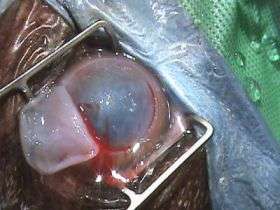
Sinisa Grozdanic an assistant professor of Veterinary Clinical Sciences performed the surgery that restored sight to 7-year-old Dixie, a Mountain Cur breed owned by Brett Williams of Runnells.
"We are excited for Dixie," said Grozdanic. "She was our patient for such a long time and nothing really worked. She was gradually going down visually and we were finally able to do something to definitely improve her quality of life."
"She is my pet and my friend," said Williams. "She is the best dog I've ever had. Even when she was almost blind, she was still my best dog."
Dixie, who had gained weight due to inactivity from her blindness, has lost seven pounds since the surgery.
"She used to walk right behind me when we'd go for a walk. She couldn't see and was scared," said Williams. "Now she wants to run ahead."
Dixie's sight was restored through a two-step surgical procedure that involves cutting into the eye to take out the cloudy cornea and inserting a permanent, plastic cornea. The new cornea is sutured, or stitched, into place. The entire eye including the new, plastic cornea is then covered with tissue from the dog to help the eye heal from the surgery. Because of the tissue and the bandages, the dog cannot see after this procedure.
After several weeks, the bandages are removed and a hole is cut into the tissue exposing the new, plastic cornea.
In addition to being the first such procedure in North America, it was one of only a few in the world. The technology is still being developed.
A German company called Acrivet is developing the plastic corneas. When Grozdanic met a company representative at a conference a few years ago, he became interested in the possibilities of doing the procedure on canine patients at Iowa State.
"These are special prototypes," said Joyce Wickham from Acrivet's U.S.-based office in Salt Lake City. "They are not made routinely, and are not yet available commercially."
Wickham is eager to get the full report from Grozdanic. Depending on what he tells the company, the corneas may soon be available to more veterinary doctors.
"Anytime you develop something, you want to know how it's going to work," she said. "If it's something that is going to work, we'll move forward with it."
The new cornea is working for Dixie, but she has very little peripheral vision, Grozdanic said.
"She is visual," he said. "For Dixie, it's like looking through a peephole."
One of the tests doctors used to see how Dixie's vision is progressing is done by simply dropping a cotton ball in front of her.
If she follows the ball with her head and eyes, they know she can see it. When they preformed the test in front of her owner and she tracked the ball, Williamson was excited.
"When I came in to watch, and they dropped that cotton ball, I thought 'I got my dog back,'" he said.
Months before the surgery, when Grozdanic described the process to Williams, he didn't hesitate to give his approval, even though the procedure was new.
"It could have failed," Williams said. "But I thought it was worth trying to see what they could do. I hope they continue to research this. It's a great lesson for everybody about taking risks."
While Grozdanic recognizes that the procedure was noteworthy because it was the first, he is most excited about the improvement in Dixie's quality of life.
"It's not a good thing because it's the first one in North America. That's really secondary," he said. "We are excited because of Dixie. She was our patient for such a long time and nothing really worked. It is interesting from the research side of it, but if you can fix something that is thought to be unfixable, it gives you a huge amount of pleasure. I think all of us here feel that way. The biggest reward comes from the patient. It's great to see a completely transformed dog, and an owner who is pleased."
Dixie has been a patient of Grozdanic for four years during which he had worked to restore, or at least retain, Dixie's deteriorating eyesight.
According to Grozdanic, corneal transplants -- using live corneal tissue from other dogs -- have a low success rate because of the high likelihood of rejection.
Canine implant corneas being produced by Acrivet are not made from biomaterial so rejection is unlikely.
Another problem with getting a transplant from a donor dog is that the cornea may turn into scar tissue during the healing process.
"It's just a fact of the species," Grozdanic said.
Artificial corneal implants are somewhat common in humans. They have been performed for several years. It has taken time for the procedure to take place in dogs.
"Humans need to work and drive cars and read, so they are more likely to have the surgery," said Grozdanic. "As long as dogs can see and have a pretty good quality of life, owners are reluctant to put them through this type of procedure. And my advice to them would be 'Don't take the risk.' But when the quality of life is severely affected, those are candidates for this procedure. We're very glad it worked out for Dixie."
Source: Iowa State University


