Designing bug perception into robots
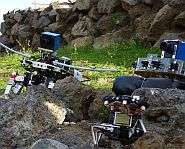
Insects have provided the inspiration for a team of European researchers seeking to improve the functionality of robots and robotic tools.
The research furthers the development of more intelligent robots, which can then be used by industry, and by emergency and security services, among others. Smarter robots would be better able to find humans buried beneath the rubble of a collapsed building, for example.
The EU-funded SPARK project set out to develop a new robot control architecture for roving robots inspired by the principles governing the behaviour of living systems and based on the concept of self-organisation.
Basing their work on the basic functions of the insect brain, the team developed a new architecture for artificial cognitive systems that could significantly increase the ability of robots to react to changing environmental conditions and to ‘learn’ behaviour in response to external stimuli.
The research team calls their new software architecture a spatial-temporal array computer based structure (SPARC).
Robots are complex systems that rely on software, hardware and mechanical systems all working together. One of the challenges facing researchers is to develop robots, or moving artefacts, that are capable of several different behaviours, that are able to sense or perceive external signals and, most importantly, are able to ‘learn’ and react appropriately to changing conditions.
For example, a robot travelling over unknown terrain may need to adapt its way of moving depending on whether it is navigating flat, rocky or wet ground. Or it may need to modify its course to reach a defined target.
The objective is to enable a robot to do this without human intervention, based on its own powers of perception and ability to adapt.
Powers of perception
Within the SPARC software architecture, the robot’s powers of perception are enhanced by its ability to use information derived from visual, audio and tactile sensors to form a dynamically evolving pattern. The pattern is in turn used to determine the movements of the device.
The researchers technical objective was to produce a moving artefact able to actively interact with its environment to carry out a set task.
The research so far has already provided a new theoretical framework, or paradigm, for active robot perception. The paradigm is based on principles borrowed from psychology, synergetics, artificial intelligence and non-linear dynamical systems theory.
Learning as you go
One of the researchers central objectives was to develop a machine with the ability to build knowledge independent of human control. Researchers based the proposed architecture for artificial cognitive systems on the basic building blocks of the insect brain.
“The SPARC architecture is a starting step toward emulating the essential perception-action architecture of living beings, where some basic behaviours are inherited, like escaping or feeding, while others are incrementally learned, leading to the emergence of higher cognitive abilities,” notes Paolo Arena, the project coordinator.
The cognitive system allows the device to autonomously ‘learn’ based on a combination of basic reflexive behaviours and feedback from external environmental data.
Once the robot is assigned a mission, compatible with its structural and mechanical capabilities – for example ‘find people alive’ – it is able to work out how best to do this itself in a particular external context.
“The robot will initially behave by using primarily the basic inherited behaviours,” says Arena. “Higher knowledge will be incrementally formed in the higher layer of the architecture, which is a neuron lattice based on the Reaction-Diffusion Cellular Non-linear Network (RD-CNN) paradigm, able to generate self-organising dynamic patterns.”
Basic behaviours incorporated in the demonstrations so far include, for example, the ability of a robot to direct itself towards a specific sound source. This optomotor reflex allows the robot to maintain heading and avoid obstacles.
During the course of the demonstration, the robot ‘learns’ how to safely reach the sound source. This it does while it is properly modulating its basic behaviours so it does not become trapped into the deadlock situations that are typical of complex and dynamically changing environments.
Next steps
The project’s experimental robots used some of the partners’ technologies, such as the real-time visual processing features of the Eye-RIS vision system, one of the lead products of Spain-based Innovaciones Microelectrònicas (Anafocus).
The project also attracted the interest of other commercial enterprises, including STMicroelectronics, which provided components and boards for Rover II, one of the robots developed by SPARK.
Altera, another company, supplied field-programmable gate array (FPGA) devices for the development and implementation of perceptual algorithms.
The advances made have led to a number of software and hardware innovations for the improvement of machine perception. The project’s industrial partners are continuing to work on the innovations.
The cognitive visual algorithms designed and improved by the project’s researchers have, for example, already been integrated into products produced by some of the project’s partners.
Hungary-based Analogic Computers, a partner in the project, has launched its InstantVision software package based on some of the research. The package has become one of the company’s lead products.
The work of the SPARK project is continuing with the SPARK II project, which will look more deeply into the details of insect brain neurobiology to refine, assess and generalise the SPARK cognitive architecture.
Further down the line, the research is expected to lead to the introduction of powerful and flexible machines suitable for use in dynamically changing environments where conditions are unstable or unpredictable, such as war zones or disaster areas.
The project has introduced a new model for action-oriented perception. Ongoing work will focus on assessing this model and on expanding it to a larger family of moving machines.
The SPARK project received funding from the EU's Sixth Framework Programme for research.
Source: ICT Results


