Put the Trees in the Ground: A solution for the global carbon dioxide problem?
May 13, 2008 Put the Trees in the Ground: A solution for the global carbon dioxide problem?

Of the current global environmental problems, the excessive release of carbon dioxide from the combustion of fossil fuels and the related global warming is one of the most pressing.

In an essay in the journal ChemSusChem, Fritz Scholz and Ulrich Hasse from the University of Greifswald introduce a possible approach to a solution: deliberately planted forests bind the CO2 through photosynthesis and are then removed from the global CO2 cycle by burial. “For the first time, humankind will give something back to nature that we have taken away before,” says Scholz.

“Whereas other environmental problems can, at least in principle, be solved by the appropriate modern technology,” reports Scholz, “there are no realistic solutions for the CO2 problem.” At present, a daunting 32 gigatons of CO2 are released into the atmosphere every year. Previous proposals to pump the CO2 into the oceans are not practicable or are ecologically problematic.

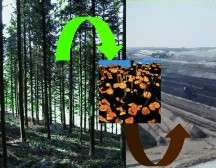
The only possible way to bind sufficiently large quantities of CO2 from the atmosphere is photosynthesis. However, the resulting biomass cannot be burned or composted, because this would release the bound CO2. The trick will be to make the biomass “disappear”. Scholz recommends planting forests whose wood will subsequently be buried. Possible burial sites include open brown coal pits or other surface mines. These should be filled with wood and covered with soil. Cut off from the air in this manner, the wood would not change, even over long periods. It could in principle be dug up in the future and used.

According to estimations made by Scholz and Hasse, we would have to plant a little over one billion (109) hectares of forest in order to bind all of the carbon dioxide produced in a year. This corresponds roughly to the surface of the virgin forest cut down in the last century. This project could be financed by an additional tax of 0.11 € per liter of gasoline or 0.003 € per kilowatt-hour of electricity.

“The forests should be planted in countries that are suitable for growing forest and also have the necessary sites for burial of the wood,” stresses Scholz. “Other countries, the primary consumers of fossil fuels, can pay them for it. This would produce a global trade that would benefit everyone involved.”

Citation: ChemSusChem, doi: 10.1002/cssc.200800048

Source: Wiley


print this article email this article download pdf blog this article bookmark this article     Stumble it Digg this share on Facebook retweet share on Reddit add to delicious
Rate this story - 2.8 /5 (6 votes)

Rank Filter

Move the slider to adjust rank threshold, so that you can hide some of the comments.


Display comments: newest first

  • Zig158 - May 13, 2008
    • Rank: 5 / 5 (2)
    First off wouldn%u2019t it be far more effective to grow and bury algae or other single celled organism due to higher efficiency and faster growth rate. Second I%u2019m assuming they are meaning 11 cents per liter tax increase since Physorg.com is an American publication. If you work that out that is 41 cents per galleon. That is all that the lower and middle class need is an even heaver burden wile layoffs and pay cuts becoming more and more common every day. Finally one billion hectares is 3,861,021.6 square miles, which is more land than the entire United States. If you think it is such a good idea you pay for it you elitist hack.
  • AJW - May 13, 2008
    • Rank: 4 / 5 (1)
    Reads like a sixth grade essay on making a better world.
  • Zig158 - May 13, 2008
    • Rank: 4 / 5 (1)
    I'm reading this on a mac so of course special characters don't work.
  • DGBEACH - May 13, 2008
    • Rank: 3 / 5 (1)
    Actually Zig158, the USA occupies 5983239.75 sq.miles
  • Corban - May 13, 2008
    • Rank: 5 / 5 (1)
    While we're on the subject of fast-growing plants to bind CO2, why not bamboo? It's a grass that grows almost a meter a day under the proper conditions. Hell, you could even cut them down and "bind" the CO2 into housing material that way it both stays out of the air and is actually useful, as opposed to being some creative way to balance out the druid accounting.
  • bobwinners - May 13, 2008
    • Rank: 5 / 5 (1)
    Why don't we just get off the carbon cycle all together? We will have to, sooner or later. Sooner will be better for the citizens of the US. Energy independence in today's world would provide the US with tremendous freedom.

May 13, 2008 all stories

Comments: 6

2.8 /5 (6 votes)
  • Stumble this up

  • Digg this

  • share this

  • hide
  • Related Stories

  • Antarctic ice loss vaster, faster than thought: study
    created 22 hours ago | popularity not rated yet | comments 0
  • Scientific debate sparked over carbon sink data
    created Nov 18, 2009 | popularity not rated yet | comments 0
  • Fighting climate change by turning CO2 to stone
    created Nov 17, 2009 | popularity not rated yet | comments 0
  • Fossil fuel CO2 emissions up by 29 percent since 2000
    created Nov 17, 2009 | popularity not rated yet | comments 0
  • Scientists Find Ozone Levels Already Affecting Soybean Yields
    created Nov 17, 2009 | popularity not rated yet | comments 0


Other News

New hydrogen-storage method discovered

New hydrogen-storage method discovered

Chemistry / Materials Science

created 23 hours ago | popularity 4.3 / 5 (33) | comments 11

Scientists at the Carnegie Institution have found for the first time that high pressure can be used to make a unique hydrogen-storage material. The discovery paves the way for an entirely new way to approach ...


Accidental discovery produces durable new blue pigment for multiple applications

Accidental discovery produces durable new blue pigment for multiple applications

Chemistry / Biochemistry

created Nov 16, 2009 | popularity 4.5 / 5 (32) | comments 6

An accidental discovery in a laboratory at Oregon State University has apparently solved a quest that over thousands of years has absorbed the energies of ancient Egyptians, the Han dynasty in China, Mayan ...


One word: bioplastics

One word: bioplastics

Chemistry / Materials Science

created Nov 17, 2009 | popularity 4.6 / 5 (13) | comments 4

(PhysOrg.com) -- Every year, more than 250 billion pounds of plastic are produced worldwide. Much of it ends up in the world's oceans, a fact that troubles MIT biology professor Anthony Sinskey.


New on-off 'switch' triggers and reverses paralysis in animals with a beam of light

New on-off 'switch' triggers and reverses paralysis in animals with a beam of light (w/ Video)

Chemistry / Biochemistry

created Nov 18, 2009 | popularity 4.8 / 5 (5) | comments 4

In an advance with overtones of Star Trek phasers and other sci-fi ray guns, scientists in Canada are reporting development of an internal on-off "switch" that paralyzes animals when exposed to a beam of ultraviolet ...


New research provides blueprint for molecular basis of global warming

New research provides blueprint for molecular basis of global warming

Chemistry / Materials Science

created Nov 17, 2009 | popularity 4 / 5 (4) | comments 3

A new study indicates that major chemicals most often cited as leading causes of climate change, such as carbon dioxide and methane, are outclassed in their warming potential by compounds receiving less attention.