Air pollution, smoking affect latent tuberculosis
May 13, 2008
Mtb Lesions

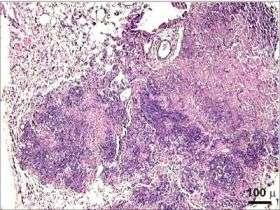
TB lung lesions stained to show CO fingerprint biology. Credit: UAB

A toxic gas present in air pollution and tobacco smoke plays a significant role in triggering tuberculosis infection, according to a new study from researchers at the University of Alabama at Birmingham (UAB).

The UAB study focused on carbon monoxide (CO), a colorless, odorless gas present in tobacco smoke, and vehicle and manufacturing plant emissions. Also, CO is produced naturally in brushfires and volcanic gas.

The study showed that CO triggers Mycobacterium tuberculosis (Mtb), the causative agent of tuberculosis, to shift from active infection to a drug-resistant dormant state. This is called latency, a global problem that results in tuberculosis escaping detection and treatment, and which contributes to overall tuberculosis transmission.

“This is the first description of a role for CO in mycobacterial pathogenesis, and may explain why smoking and air pollution contributes to TB,” said Adrie Steyn, Ph.D., assistant professor in UAB’s Department of Microbiology and lead author on the study.

The findings were published online in The Journal of Biological Chemistry.

In the study, the researchers worked with Mtb cells under biosafe laboratory conditions and found Mtb proteins ‘sense’ CO at the molecular level, much like the bacteria’s proteins sense other gases in the lungs. The CO interaction is what led to a series of biological steps that sent Mtb into latency.

The finding holds political and social implications for speeding up clean-air measures as a way to improve public health, in addition to the environmental significance. The study holds promise for helping to discover new ways to fight extreme drug-resistant tuberculosis, or XDR TB, the UAB researchers said.

“We’re talking about huge socio-economic and public health implications,” said Steyn. One third of the world’s population is infected with undetectable forms of tuberculosis, which hinders screening and eradication efforts.

The finding adds to a growing understanding that exposure to high levels of CO through air pollution and cigarette smoke plays a role in tuberculosis infection rates. Also, the study showed that low levels of CO present in the body are capable of triggering tuberculosis latency, Steyn said. Inflammation, infection and oxidative stress are among contributors to CO in the body.

Research published by Steyn in 2007 showed that combined production of CO, oxygen and nitric oxide should be used in future models of Mtb persistence.

Source: University of Alabama at Birmingham


Rank 5 /5 (3 votes)
Tags

Relevant PhysicsForums posts

More news stories

WSU chemist applies Google software to webs of the molecular world

The technology that Google uses to analyze trillions of Web pages is being brought to bear on the way molecules are shaped and organized.

Chemistry / Other

created 54 minutes ago | popularity not rated yet | comments 0

Compound may help in fight against antibiotic-resistant superbugs

North Carolina State University chemists have created a compound that makes existing antibiotics 16 times more effective against recently discovered antibiotic-resistant "superbugs."

Chemistry / Biochemistry

created 3 hours ago | popularity 5 / 5 (1) | comments 0 | with audio podcast

Ordered planar polymers created for the first time

(PhysOrg.com) -- Scientists under the direction of ETH Zurich have created a minor sensation in synthetic chemistry. They succeeded for the first time in producing regularly ordered planar polymers that form ...

Chemistry / Polymers

created 12 hours ago | popularity 4.1 / 5 (7) | comments 2 | with audio podcast

Manipulating genes with hidden TALENs

(PhysOrg.com) -- A better understanding of gene function in model plant and animal systems could be used to develop useful traits in livestock and crop plants, and might someday lead to developments in stem ...

Chemistry / Biochemistry

created 11 hours ago | popularity 5 / 5 (2) | comments 0 | with audio podcast

Pharmaceuticals from crab shells

The pharmaceutical NANA is 50 times more expensive than gold. Now it can be produced from chitin - a very cheap natural resource. The process was made possible by genetically modifying mold fungi.

Chemistry / Biochemistry

created 7 hours ago | popularity 5 / 5 (3) | comments 0


Plants use circadian rhythms to prepare for battle with insects

In a study of the molecular underpinnings of plants' pest resistance, Rice University biologists have shown that plants both anticipate daytime raids by hungry insects and make sophisticated preparations to ...

Sensing self and non-self: New research into immune tolerance

At the most basic level, the immune system must distinguish self from non-self, that is, it must discriminate between the molecular signatures of invading pathogens (non-self antigens) and cellular constituents that usually ...

Missing dark matter located: Intergalactic space is filled with dark matter

Researchers at the University of Tokyo’s Institute for the Physics and Mathematics of the Universe (IPMU) and Nagoya University used large-scale computer simulations and recent observational data of gravitational ...

Scientists discover reason for Mt. Hood's non-explosive nature

(PhysOrg.com) -- For a half-million years, Mount Hood has towered over the landscape, but unlike some of its cousins in Oregon’s Cascade Mountains and many other volcanoes around the Pacific “Rim ...

Radiation treatment transforms breast cancer cells into cancer stem cells

Breast cancer stem cells are thought to be the sole source of tumor recurrence and are known to be resistant to radiation therapy and don't respond well to chemotherapy.

Cut your Valentine some slack

If the one you love usually forgets Valentine's Day, but this year makes a romantic effort, you should give him credit for trying.