Astronaut health on moon may depend on good dusting
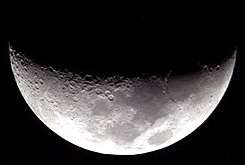
Lunar dust could be more than a housekeeping issue for astronauts who visit the moon. Their good health may depend on the amount of exposure they have to the tiny particles.
To prepare for a return to the moon, researchers with the National Space Biomedical Research Institute (NSBRI) are evaluating how dust deposits in the lungs in reduced gravity in order to assess the health risk of long-term exposure to the particles. The findings will influence the design of lunar bases and could also provide benefits for healthcare on Earth, such as improved delivery of aerosol medications to the lungs.
NSBRI Human Factors and Performance Team researcher Dr. Kim Prisk said there are major questions that need to be answered. “In the big picture, the questions are: How much goes into the lung? Where does it go? How long does it stay? And how nasty is the stuff?” said Prisk, who is an adjunct professor in the Department of Medicine at the University of California, San Diego.
During the Apollo lunar missions in the late 1960s and 1970s, the clingy particles were easily transported via spacesuits into the lunar lander following moonwalks. The amount of dust inside the vehicle was so great some astronauts reported they could smell it.
Even though there were no known illnesses due to exposure, lunar dust is a concern because it has properties comparable to that of fresh-fractured quartz, a highly toxic substance. However, the Apollo flights lasted only a few days. During the proposed return to the moon, astronauts will be exposed to lunar dust for longer periods of time, including missions that could last months.
Due to the moon’s reduced gravity and the size of its dust particles, the respiratory system’s process to remove unwanted matter may not work as efficiently as it does on Earth. “In the moon’s fractional gravity, particles remain suspended in the airways rather than settling out, increasing the chances of distribution deep in the lung, with the possible consequence that the particles will remain there for a long period of time,” Prisk said.
The lungs are a highly sensitive organ because of the large surface area that delivers oxygen molecules through a thin membrane directly to the blood. The health risk to astronauts increases as dust particles go deeper into the lungs.
To conduct the research, scientists take measurements during flights on NASA’s Microgravity Research Aircraft. These airplanes are used to provide short periods of reduced- and zero-gravity during a series of steep climbs and descents.
“During the portions of the flight in which gravity is reduced to levels seen on the lunar surface, we inject particles into a mouthpiece through which the study participants breathe,” Prisk said. “Subjects breathe in and out, and we measure how the particles behave and how many end up inside the lung.”
Prisk said the research flights have been beneficial so far. “With the reduced-gravity flights, we’re improving the process of assessing environmental exposure to inhaled particles,” he said. “We’ve learned that tiny particles (less than 2.5 microns) which are the most significant in terms of damage, are greatly affected by alterations in gravity.”
The next step is to investigate the risks and determine ways to limit exposure. The severity of the risks will determine the level of engineering work needed to limit exposure to lunar dust, which also can cause problems for equipment.
As for benefits on Earth, the research could give scientists a better understanding of how the lungs work, improving the understanding of how particles distribute within the lungs.
“If we learn how to target drugs to specific areas inside the lung, it will be possible to achieve optimal results with small quantities of drugs delivered to exactly the right place in the lung, and it will minimize side effects,” Prisk said.
Source: National Space Biomedical Research Institute


