DNA fingerprinting simplified
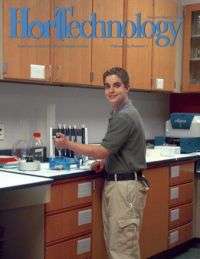
Agarose gel electrophoresis? Most teenagers wouldn’t have a clue what this scientific term means, but middle school student Andrew Trigiano knows the protocol inside and out. When Andrew was 12, his father Robert Trigiano, a professor at the University of Tennessee, was looking for an interesting science project for his son. Setting out to compare differences in popular brands of Easter egg dyes, Trigiano’s project soon grew into a full-blown scientific study and set of replicable classroom experiments.
One of the most frequently used tools in biochemistry and biotechnology, agarose gel electrophoresis is a common forensic technique often used in genetic or DNA fingerprinting. The procedure is achieved by moving negatively charged nucleic acid molecules through a gelatinous substance known as agarose by using an electric field.
Andrew, in collaboration with his father and other researchers, completed the study, which is published in the January 2008 issue the American Society of Horticultural Science’s journal HortTechnology. The youngest author ever to publish in an ASHS journal, Andrew was only 12 when he began the research project and 14 when the study was published.
The resulting experiments were developed for use in middle and high school classrooms or for teachers and undergraduate students who have limited hands-on experience with this technique. As Dr. Trigiano explained, “one experiment, electrophoresis of common food dyes, was designed for secondary and undergraduate students but can be used as an inexpensive means for introducing the main concepts of electrophoresis to anyone. Popular brands of food dyes (red, blue, yellow, and green) purchased at local markets are mixed into a 60% glycerol/water solution and are separated on 1% agarose gels. Mixed colors are separated into primary colors (e.g., green into blue and yellow) and some apparently single dyes often have extra “surprise” components.”
Explaining another experiment from the study, Trigiano continued: “The second laboratory exercise requires more extensive equipment and a more advanced set of skills, but the exercise has been completed successfully by middle school-level through graduate-level students and teachers. In this exercise, the internally transcribed spacer region of the ribosomal subunit for a fungus, plant, and insect are amplified and separated electrophoretically on agarose gels. A simple crime is solved using polymerase chain reaction (PCR) and DNA fingerprinting.”
The experiments outlined in the study provide students with hands-on practice assembling master mixes for PCR, using pipettes, and performing the various steps involved in PCR amplification. Instructions for both exercises are formatted in easy-to-follow procedure boxes, and a downloadable presentation is available on the web. The cost of supplies is about one dollar per student, making these exercises relatively inexpensive to conduct.
Dr. Trigiano hopes the experiments will be a vehicle to introduce electrophoresis to students of all ages. “The experiments are fun, engaging and inexpensive compared to most commercially available kits. The downloadable PowerPoint presentation also helps explain the process visually. The techniques are easily understood and completed by students of all ages with a minimum of equipment and other resources.”
Trigiano attributes his son Andrew for much of the research study’s success. “Andrew did most of the PowerPoint presentation, the dye figures in the article, much of the experimentation with the dyes and helped develop the dye-based forensic exercise.” From the results, it’s clear that this teenager has science in his DNA.
The complete study and abstract are available on the ASHS HortTechnology electronic journal web site: horttech.ashspublications.org/ … nt/abstract/18/1/177
Source: American Society for Horticultural Science


