Scientists aim to unlock deep-sea 'secrets' of Earth's crust
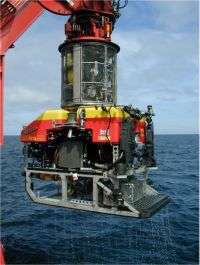
May 14, 2008 The ISIS Robot

The ISIS robot which will be used by scientists to collect rock samples from volcanoes on the Mid-Atlantic Ridge two miles (3km) below the surface of the sea. Photograph courtesy of the Natural Environment Research Council

Scientists from Durham University will use robots to explore the depths of the Atlantic Ocean to study the growth of underwater volcanoes that build the Earth’s crust.

The Durham experts will lead an international team of 12 scientists aboard Britain’s Royal Research Ship James Cook which will set sail from Ponta Delgada, San Miguel, in the Azores on Friday, May 23.

During the five-week expedition they will use explorer robots to map individual volcanoes on the Mid-Atlantic Ridge tectonic plate boundary – which effectively runs down the centre of the Atlantic Ocean - almost two miles (3km) below the surface of the sea.

They will then use another robot, called ISIS, to collect rock samples from the volcanoes which will be dated using various techniques to shed more light on the timescales behind the growth of the Earth’s crust and the related tectonic plates.

As tectonic plates – formations that make up the Earth’s shell - are pulled apart by forces in the Earth, rocks deep down in the mantle are pulled up to fill the gap left behind. As the rocks rise they start to melt and form thousands of volcanoes on the sea floor which eventually cluster into giant ridges.

The ridges along the Mid-Atlantic Ridge plate boundary are each about the size of the Malvern Hills and contain hundreds of individual volcanoes.

Principal investigator Professor Roger Searle, in the Department of Earth Sciences, at Durham University, said: “The problem is that we don’t know how fast these volcanoes form or if they all come from melting the same piece of mantle rock.

“The ridges may form quickly, perhaps in just 10,000 years (about the time since the end of the last Ice Age) with hundreds of thousands of years inactivity before the next one forms, or they may take half-a-million years to form, the most recent having begun before the rise of modern humans.

“Understanding the processes forming the crust is important, because the whole ocean floor, some 60 per cent of the Earth’s surface, has been recycled and re-formed many times over the Earth’s history.”

Professor Searle’s team will include scientists from the National Oceanography Centre, Southampton, the Open University, the University of Paris and several institutions in the USA.

They will date the volcanoes using radiometric dating (which measures the radioactive decay of atoms) and by measuring the changing strength of the Earth’s magnetic field through time as recorded by the natural magnetism of the rocks.

Source: Durham University


print this article email this article download pdf blog this article bookmark this article     Stumble it Digg this share on Facebook retweet share on Reddit add to delicious
Rate this story - 4.2 /5 (9 votes)


May 14, 2008 all stories

Comments: 0

4.2 /5 (9 votes)
  • Stumble this up

  • Digg this

  • share this

  • hide
  • Related Stories

  • Fantastic Voyage
    created Nov 02, 2009 | popularity not rated yet | comments 0
  • Previously Unknown Volcanic Eruption Helped Trigger Cold Decade
    created Oct 29, 2009 | popularity not rated yet | comments 0
  • Volcanoes played pivotal role in ancient ice age, mass extinction
    created Oct 26, 2009 | popularity not rated yet | comments 0
  • Searching for Alien Life, on Earth
    created Oct 05, 2009 | popularity not rated yet | comments 0
  • Expert: Lift taboo on Earth engineering
    created Sep 23, 2009 | popularity not rated yet | comments 0


  • hide
  • Relevant PhysicsForums posts

Other News

MIT scientists pinpoint origin of dissolved arsenic in Bangladesh drinking water

Scientists pinpoint origin of dissolved arsenic in Bangladesh drinking water

Space & Earth / Environment

created 12 hours ago | popularity 5 / 5 (9) | comments 0

Researchers in MIT's Department of Civil and Environmental Engineering believe they have pinpointed a pathway by which arsenic may be contaminating the drinking water in Bangladesh, a phenomenon that has puzzled ...


Commuters wait on the platform shrouded by fog in London

Climate change not man-made, say majority of Britons: poll

Space & Earth / Environment

created 18 hours ago | popularity 2.7 / 5 (9) | comments 22

Less than half of Britons believes that human activity is to blame for global warming, according to a poll carried out for The Times newspaper and published on Saturday.


Warmer means windier on world's biggest lake

Space & Earth / Earth Sciences

created 12 hours ago | popularity 3.3 / 5 (3) | comments 0

Rising water temperatures are kicking up more powerful winds on Lake Superior, with consequences for currents, biological cycles, pollution and more on the world's largest lake and its smaller brethren.


Geeky 'tweeters' to report on space shuttle launch (AP)

Geeky 'tweeters' to report on space shuttle launch

Space & Earth / Space Exploration

created 11 hours ago | popularity not rated yet | comments 0

(AP) -- Fingers will be flying when space shuttle Atlantis blasts off Monday: About 100 of NASA's geekiest fans will be on hand, pecking away at iPhones, BlackBerrys, laptops and other Twittering gadgets.


Hawaii's famed white sandy beaches are shrinking (AP)

Hawaii's famed white sandy beaches are shrinking

Space & Earth / Environment

created 17 hours ago | popularity 5 / 5 (1) | comments 1

(AP) -- Jenn Boneza remembers when the white sandy beach near the boat ramp in her hometown was wide enough for people to build sand castles.