Can you trust a robot to work safely with you in the kitchen?
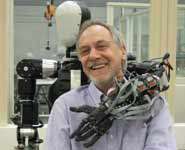
Can robots and humans work safely together? This issue will be addressed thanks to a research grant of over £1 million from the European Commission (EC).
The project called Cooperative Human Robot Interaction Systems (CHRIS), based at Bristol Robotics Lab, (BRL) is a collaborative research partnership between the University of Bristol and the University of the West of England (UWE Bristol) .
The research is based on the hypothesis that safe interaction between robots and humans can be achieved through engineering the robot and its ‘thinking’ (cognition) for joint physical tasks which involve real world objects.
It will specifically look at the problems of a human and a robot working together in the same space, for example in a kitchen where the service robot is performing a task such as stirring soup, while you add cream.
Professor Chris Melhuish, Director of BRL, explains: “When we interact with other humans we are interpreting facial expression, body position, gestures, tone of voice as well as sharing a goal and understanding and following verbal instructions.
For example in the soup situation, not only does the robot need to know what the goal is (making the soup) but he also needs to know how hard to stir the soup, what it means when you hold up your hand to say enough, to interpret the look of pain on your face if you accidentally get splashed with hot soup, and to stop stirring when told. This project aims to develop the rules we need to introduce this level of sophistication into service robots who are working closely with people.
“Robots are currently used widely in manufacturing, but they are usually limited in what tasks they perform and there are frequently physical barriers between robots and people. In a domestic situation, where a robot is performing a service or caring for people, we need to have rules and the engineering in place so that this interaction can be made safe for the humans when they are in close proximity to robots.
“Enabling robots to interact safely with humans is a key need for the future development of robotics. A key premise of this project is that it will be beneficial to our society and our economy to generate service robots capable of safe co-operative physical interaction with humans. If we can provide the ‘thinking’ (cognition) necessary for safe robot human cooperation in the same physical space then this will enable significant advancement in this area, and we will be a step closer to having service robots in society.”
The project is multi-disciplinary, involving robotic engineers, cognitive scientists, and psychologists. Much of the work will be carried out in specially designed room at BRL (based in the Dupont building at UWE) where the voice tone, gestures and expressions of researchers will be recorded and examined minutely, so that rules can be developed which can be applied to service robotics. Engineering principles of safe movement and dexterity will also be developed along with principles of language, communication, decision making and action planning - where the robot reasons explicitly with its human partner.
Source: University of Bristol


