Warming climate is changing life on global scale, says new study
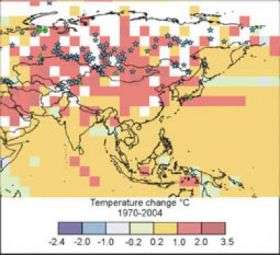
A vast array of physical and biological systems across the earth are being affected by warming temperatures caused by humans, says a new analysis of information not previously assembled all in one spot. The effects on living things include earlier leafing of trees and plants over many regions; movements of species to higher latitudes and altitudes in the northern hemisphere; changes in bird migrations in Europe, North America and Australia; and shifting of the oceans’ plankton and fish from cold- to warm-adapted communities. The study appears in the May 15 issue of the leading scientific journal Nature.
“Humans are influencing climate through increasing greenhouse gas emissions, and the warming world is causing impacts on physical and biological systems attributable at the global scale,” said lead author Cynthia Rosenzweig, a scientist at the NASA Goddard Institute for Space Studies and the Columbia Center for Climate Systems Research. Both are affiliates of The Earth Institute at Columbia University.
Rosenzweig and researchers from 10 other institutions across the world analyzed data from published papers on 829 physical systems and some 28,800 plant and animal systems, stretching back to 1970. Their analysis of revealed a picture of changes on continental scales; previous studies had looked mainly at single phenomena, or smaller areas. In physical systems, 95% of observed changes are consistent with warming trends.
These include wastage of glaciers on all continents; melting permafrost; earlier spring river runoff; and warming of water bodies. Among living creatures inhabiting such systems, 90% of changes are consistent with warming.
The researchers say it is unlikely that any force but human-influenced climate change could be driving all this; factors like deforestation or natural climate variations could not explain it. Their work builds upon the consensus of the Intergovernmental Panel on Climate Change, which in 2007 declared manmade climate warming “likely” to have discernible effects on biological and physical systems.
“It was a real challenge to separate the influence of human-caused temperature increases from natural climate variations or other confounding factors, such as land-use changes or pollution,” said coauthor David Karoly, a climate scientist at the University of Melbourne in Victoria, Australia. “This was possible only through the combined efforts of our multi-disciplinary team, which examined observed changes in many different systems around the globe, as well as global climate model simulations of temperature changes.”
The data showing the patterns of change are strongest in North America, Asia and Europe--mainly because far more studies have been done there, said Rosenzweig. On the other continents, including South America, Australia and Africa, documentation of changes in physical and biological systems is sparse, even though there is good evidence there of human-influenced warming itself. The authors say that there is an urgent need to study these environmental systems, especially in tropical and subtropical areas.
Source: The Earth Institute at Columbia University


