Astrophysicists discover youngest known supernova in Milky Way
May 14, 2008
Discovery of most recent supernova in our galaxy

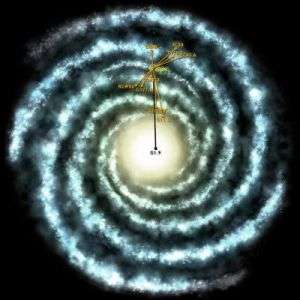
This artist's impression shows a view looking down on the Milky Way galaxy. The position of the Sun is shown, as are the approximate positions and names (shown in orange) of historical supernovas. These are stellar explosions that are thought to have occurred in the last 2,000 years and may have been seen by early astronomers. The estimated position of the recently discovered G1.9+0.3 is shown in black. Although the distance to this remnant is uncertain, the angle is accurately known. Note that G1.9+0.3 is the only object that is found in the bulge of the galaxy. Credit: NASA/CXC/M. Weiss

A North Carolina State University researcher has discovered the youngest known supernova in our galaxy. Estimated at a mere 140 years old, this celestial whippersnapper is at least 200 years younger than the next oldest known supernova, and its discovery may pave the way to a greater understanding of exploding stars.

Dr. Stephen Reynolds, an astrophysicist at NC State, led a team of researchers who suspected that a celestial object known as G1.9+0.3 was a very young supernova remnant. They examined images of the object that were taken in 2007 by NASA’s Chandra X-Ray Observatory and compared these images to those taken of the same object in 1985 by the National Radio Astronomy Observatory’s Very Large Array radio telescope.

Not only did the Chandra images confirm Reynolds’ suspicions that the object was a young supernova remnant, but the scientists discovered that the supernova had increased in size by 16 percent in just 22 years, suggesting that the initial explosion had occurred only 140 years ago – or less if the rate of explosion had been slowing.

The results will appear in the June 10 edition of Astrophysical Journal Letters.

Supernovae are exploding stars, and act as the “engines” that drive the life cycles of galaxies. A supernova explosion disperses heavy metals, cosmic rays, and high-energy particles throughout the galaxy, aiding in the formation of new stars. In fact, a supernova explosion may have helped prod our own solar system into existence.

The brightness of supernovae can easily be obscured from optical telescopes by large amounts of interstellar gas and dust, rendering them all but invisible to astronomers. X-ray and radio telescopes, however, can detect the radio waves and high energy X-rays that supernovae emit, enabling us to “see” even highly obscured explosions.

Reynolds says that the G1.9+0.3 supernova has the largest obscuration of any known galactic supernova object.

“If not for all the interstellar ‘gunk’ between us and this object, people would have seen this supernova as a new star in the constellation Sagittarius in the years around 1870 to 1900,” Reynolds adds.

“Normally, we deal with older remnants and have to work very hard to see even tiny changes. This supernova is getting brighter, which means it's still on its way up — studying it will go a long way toward filling in gaps in our knowledge of these events and their effect on galaxies.”

Source: North Carolina State University

4.7 /5 (15 votes)  

Filter


Move the slider to adjust rank threshold, so that you can hide some of the comments.


Display comments: newest first

Teonanacatl
May 14, 2008

Rank: 2 / 5 (1)
Why would they wait like a month to release this information?! Jeeeeeezus...NASA pisses me off!
drel
May 14, 2008

Rank: 4 / 5 (1)
Why? Well I'll tell you... but you'll have to wait a month for the answer, and by then you will have forgotten you asked.
x646d63
May 14, 2008

Rank: 4 / 5 (1)
What's truly annoying is that this supernova did not explode 160 years ago, its light reached earth 160 years ago. It's 26,000 light years away, so it exploded at least 26,160 years ago.
yyz
May 14, 2008

Rank: 1 / 5 (1)
Teonanacatl, I remember reading a peer-reviewed article on this SNR about a month ago at the arXiv.org site. Check there if you really want the detailed scoop on all things astro.
yyz
May 14, 2008

Rank: 3 / 5 (2)
Check out arXiv:0803.1487 for Reynolds' original paper.
barakn
May 14, 2008

Rank: 2.5 / 5 (2)
The artist's impression of the Milky Way galaxy is flawed, is it is now known to be a barred spiral.
Rank 4.7 /5 (15 votes)
Tags

Related Stories
Relevant PhysicsForums posts
  • Titan's lack of impact craters
    created18 hours ago
  • Real pictures of black hole eating a star?
    createdFeb 08, 2012
  • Hypothetical way to travel faster than light, but not technically exceed lightspeed
    createdFeb 06, 2012
  • How do scientists monitor the Sun's activity?
    createdFeb 05, 2012
  • Search patterns in observational studies
    createdFeb 05, 2012
  • Derivation of Pogson's law
    createdFeb 03, 2012
  • More from Physics Forums - General Astronomy

More news stories

Humans may have helped the decline of African rainforests 3000 years ago

(PhysOrg.com) -- Large areas of rainforests in Central Africa mysteriously disappeared over three thousand years ago, to be replaced by savannas. The prevailing theory has been that the cause was a change ...

Space & Earth / Environment

created just added | popularity not rated yet | comments 0 | with audio podcast report

New views show old NASA Mars landers

(PhysOrg.com) -- The High Resolution Imaging Science Experiment (HiRISE) camera on NASA's Mars Reconnaissance Orbiter recorded a scene on Jan. 29, 2012, that includes the first color image from orbit showing ...

Space & Earth / Space Exploration

created 21 hours ago | popularity 4.9 / 5 (7) | comments 9 | with audio podcast

Black holes and star formation

(PhysOrg.com) -- It has long been recognized that galaxy mergers or even close interactions can play a vital role in shaping the morphology of galaxies. One way they can do so, it is thought, is by triggering ...

Space & Earth / Astronomy

created 20 hours ago | popularity 4.1 / 5 (7) | comments 5 | with audio podcast

Deconstructing a mystery: What caused Snowmaggedon?

In the quiet after the storms, streets and cars had all but disappeared under piles of snow. The U.S. Postal Service suspended service for the first time in 30 years. Snow plows struggled to push the evidence ...

Space & Earth / Earth Sciences

created 13 hours ago | popularity 4.7 / 5 (3) | comments 1 | with audio podcast

Ocean microbe communities changing, but long-term environmental impact is unclear

As oceans warm due to climate change, water layers will mix less and affect the microbes and plankton that pump carbon out of the atmosphere – but researchers say it's still unclear whether these processes ...

Space & Earth / Earth Sciences

created 15 hours ago | popularity 5 / 5 (2) | comments 2 | with audio podcast


Japan scientist makes 'Avatar' robot

A Japanese-developed robot that mimics the movements of its human controller is bringing the Hollywood blockbuster "Avatar" one step closer to reality.

Fighting crimes against biodiversity: How to catch a killer weed

Invasive species which have the potential to destroy biodiversity and influence global change could be tracked and controlled in the same way as wanted criminals, according to new research from Queen Mary, University of London.

Metastatic breast cancer hitches a free ride from the immune system

Inflammatory breast cancer (IBC) is the most lethal form of breast cancer . It spreads easily through the lymphatic and blood vessels, forming metastasis which can lead to multi-organ failure. New research published in BioMed ...

A novel method for simultaneously measuring blood pressure and arterial stiffness

Arterial stiffness due to is a major contributor to cardiovascular disease but is very difficult to measure. It also can influence blood pressure readings since these rely on the time taken for arteries to return to normal ...

India's global pharmacy role threatened by EU pact

(AP) -- Efforts by India and the European Union to strengthen trade are threatening India's ability to deliver lifesaving medicines to the world's poorest, analysts say as the two sides push through protracted ...

US video game sales fall 34 percent in January

(AP) -- U.S. retail sales of video game hardware, software and accessories fell 34 percent in January from a year earlier to $751 million due to the lack of new game titles, according to market researcher NPD Group.